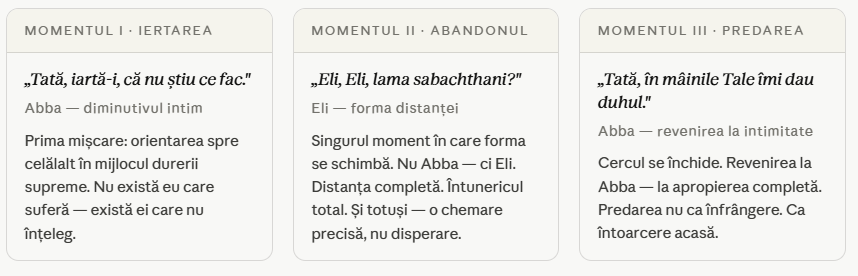
The seven words spoken from the Cross are not seven separate statements. They are a single arc of consciousness—three moments that together compose the most complete description of voluntary symbolic death known to human traditions.
There is a mystery in Aramaic—the language in which Jesus actually spoke—that translations invariably gloss over. Abba is not “Father” in the formal, solemn sense of the word. It is the intimate diminutive—the word of a little child calling out to his father. The equivalent of Daddy.
No religious figure in the Jewish tradition had dared to use Abba in addressing God. It was considered too intimate. Almost irreverent. And it is he who opens and closes the arc of the seven words—with Abba at the first word and Father at the last.
The only moment the form changes is in the middle— Eli, Eli. Maximum distance. Complete abandonment. And it is precisely this temporary distance that makes the return to Abba more profound than if it had never existed.
Psalm 22 —from which comes the cry Eli, Eli —is not a psalm of despair. He who knows it knows that it ends with recognition and triumph. The cry from the Cross is not of the lost—it is of the one who consciously crosses through complete darkness, knowing that on the other side there is the light that the darkness itself makes possible.
And then, the real mystery of the seven words is not theological. It is experiential. The same arc—forgiveness, abandonment, surrender—occurs in the consciousness of any human being who goes through an authentic symbolic death. Not as an imitation. As a recognition of the same universal pattern inscribed in the structure of transformation.
When the mind truly illuminates and the veil falls for a moment—the only language available is not description. It's not analysis. It's not understanding. It's direct addressing: "I surrender myself to You, Father." Not a formula. The recognition that there is no longer any distance between the one who speaks and the One to whom he speaks.
This is the mystery of Good Friday that the ritual protects and that the liturgy, in its silence today, allows to exist uncovered. There is no service that describes it better than the void that its absence leaves. Good Friday is silent precisely because what happened surpasses any form of liturgical expression. And in that silence — for those who are present — the mystery speaks for itself.