

Anchor from Heaven | Essence of Momentum #19
I've been sitting these days in a silence that I didn't ask for.
It's not the rest you seek after you're tired. It's not the break you take so you can work again. It's something else — a release that came from within, as if a string held taut for years was let go. Not because it gave up on sound. But because it was discovered that tension was no longer necessary for music to exist.
I called it, at first, a vacation. But it's not the vacation that a tired man runs away to the sea for. It's a vacation that the Self imposed on man. And it took me a while to understand why.
Because the world around us is not on vacation at all. The world is spinning faster than ever. The collective mind is boiling, fragmenting, arguing with itself in a thousand voices that are all right and none of them are listening. And right in the middle of this whirlwind, something in being has settled down and fallen silent.
For a long time I would have thought it was a contradiction. How can you calm down when everything is burning? Isn't this a form of escape, of indifference, of turning your back on the suffering world?
Now I know it's exactly the opposite.
There is a place from which chaos no longer looks like chaos.
Not because you denied the disorder. Not because you covered your eyes. But because you climbed high enough to see that what from below seems like a disintegration, from above seems like a settlement. The elements that, at street level, collide with each other like shards, seen from above move according to a pattern that the eye below cannot comprehend.
perspective
This is not cheap consolation. I am not saying that all is well and that suffering does not hurt. I am saying that perspective changes the nature of what you see. The storm, from the level of the wave, is the end of the world. From the altitude at which the bird flies, it is just a breath of the sea that will calm down. Both are true. But only one of them allows you to remain whole while you go through it.
This article is an invitation to altitude. Not to escape — to altitude. The difference between the two is everything.
The one who escapes takes his eyes off the world. The one who climbs to altitude sees the world more fully than he saw it from below. The first flees from pain. The second merely ceases to let himself be carried along by every wave, so that he can finally be of use to the whole ocean.
As I sat in this silence and let it speak to me, two texts came to me. They come from worlds that have never met—one from China thousands of years ago, the other from the heart of early Christianity. And yet they say, each in its own language, exactly the same thing.
Lao Tzu talks about water that fights nothing and that's why it conquers everything. About the wise man who acts without forcing — wu wei, the action that doesn't drag the world. Not inaction, let's understand.
But action that no longer opposes the flow, that no longer adds struggle to the struggle. Lao Tzu says somewhere that turmoil clears if you leave it alone. Muddy water doesn't clear if you stir it harder. It clears if you stop stirring it. It sits, and the mud sinks by itself, and above it remains the clarity that was there all along, just hidden by your own restlessness.
How much of the chaos of our world is water that we don't let clear. How much turmoil we keep alive precisely because we can't bear to leave it alone.
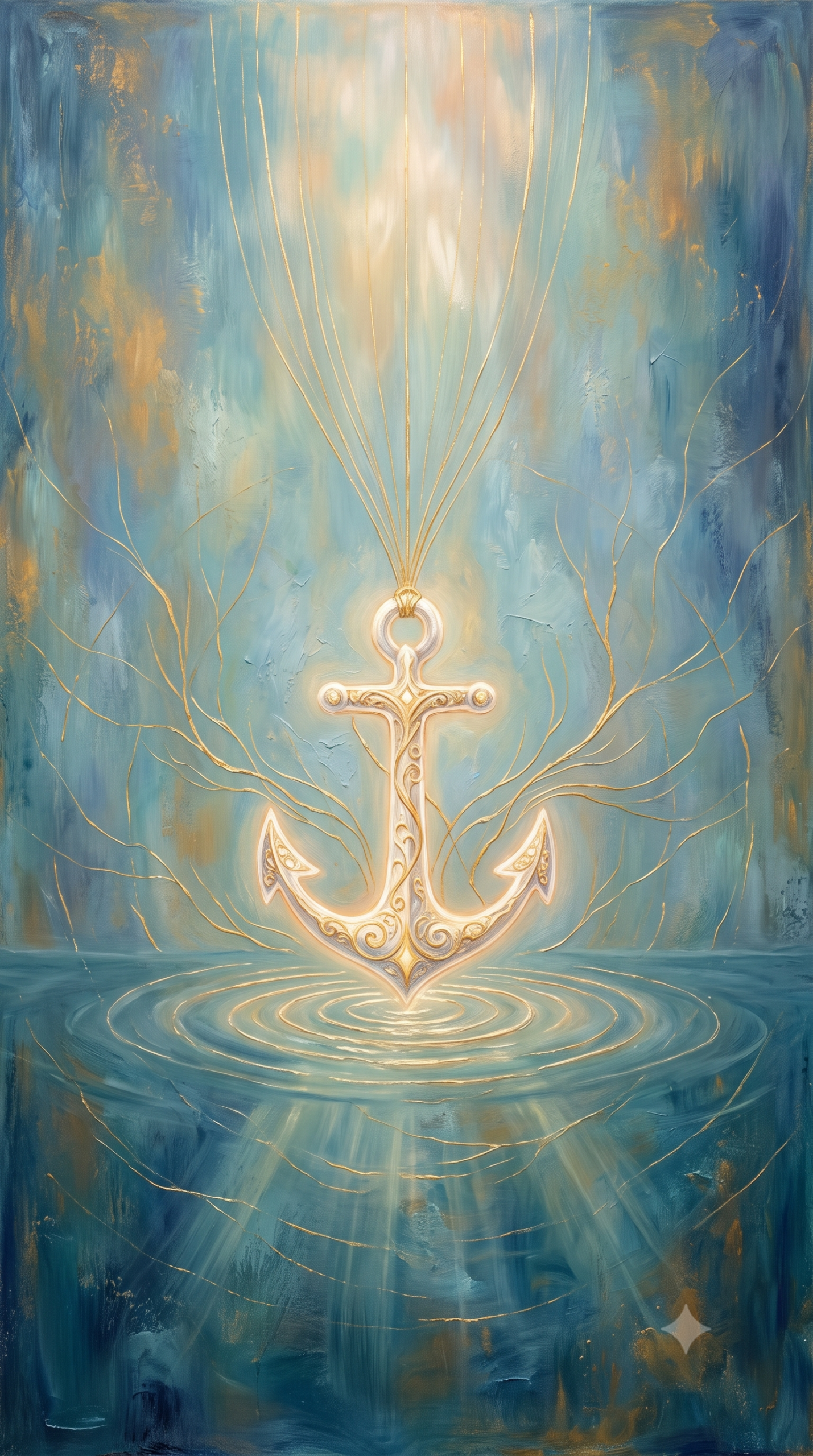
And then, from the other side of the world, the Epistle to the Hebrews. There they talk about hope as an anchor of the soul—sure and steadfast. But it's a strange anchor. It doesn't sink deep, into the bottom of the sea, into the deep. It sinks upward. The text says that it enters beyond the veil, into the innermost sanctuary, where the storm no longer reaches. This anchor doesn't hold you to the ground. It holds you to the sky.
And here the two voices meet. Lao Tzu says: stop stirring the water, and the clarity descends of itself. The Epistle says: let yourself be anchored from above, and no storm from below can shake you. Both ask for the same renunciation — the renunciation of pulling the thread. And both promise the same gift: a peace that comes not from your control, but from the cessation of your control.
The safe and the service of the heart
I've been thinking a lot about this image of the anchor, because at first glance it seems to say the exact opposite of what I feel.
The anchor, in our minds, is weight. It's what holds you in place, what fixes you, what doesn't let you go. We associate it with the heavy, with the bottom of the sea, with the dense matter that resists the wave. And yet the anchor of the soul, the text tells us, is caught high. Its arms don't go down. It goes up.
Then I understood what I really felt in this silence. The peace that descended into me did not ascend from me to heaven as an achievement of mine. I did not conquer it. I did not meditate enough, I did not work spiritually enough to deserve it. It descended. It came from above, as an emanation of a more subtle world, and settled in the being that, for a moment, stopped pulling its own thread.
That changes everything. Because if peace were mine, it would be fragile—I could lose it, I would have to defend it, I would always be afraid that it would end. But if peace descends, if I am just the place through which it enters the world, then I have nothing to defend. I am not holding the thread. The thread holds me. And precisely because I am held from above, I can no longer be shaken by anything from below.
The release of tension from the beginning, I understand it now. It wasn't the rope that broke. I stopped pulling on it. And as I stopped pulling, the sky was able to come down.
Mental fracture
This is why inner work is not a luxury for those who have time. It is, in this century, the condition of civilized survival. The world built with the tip of the pencil has reached its limit. Not because the pencil is bad — but because it alone cannot do it. It needs the gaze.
I am not asking the reader, through this article, to do anything. Not because there is nothing to do, but because what can be done cannot be asked in the form of an instruction. That would be another pencil on top of an already tired pencil.
I'm just going to make the observation that maybe that feeling that nothing works anymore, that everything creaks, that public speaking exhausts you, that daily decisions drain you, is not the symptom of a failed life. It's the sound of a contraction that can no longer be sustained.
And beneath this contraction, intact, untouched, unexhausted, forgotten in any real sense, is the same gaze that saw the labyrinth in a single glance. It doesn't demand it. It doesn't teach it. It just reminds you, when everything gets too sharp, that you once saw without limits.
That light that lasted a whole day didn't go out. It was just covered with days.
And the fracture of the mentality of this moment — both collective and personal — is not the bad news. It is the noise of layers that can no longer support themselves. Beneath, the child waits. Not to be healed. To be recognized.
And here I come to the thing I want to say most.
We each have a mind that is constantly interpreting. A fine mechanism, full of springs, that catches everything and judges it, weighs it, places it in one camp or another. It is a gift, this mind. But in these times, it has been captured. Every spring of it has been recruited into the service of an egregor — of a great collective fragmentation that feeds on our indignation, our certainty, our need to be right against someone.
This egregor doesn't ask much of us. It just asks that we participate. Let us add a voice to the din. Let us take a stand, let us get fired up, let us deposit the energy of our minds into the great account of division. And in return, it gives us the drunken feeling that we are on the side of good. That silence would be complicity. That if we don't shout too, we are betraying.
But I believe there is another place where we can store our mind's arcs. Not in the vault of the egregor. In the vault and in the service of the heart of the Whole.
That doesn't mean you don't care. It means you care so much that you refuse to add struggle to struggle. It means withdrawing the energy of your mind from the vortex that demands it and putting it into the service of something that never fragments—the heart that embraces all sides without being of any. It's a silent, inner shift that no one sees. It's not posted. It's not announced. But it changes the density of the world.
Because the world doesn't need another voice in the noise. It needs someone who has sat down.
The point around which the dance revolves
There is a saying by a poet about the still point in the middle of the spinning world. He says that without that still point, there is no dance. All movement, all life, all the dance of the world needs a center that does not move, around which it can unfold without falling apart.
This is the function I feel called to now. Not from me specifically—from anyone who can receive it. The settling of your being is not for you. It is for the axis. In the midst of the collective mind that spins faster and faster, someone must sit so that the world does not lose its center of gravity altogether. Not by commanding the world. Not by straightening it out. Just by being a point through which the stillness from above touches the earth.
Think of a gyroscope. A gyroscope does not oppose the movement around it. It rotates deep within its own center, and that is why it stabilizes everything that contains it. The ship rocks, the sea churns, but the gyroscope holds its axis—not because it struggles, but because it has settled so deeply into its own stillness that it has become the reference for everything else.
And the master, I understand now, is not the one who retreats to the mountain, far from people. The master is the one who sits in the middle of the square, in the heart of civilization, unwavering. He has not fled from chaos. He has only ceased to be part of it. He stands in the center, anchored from above, and by his simple placement he holds an open place through which the subtle world descends into the dense one.
So this is the paradox I leave you with, in this July filled with light so heavy that it has stopped growing.
He who surrenders to heaven becomes the anchor of the earth.
It's not running away. It's the highest form of responsibility. Because in a time when everyone believes that good is done by shouting louder, the true service to the Whole may be precisely that of being deeply silent, of letting yourself be anchored from above and of becoming, with your own settled being, the point of peace that the spinning world needs so that it doesn't fall apart.
Let the water clear. You won't clean it by shaking it.
Let the anchor hold you from above. You won't be able to resist sinking deeper into the bottom weight.
And deposit every arch of your mind, which wants so much to judge and take a stand, not in the noisy vault of fragmentation, but in the silent service of the all-encompassing heart.
This is the vacation that the Self imposes on man. Not an escape from the world.
A resettlement of man at its center.
essence momentum #19
He who surrenders to heaven becomes the anchor of the earth.
mell
ARTICLE AUTHOR
MELL
Mell is the founder of the magazine TotUna – Essentia Momentum, an editorial space dedicated to the maturation of consciousness through direct experience and integrative reflection. Her writings do not start from theory, but from real journeys — from encountering life in its most fragile and revealing forms.
His interest in traditions such as Advaita Vedanta, Gnosticism, Kabbalah, and anthroposophy is not a comparative one, but an attempt to recognize the same divine thread that runs through different languages. For Mell, creative consciousness is not a concept—it is a living reality, present in all forms of existence, which he explores, writes about, and experiences. He does not direct; he recognizes. And by recognizing, he holds open the door that each reader must pass through for themselves.
CO-FOUNDER OF THEMEDITATION.ACADEMY


TotUna is not just a magazine. It is a co-creation space.
Submit your article!
If you feel the call to write, share, or contribute your voice, we are here.




