

Water | Conscious Food #19
This month's food is not eaten. It is not cooked, it is not chewed, it has no taste that you can name, and that is precisely why we forget it — because it is always there. It is the simplest thing on our table and the most overlooked. Water.
I chose it for this edition because water is the food of teaching. You don't ask from it, you receive it. You don't conquer it, you let yourself be nourished by it. In a month in which we talk about the vacation that the Self imposes on man, about the peace that descends instead of being conquered, water is the perfect teacher. It doesn't fight with anything. It takes the shape of any vessel. It clears when you leave it alone. And it becomes a mirror of the sky at the exact moment it stops struggling.
It is, if we look closely, always present, so close that we no longer notice it, truly felt only when we stop.
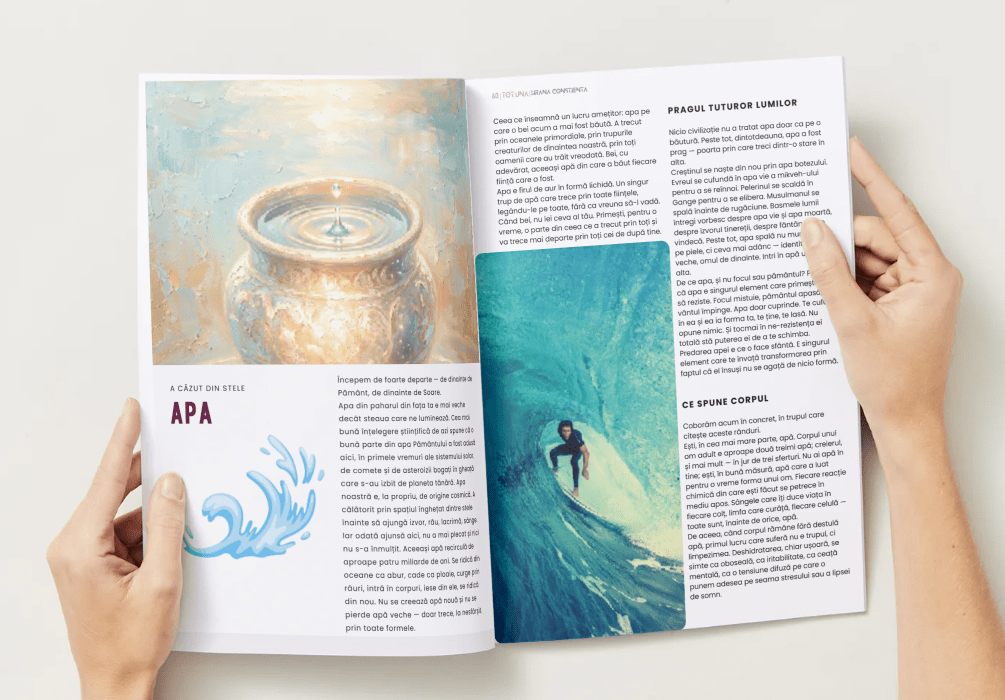
WATER
We start very far away—before the Earth, before the Sun.
The water in your glass is older than the star that shines on us. The best scientific understanding today says that much of Earth's water was brought here in the early days of the solar system by comets and ice-rich asteroids that crashed into the young planet. Our water is, quite literally, of cosmic origin. It traveled through the frozen space between the stars before becoming a spring, a river, a tear, blood.
And once it got here, it never left, nor did it multiply. The same water has been recirculating for nearly four billion years. It rises from the oceans as steam, falls as rain, flows through rivers, enters bodies, exits them, rises again. No new water is created and no old water is lost—it just passes, endlessly, through all forms.
Which means something mind-boggling: the water you're drinking now has been drunk before. It's passed through the primordial oceans, through the bodies of creatures before us, through every human who has ever lived. You're truly drinking the same water that every living being that has ever lived has drunk from.
Water is the golden thread in liquid form. A single body of water that runs through all beings, connecting them all, without any of them seeing it. When you drink, you don't take something of your own. You receive, for a while, a part of what has passed through all and will continue to pass through all those after you.
The threshold of all worlds
No civilization has ever treated water as just a drink. Everywhere, from time immemorial, water has been a threshold—the gateway through which you pass from one state to another.
The Christian is born again through the water of baptism. The Jew immerses himself in the living water of the mikveh to renew himself. The pilgrim bathes in the Ganges to free himself. The Muslim washes himself before prayer. Fairy tales from all over the world speak of living water and dead water, of the fountain of youth, of the healing fountain. Everywhere, water washes away not the dirt on the skin, but something deeper—the old identity, the old man. You enter the water one thing and come out another.
Why water, and not fire or earth? Because water is the only element that receives without resisting. Fire consumes, earth presses, wind pushes. Water simply encompasses. You immerse yourself in it and it takes your form, holds you, lets you go. It opposes nothing. And precisely in its total non-resistance lies its power to change you. Surrendering to water is what makes it holy. It is the only element that teaches you transformation by the fact that it itself does not cling to any form.
WHAT THE BODY SAYS
We now descend into the concrete, into the body that reads these lines.
You are, for the most part, water. The body of an adult human is about two-thirds water; the brain, even more so—about three-quarters. You have no water in you; you are, to a large extent, water that has taken on the form of a human for a time. Every chemical reaction of which you are made takes place in a watery environment. The blood that carries your life to every corner, the lymph that cleanses, every cell—all are, first and foremost, water.
That's why when the body is deprived of enough water, the first thing that suffers is not the body, but the clarity. Dehydration, even mild, feels like fatigue, irritability, mental fog, a diffuse tension that we often attribute to stress or lack of sleep.
Often, the muddy water of our minds is, quite literally, a mind in need of clear water. A glass of water drunk slowly, at the right time, can do more for your clarity than another hour of effort.
And the simple act of drinking water, done with presence, also has an effect on the nervous system. Pausing, bringing the glass to your lips, swallowing slowly, feeling the coolness sinking down—all of these bring attention to the body, to the present, and take the mind out of its whirlwind. A glass of water drunk consciously is a small anchor thrown into the middle of a hectic day.
TEACHER LINDA
And we come to what water has to say about the very heart of this edition.
Lao Tzu, whom we have already met in these pages, loved his water more than any other image. He said that nothing in the world is softer and more permissive than water—and yet nothing surpasses it in overcoming what is hard and strong. Water does not fight with stone. It flows over it, past it, around it—and in a thousand years it carves out the canyon. Not by force. By the gentle perseverance of one who does not resist, but does not give up either.
This is the teaching of water for the vacation of the Self. It does not ask you to become stronger to face the world. It shows you the opposite way—to be so permissive, so settled, so without resistance, that nothing can break you, because you no longer oppose anything that would break you. Water cannot be struck. The fist enters it and it closes back, undisturbed, whole.
And there is her last teaching, the quietest. Water becomes a mirror of the sky only when it calms down. As long as it struggles, it reflects shards of light, fragments, chaos.
When it settles, the whole sky descends into it, and you can no longer tell where the water ends and the sky begins. This is the anchor in the sky, contained in a simple vessel of water left alone: be still, and the sky will descend into you so completely that you will no longer know where you end and it begins.
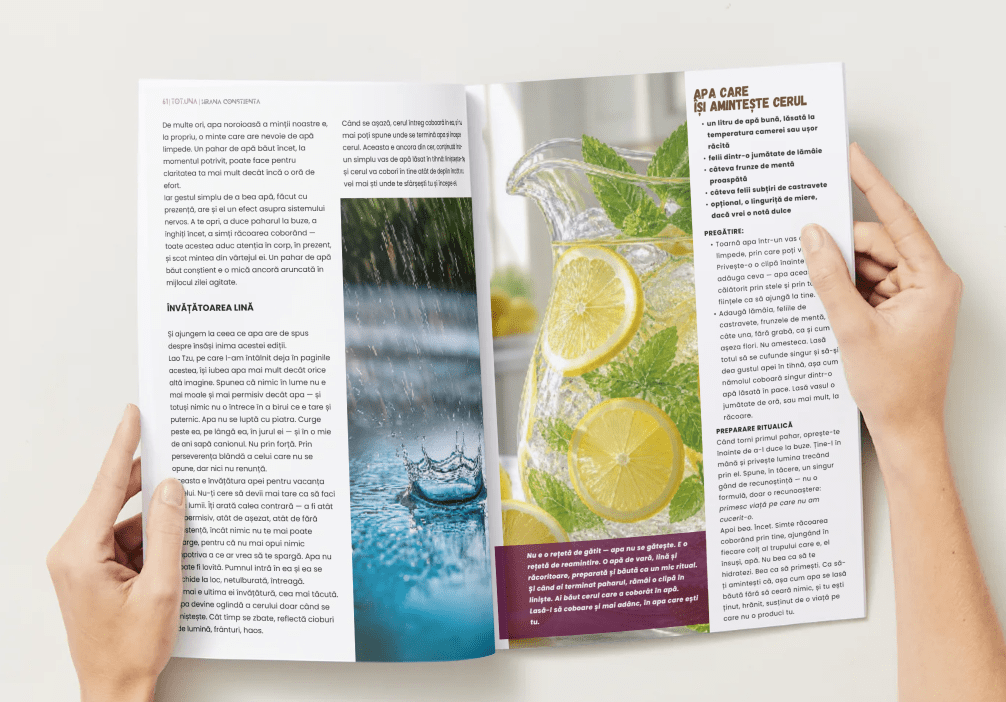
The water that remembers the sky
- one liter of good water, left at room temperature or slightly cooled
- slices of half a lemon
- a few fresh mint leaves
- a few thin slices of cucumber
- optional, a teaspoon of honey, if you want a sweet note
Training:
Pour the water into a clear glass vessel that you can see through. Look at it for a moment before adding anything—this water has traveled through the stars and all beings to reach you.
Add the lemon, the cucumber slices, the mint leaves, one by one, slowly, as if you were arranging flowers. Do not stir. Let everything sink on its own and give its taste to the water in peace, just as the mud descends on its own from a water left alone. Leave the bowl for half an hour, or more, in the cool.
Ritual preparation
When you pour the first glass, stop before you lift it to your lips. Hold it in your hand and watch the light pass through it. Say, silently, a single thought of gratitude—not a formula, just an acknowledgment: I receive life that I have not conquered.
Then drink. Slowly. Feel the coolness descending through you, reaching every corner of your body that is, itself, water. Don't drink to hydrate yourself. Drink to receive. To remember that, just as water lets itself be drunk without asking for anything, you too are held, nourished, sustained by a life that you do not produce.
It's not a cooking recipe — the water doesn't boil. It's a reminder recipe. A summer water, smooth and refreshing, prepared and drunk as a little ritual.
And when you have finished your glass, remain silent for a moment. You have drunk the sky that has descended into the water. Let it descend even deeper, into the water that is you.
conscious food – living life #19
Water is the golden thread in liquid form.
mell
ARTICLE AUTHOR
MELL
Mell is the founder of the magazine TotUna – Essentia Momentum, an editorial space dedicated to the maturation of consciousness through direct experience and integrative reflection. Her writings do not start from theory, but from real journeys — from encountering life in its most fragile and revealing forms.
His interest in traditions such as Advaita Vedanta, Gnosticism, Kabbalah, and anthroposophy is not a comparative one, but an attempt to recognize the same divine thread that runs through different languages. For Mell, creative consciousness is not a concept—it is a living reality, present in all forms of existence, which he explores, writes about, and experiences.
CO-FOUNDER OF THEMEDITATION.ACADEMY


TotUna is not just a magazine. It is a co-creation space.
Submit your article!
If you feel the call to write, share, or contribute your voice, we are here.




