

Architecture of the Soul – SOFIA, Wisdom of the Soul
There are moments in life when we feel that everything we experience has a shape, an inner geometry, a kind of invisible architecture that explains why we return to the same rooms of our own existence... and why some doors never seem to open.
This feeling usually arises in liminal moments: at the passing of years, at the end of a stage, after a loss, or after a revelation. Then we perceive for the first time that we are not only the inhabitants of our own lives, but also their builders. We realize that the soul has a "plan" - not a fixed destiny, but a living architecture, which changes and rebuilds itself with each conscious choice. And the recognition of this plan ... changes everything. This is the space we now enter: between the divine intelligence that gave us shape and the human freedom to reshape it.
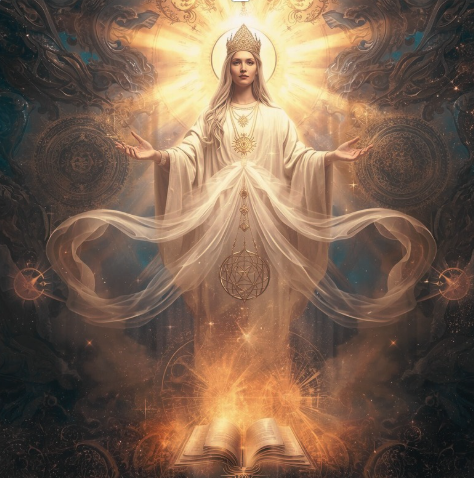
The Architecture of the Soul and the Awakening of the Inner Architect
Inside every person lives a forgotten architect. Not one who builds with brick and concrete, but one who works with invisible material: intention, memory, possibility. This architect knows the original plan of your inner house – but for so many years you have been building according to other people's plans that you have forgotten that it exists.
The soul is not the abstract we invoke in poetry or leave to theologians to define. The soul is a living structure – an architecture of overlapping levels, each with its function, each in relation to the others:
- Level 1: The energetic foundation The physical body and the energetic body (chakras, meridians, aura). This is where everything is anchored. A weak foundation = an unstable temple. Early traumas, lack of security, neglect of the body – all create cracks in the foundation.
- Level 2: Emotional walls Emotions are the material from which we build our inner walls. Some walls protect (healthy boundaries), others enclose (walls of fear). Some are transparent (vulnerability), others opaque (dissociation). Emotional architecture determines how “livable” the soul’s house is.
- Level 3: Mental chambers Beliefs, repetitive thoughts, self-narratives. Each belief is a room you live in: “The Undeserved Room,” “The Guilt Room,” “The Can’t Room.” Some rooms have wide windows (open thinking), others are cells (mental rigidity).
- Level 4: The existential roof The meaning, the purpose, the connection to something larger. The roof protects you from the "existential rain" - emptiness, absurdity, despair. Without a roof, the soul gets damp, rots, becomes uninhabitable.
- Level 5: The Central Light In the middle of the temple, in the deepest chamber, burns a flame – your unconditioned essence. It is not constructed. It is given. It is what you were before any conditioning, what you will be after any transformation. It is architect itself – the pure consciousness that observes the entire construction.
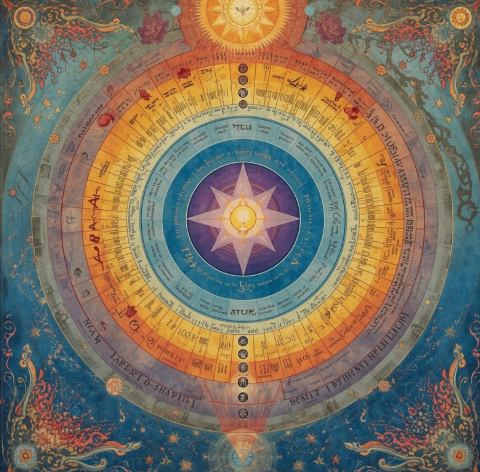
The original plan –
Map, not destination
Every human being is born with what spiritual traditions call differently:
- Hinduism: Dharma (the specific path of the soul)
- Kabbalah: Tikkun (the lesson/reparation you came to make)
- Jungian Psychology: The Process of Individuation (Becoming Your Own Self)
- Biology: Epigenetic gene expression (potential that is activated by the environment)
Let's be clear: It's not rigid predestination. You're not programmed like a robot. The original plan is more like a topographical map—it shows you the possible mountains, valleys, rivers. But you decide the path you take, the speed, who you go with, where you stop.
What does the plan contain?
- Potentialities (what you could become if…)
- Major lessons (what you came to learn in this life)
- Vulnerabilities (where you are prone to getting hurt – because that is where the lesson lies)
- Gifts (what you came to offer the world)
The problem: Most people never see the blueprint. They live their entire lives building according to other people's plans - their parents', their society's, their culture's, their collective fear. And so, at 40 or 50, they sit in a house they don't like, they don't recognize, and they ask themselves, "How did I get here?" Answer: You built without consulting the original plan.
There comes a moment in every person's life – for some it comes at 25, for others at 60, for some never – when they understand, even for a fleeting moment: "I am not a victim of my own existence. I am its architect."
This is the moment of inflection – subtle but irreversible. It’s not dramatic. It doesn’t come with trumpets. It comes as a gentle awakening: “Ah. I can choose. I always could. I just forgot.”
What is happening right now:
- 1. Recognition of creative responsibility Not in the sense of guilt ("I created all my problems"). But in the sense of power ("If I have created unconsciously until now, I can create consciously from now on"). The interior architect does not say: "It's your fault you built it poorly." The interior architect says:"You built from the plans you had available then. Now you have the original plan. Let's rebuild."
- 2. The distinction between inherited and authentic – For the first time you see clearly what belongs to the family line (Guilt room inherited from mother, who inherited it from grandmother). See what belongs to culture/society (the wall "You have to be productive" built by capitalism) and what belongs to you, to your soul (the window to art that you covered because "it's not serious").And you realize that you can preserve what nourishes, you can demolish what suffocates.
3. Permission to rebuild
The most profound change: you give yourself permission.
Before: "I have to accept the way the house is. This is how it was built." After awakening: "I can change. I can renovate. I can even demolish and build from scratch if necessary." And no , it's not destruction. It's conscious reconstruction.

the language through which divine intelligence speaks to us
The architecture of a single soul can change the architecture of an entire genealogy. And a changed genealogy contributes to a cleaner, more coherent, brighter collective field.
In this sense, every internal reconstruction is an act of universal good.
Why is it important to know the architecture of the soul? Because without it, we live like tenants in a house built by others. With it, we become the creators of our own existence. When we recognize the original plan, we begin to see clearly what is ours and what is received, what must be kept and what must be released, and what walls close us in and what windows call out to us.
The architecture of the soul is the language through which divine intelligence speaks to us. And the awakening of the Architect within is the moment when, for the first time, we understand what it is telling us.
Sophia, the wisdom of the soul #12
Dad, you know what? When I hug, my heart makes more room inside.
elian lg
ARTICLE AUTHOR
MELL
Mell is the founder and visionary behind the project The Meditation Academy and of the magazine TotUna – Momentum Essence. Mell discovered the brush at the same moment he lost his certainties. Or rather – at the moment when the certainties dissolved and all that was left was a hand that wanted to move color on the canvas, without knowing why, without asking if “it’s okay”, without waiting for permission. Years of branding, marketing, building identities for others – and then, silence. Emptiness. And in that emptiness, something began to paint. Not Mell the person. Something through Mell.
Now, The Meditation Academy and the magazine All.One they are extensions of the same creative gesture: creating spaces where people can remember that they don't have to become artists, healers, spiritual seekers – they just have to stop pretending they aren't already.
"I am not here to offer you finite truths, but to remind you that each of you carries within you the entire library of cosmic wisdom. I am merely a companion on the journey of remembering what you have always known deep within your being."
CO-FOUNDER OF THEMEDITATION.ACADEMY


TotUna is not just a magazine. It is a co-creation space.
Submit your article!
If you feel the call to write, share, or contribute your voice, we are here.




