

Constantin Brâncuși — The Sculptor Who Saw the Whole | Intuitive Art TotUna 17
Sometimes art doesn't illustrate a truth — it contains it. It doesn't explain it — it transmits it directly, beyond words, beyond concepts, directly to the place in the body where understanding needs no translation.
In this edition dedicated to the inner androgynous — the reunification of masculine and feminine polarities in one breath — we looked for an artist who would not talk about unity, but would be it in every one of his works.
I found him at home.
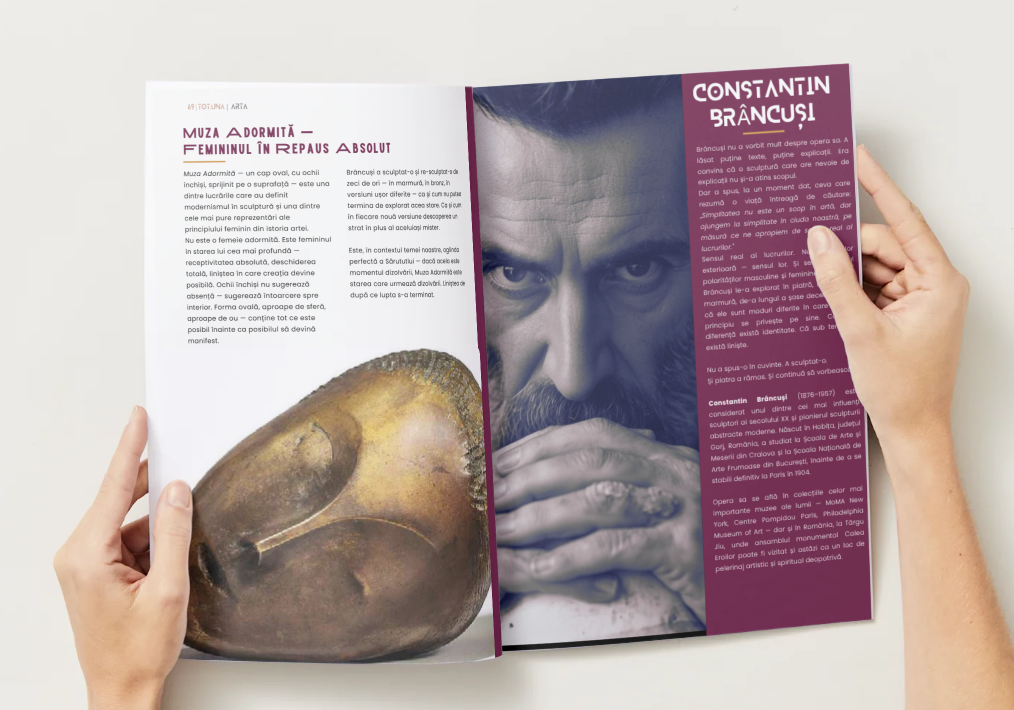
brancusi, home
Constantin Brâncuși was born in 1876 in Hobița, a village in Gorj, and died in 1957 in Paris — after a life spent searching for something that most sculptors did not dare to seek: not beautiful form, not faithful representation, not impressive monumentality, but the essence from which form is born.
He left home on foot — literally. At 18, he walked from Craiova to Bucharest, almost 200 kilometers, with a determination that says everything about a man's character. At 28, he was in Paris, in the studio of Rodin — the greatest sculptor of the era. Rodin invited him to stay as an assistant. Brâncuși refused.
He apparently said that nothing grows in the shade of the big trees.
The Sleeping Muse — The Feminine in Absolute Rest
The Sleeping Muse —an oval head, eyes closed, resting on a surface—is one of the works that defined modernism in sculpture and one of the purest representations of the feminine principle in the history of art. She is not a sleeping woman. She is the feminine in her deepest state—the absolute receptivity, the total openness, the stillness in which creation becomes possible. The closed eyes do not suggest absence—they suggest turning inward. The oval shape, almost spherical, almost egglike—contains all that is possible before the possible becomes manifest.
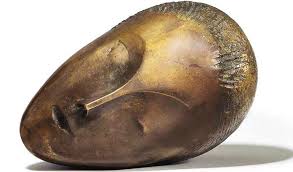
The feminine at rest
Brancusi sculpted and re-sculpted it dozens of times—in marble, in bronze, in slightly different versions—as if he could never finish exploring that state. As if in each new version he discovered an additional layer of the same mystery.
It is, in the context of our theme, the perfect mirror of The Kiss — if that is the moment of dissolution, the Sleeping Muse is the state that follows dissolution. The stillness after the fight is over.
Brancusi didn't talk much about his work. He left few texts, few explanations. He was convinced that a sculpture that needed explanations had not achieved its purpose. But he did say, at one point, something that summed up a lifetime of searching: "Simplicity is not a goal in art, but we reach simplicity in spite of ourselves as we approach the real meaning of things.” The real meaning of things. Not their outward form — their meaning. And the real meaning of the male and female polarities — which Brancusi explored in stone, in bronze, in marble, over six decades — is that they are different ways in which the same principle looks at itself. That beneath difference there is identity. That beneath tension there is stillness. He didn't say it in words. He sculpted it. And the stone remained. And it keeps talking.
Constantin Brâncusi (1876–1957) is considered one of the most influential sculptors of the 20th century and a pioneer of modern abstract sculpture. Born in Hobița, Gorj County, Romania, he studied at the School of Arts and Crafts in Craiova and the National School of Fine Arts in Bucharest, before settling permanently in Paris in 1904.
His work is in the collections of the world's most important museums — MoMA New York, Centre Pompidou Paris, Philadelphia Museum of Art — but also in Romania, in Târgu Jiu, where the monumental ensemble Calea Eroilor can still be visited today as a place of artistic and spiritual pilgrimage.
INTUITIVE ART #17
Simplicity is not a goal in art, but we reach simplicity in spite of ourselves as we approach the real meaning of things.
Constantin Brancusi
ARTICLE AUTHOR
MELL
Mell is the founder of the magazine TotUna – Essentia Momentum, an editorial space dedicated to the maturation of consciousness through direct experience and integrative reflection. Her writings do not start from theory, but from real journeys — from encountering life in its most fragile and revealing forms.
His interest in traditions such as Advaita Vedanta, Gnosticism, Kabbalah, and anthroposophy is not a comparative one, but an attempt to recognize the same divine thread that runs through different languages. For Mell, creative consciousness is not a concept—it is a living reality, present in all forms of existence, which he explores, writes about, and experiences.
CO-FOUNDER OF THEMEDITATION.ACADEMY


TotUna is not just a magazine. It is a co-creation space.
Submit your article!
If you feel the call to write, share, or contribute your voice, we are here.




