Japanese Art Ma | Hasegawa Tōhaku | Intuitive Art #22
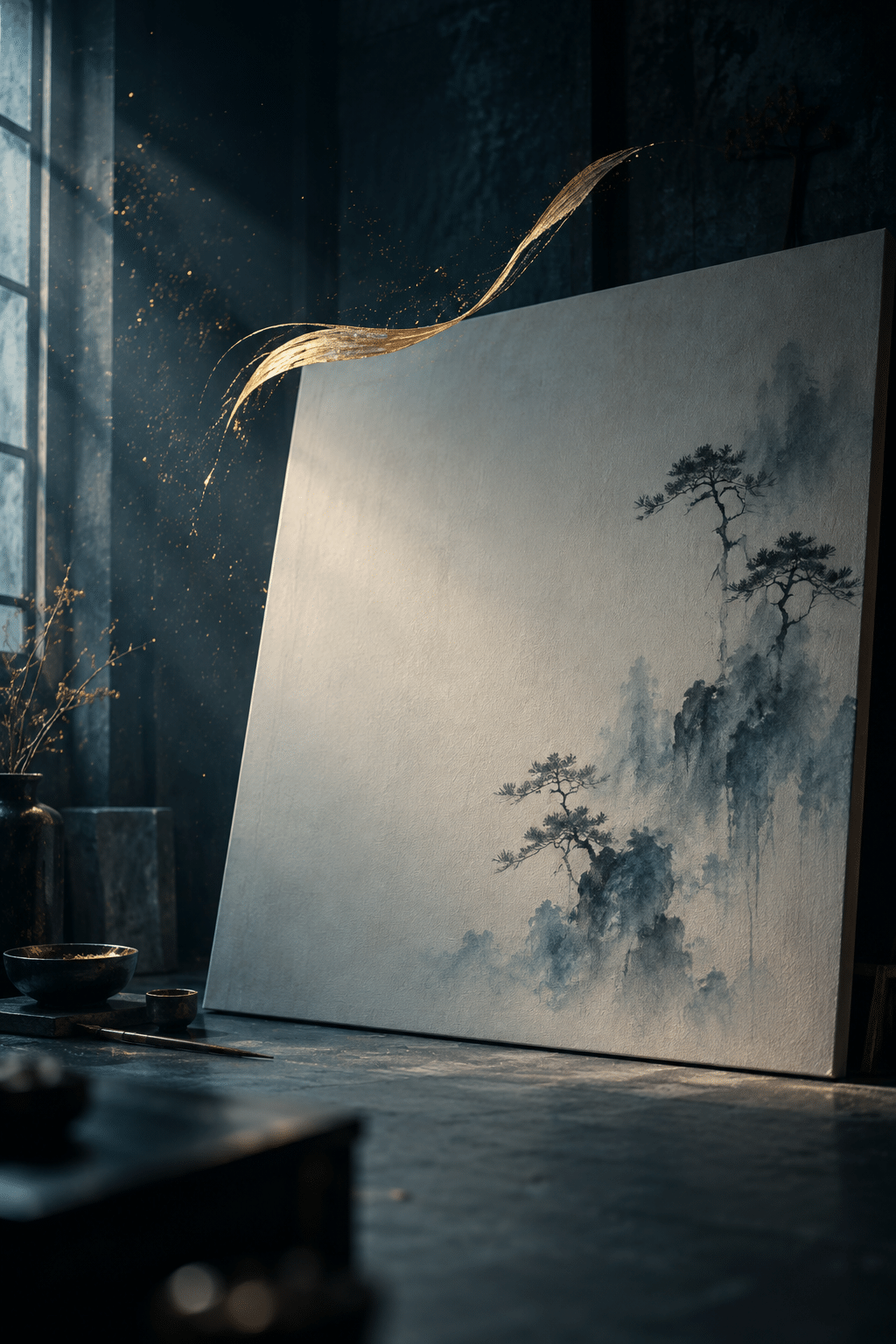
Look at the image of this edition for a few moments without trying to interpret it. Don't ask what it represents. First notice what isn't there.
And then ask yourself:
What might my life look like if I didn't immediately fill every empty space?
Japanese art "ma"
Sometimes, the first impulse in front of an empty surface is to fill it. With a shape. With a color. With a meaning. Maybe because emptiness unsettles us. It makes us feel like something is missing and that our purpose is to complete it. But there is another possibility. Let's look at the empty space not as something that hasn't been done yet, but as part of the work.
In this edition's image, the landscape occupies only a small part of the surface. A few dark shapes suggest trees, earth, distance. The rest remains almost untouched.
And yet, that very rest begins to work. It becomes fog. It becomes air. It becomes distance. It can become sky or water.
The gaze does not receive everything. It is left to continue on its own. And the work does not end where the artist stopped. That is where the viewer begins. When emptiness is no longer a lack.
In many Western artistic traditions, surface has long been a space to be organized, occupied, constructed. But in Chinese and Japanese painting, what remains unpainted can be as important as the painted form. Mountains emerge from the mist and disappear back into it. A branch can exist without the entire tree being shown. A few ink strokes can suggest a landscape that the mind continues far beyond the paper.
Hasegawa Tōhaku
Hasegawa Tōhaku lived in Japan in the 16th–17th centuries and became one of the leading figures in Momoyama period painting. He worked both in the broad decorative register of the period and in monochrome ink painting, where economy of gesture and unoccupied space acquire a special force. In his most austere works, it seems that the image does not try to fix the world, but to capture the moment in which it appears and disappears from perception.
A tree is not just a tree. It is also the fog that hides it. It is also the distance between it and the next one. It is also the space in which the viewer encounters it. Perhaps that is why such works remain alive after hundreds of years.
It doesn't give us everything.
INTUITIVE ART #22
I am the same breath of the eternal,
Mell
lived for a time in man.
ARTICLE AUTHOR
MELL
Mell is the founder of the magazine TotUna – Essentia Momentum, an editorial space dedicated to the maturation of consciousness through direct experience and integrative reflection. Her writings do not start from theory, but from real journeys — from encountering life in its most fragile and revealing forms.
His interest in traditions such as Advaita Vedanta, Gnosticism, Kabbalah, and anthroposophy is not a comparative one, but an attempt to recognize the same divine thread that runs through different languages. For Mell, creative consciousness is not a concept—it is a living reality, present in all forms of existence, which he explores, writes about, and experiences. He does not direct; he recognizes. And by recognizing, he holds open the door that each reader must pass through for themselves.
editor-in-chief totuna.live


TotUna is not just a magazine. It is a co-creation space.
Submit your article!
If you feel the call to write, share, or contribute your voice, we are here.