

The Egyptian Book of the Dead – Papyrus of Ani
My Dear Conscious Reader/Listener,
The Reading & Recommendation section in this edition is not an invitation to accumulation, but to crossing.
There are books that do not open as an object, but as a threshold. Texts that do not add information, but place us in front of our own inner weight. Readings that do not explain death, but strip it of fear. Which do not glorify life, but bring it into a simpler and truer light.
In an edition dedicated to the transhumance of the soul — from detachment to integration, from darkness to balance, from silence to joy — we choose to approach an archetypal text.
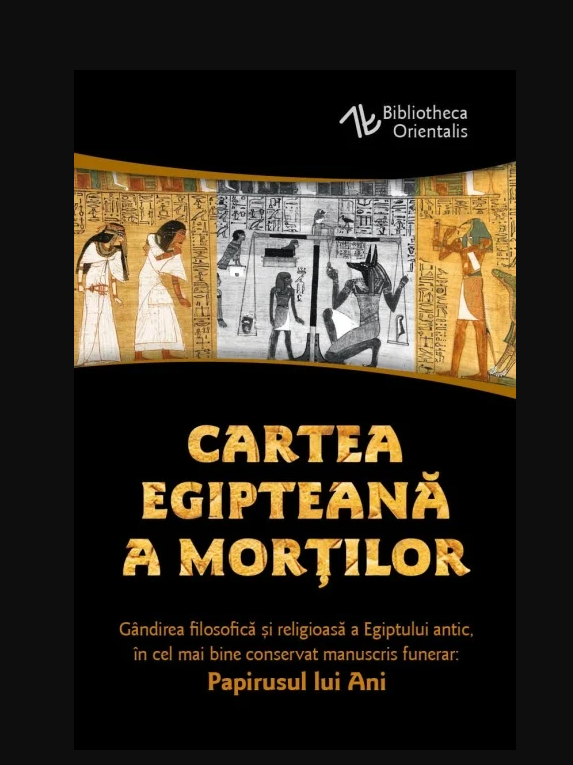
The Egyptian Book of the Dead – the Papyrus of Ani
There are texts that were not written to be read, but to be traversed.
The Egyptian Book of the Dead – known in Ancient Egypt as the “Book of Daybreak” – is one such text. It is not a manual on death, but a guide for consciousness in the process of leaving the body.
The Papyrus of Ani , written around 1250 BC, is one of the most complete and well-preserved versions of this corpus of funerary formulas. Ani , royal scribe in Thebes, commissioned this manuscript to accompany him on his post-mortem journey.
Some readings teach us to weigh our hearts
One of the most famous moments in the Papyrus of Ani is the scene of the weighing of the heart. The heart of the deceased is placed on one pan of the scales, and on the other is the feather of the goddess Ma'at - a symbol of truth and cosmic order. If the heart is heavier than the feather, the soul is devoured by Ammit. If it is balanced, the journey continues.
Beyond mythology, the message is clear: We are not judged for what we have accumulated, but for what we have become. The heart – the seat of consciousness in the Egyptian vision – must be light.
In this edition, where we talk about integration and liberation, the symbol is extraordinarily current: unprocessed bitterness makes things harder; transformation makes things easier.
Per Em Heru – Coming Out to the Light
The original title of the text – Per Em Heru – can be translated as “The Exit to the Light .” Death is not a descent into darkness, but a crossing into clarity.
Consciousness passes through different "gates," each representing a confrontation with aspects of the self. It is an initiation. Not very different, symbolically, from the psychological process through which we go through a major loss or transformation.
For the Egyptians, the soul was composed of several components:
– Ka (life force)
– Ba (mobile individuality)
– Akh (the transfigured spirit)
Death doesn't cancel them. It reorganizes them.
This view is surprisingly consistent with many non-dual traditions: consciousness is not the product of the body, but uses the body as a temporary vehicle.
Why should we read it?
Because the Papyrus of Ani is not about fear. It is about preparation. Not about the end. But about inner coherence. Not about punishment. But about balance. In an edition in which we discuss the transhumance of the soul, the equinox, the liver as an organ of transformation, and the joy that arises after adjustment, the Egyptian Book of the Dead becomes an archetypal mirror. Death is a threshold. But the threshold is not darkness. It is the verification of the weight of the heart.
Maybe we shouldn't read this book as a funeral text. Maybe we should read it as a daily exercise: How heavy is my heart today? What needs to be released to become light?
Death, in the Egyptian view, does not begin at the end of life. It begins every moment we choose to disidentify with what is no longer true.
Recommended editions
For those interested in an accessible and faithful reading:
- Translation by EA Wallis Budge – The Papyrus of Ani
- Modern translation and commentary by Raymond O. Faulkner
- Illustrated versions that preserve the original papyrus images
If there are books that have accompanied you in moments of transition, that have changed your perspective or brought you closer to an inner truth, we invite you to share them with us. Together, we can cultivate a reading space that nourishes not only the mind, but also the silence from which understanding is born.
Together, we can create a reading space that nourishes the mind and soul.
Reading & inspiration #15
"O my heart, which I received from my mother, O my heart from the various ages of my life, do not rise up against me as a witness, do not stand against me before the judges, do not show yourself against me in the presence of the Lord of Libra. You are my ka in my body, the creator who gave birth to my limbs. Be quiet, do not betray me."
Years
ARTICLE AUTHOR
MELL
Mell is the founder of the magazine TotUna – Essentia Momentum, an editorial space dedicated to the maturation of consciousness through direct experience and integrative reflection. Her writings do not start from theory, but from real journeys – from the encounter with life in its most fragile and revealing forms.
His interest in traditions such as Advaita Vedanta, anthroposophy, Kabbalah or Christian spirituality is not a comparative one, but an attempt to recognize the same thread of continuity that runs through different languages. For Mell, death, suffering and transformation are not abstract themes, but living processes of integration of consciousness into its own vastness.
Through the magazine TotUna and the spaces created around The Meditation Academy, she supports a lucid spirituality, devoid of drama and escapism, anchored in concrete life and open to its subtle dimension. Her approach does not seek followers, but inner maturity; it does not propose doctrines, but invites experience and assumption.
CO-FOUNDER OF THEMEDITATION.ACADEMY


TotUna is not just a magazine. It is a co-creation space.
Submit your article!
If you feel the call to write, share, or contribute your voice, we are here.




