

The Red Book – Carl Gustav Jung – Reading & Inspiration
My Dear Conscious Reader/Listener,
There are books that inform you, books that inspire you, and then there are books that fundamentally transform your perception of reality. Liber Novus – Carl Gustav Jung ’s Red Book – belongs to the latter category. It is not a book in the conventional sense, but a living psychic artifact, a portal to the invisible dimensions of human consciousness, a map of the territories that every spiritual seeker will traverse on their journey to individuation.
Between 1913 and 1930, Jung devoted his life to an unprecedented psychological experimentation. In a period of profound existential crisis, he chose to confront his own unconscious directly, to dialogue with the archetypal figures that revealed themselves to him in dreams and visions, to transcribe and illustrate this encounter with the hidden aspects of his own psyche.
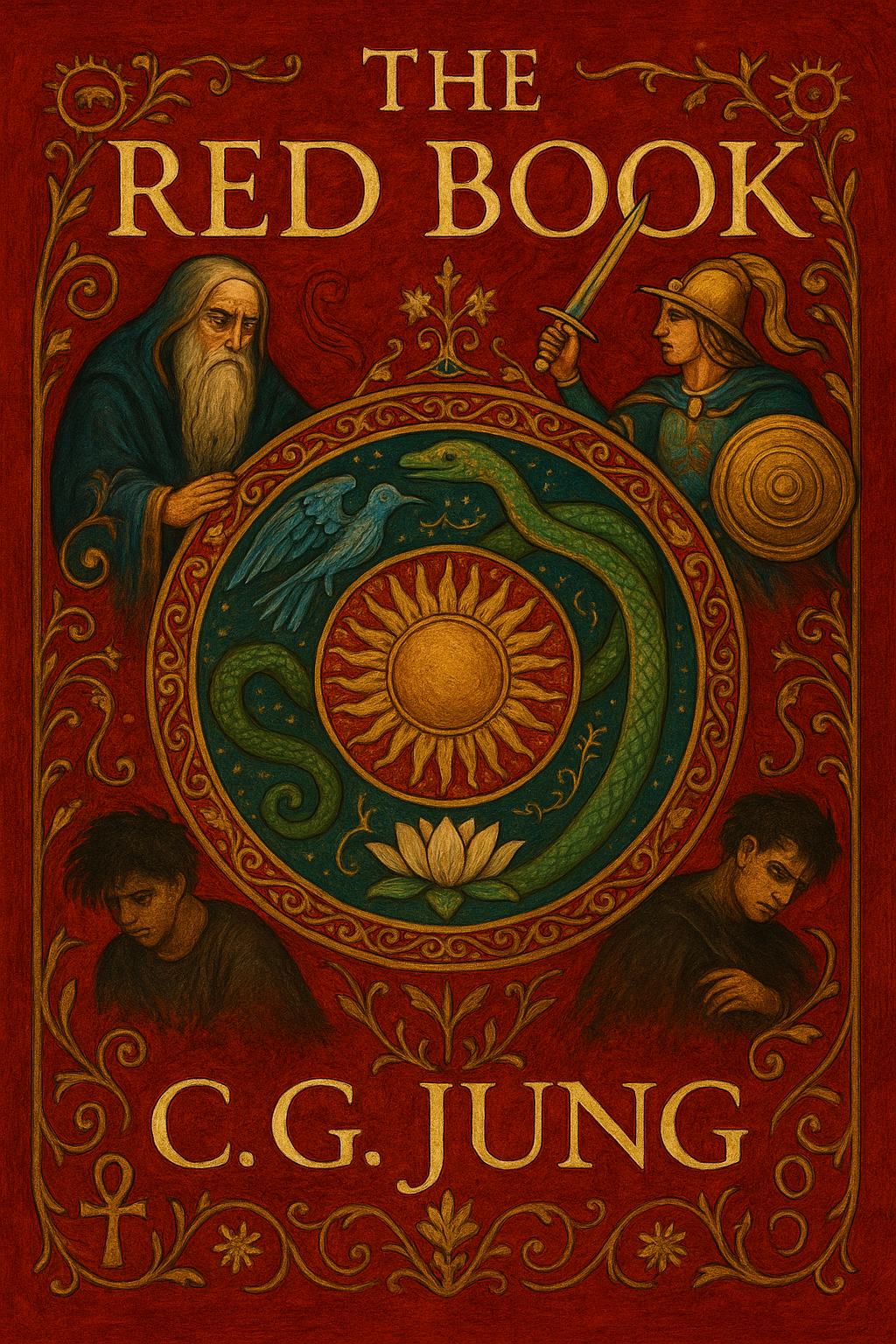
Jung's red book
The Red Book is not the result of academic research, but the document of a total immersion in what Jung would call the “collective unconscious .” It is the journal of an inner journey that lasted almost two decades, in which the greatest psychologist of modernity explored his own invisible matrix and discovered there the archetypes and symbols that govern the universal human experience.
The color red symbolizes in alchemy the final phase of the Great Work – the rubedo, the moment when the lead of undeveloped consciousness is definitively transformed into the gold of integrated wisdom. Jung chose this color to mark that his experience was not just exploration, but complete transformation.
What makes the Red Book truly extraordinary is that Jung does not describe the archetypes theoretically – he converses directly with them, allowing them to tell their story in their own words, to reveal their motivations and the wisdom they carry. Philemon , the wise old man with the wings of a seagull, becomes his inner spiritual guide – the senile aspect of the psyche that holds ancestral wisdom and answers his fundamental existential questions. Salome, the beautiful and blind woman represented in Jung’s visions, symbolizes the eros aspect of the psyche – the power of love that sees beyond appearances but which can be, paradoxically, “blind” to the consequences of its actions.

Spirit of the Depths versus The Spirit of This Time
The central conflict in The Red Book – reflects the eternal tension between the soul’s deep spiritual aspirations and the superficial pressures of modern civilization. Jung experiences this conflict not as a theory, but as a personal drama in which he must choose between social conformity and spiritual authenticity.
In addition to the visionary text, the Red Book contains dozens of illustrations created by Jung himself – mandalas, symbolic scenes, portraits of archetypal figures he encountered on his inner journey. These images are not mere decorations, but accurate representations of the visions he had, attempts to translate trans-dimensional experiences into the visual language accessible to ordinary consciousness.
Why read the Red Book now?
Because we live in a similar era to the one in which Jung wrote – a period of accelerated transition, of the breaking down of old certainties, of the search for new ways of understanding reality. Like Jung a century ago, we must confront the collapse of old paradigms and find spiritual coordinates in a world that seems to have lost its compass.
The Red Book It teaches us that this confrontation does not have to happen in isolation – that there are resources deep within the human psyche that can guide and support transformation. That what appears to be a crisis is actually an opportunity for reintegration into a higher level of consciousness.
In the context of this edition's theme – "Symbols and Archetypes – The Matrix of the Invisible" – the Red Book is the ultimate document, living proof that these concepts are not philosophical abstractions, but psychic realities that shape human experience in concrete and measurable ways.
reading & inspiration #10
"The path I follow is not anyone else's path. No one can follow my path for me."
carl gustav jung
I myself must go my own way.
ARTICLE AUTHOR
MELL
Mell is the founder and visionary behind The Meditation Academy project and the magazine TotUna – Essentia Momentum . In this edition dedicated to the matrix of the invisible, Mell reveals her unique ability to perceive and articulate the subtle connections between ancestral spiritual traditions and the needs of the modern seeker, offering not just knowledge, but an integrated experience of rediscovering one’s own cosmic nature. Her writings do not ask for blind adherence or idolatry, but the courage to look at life in all its dimensions – seen and unseen – and to embrace it as an infinite field of consciousness in continuous self-exploration. Through the magazine Tot.Una , Mell creates a meeting space for all those who recognize that the separation between the spiritual and the everyday is only a temporary illusion, and that the true quest lies in integrating the sacred into every moment of human existence
"I am not here to offer you finite truths, but to remind you that each of you carries within you the entire library of cosmic wisdom. I am merely a companion on the journey of remembering what you have always known deep within your being."
CO-FOUNDER OF THEMEDITATION.ACADEMY


TotUna is not just a magazine. It is a co-creation space.
Submit your article!
If you feel the call to write, share, or contribute your voice, we are here.




