

Who are you when you're not performing | The Voice of the Self #19 | Alexandra Șchianu
This entire edition speaks, in many languages, about a single settlement: the moment when man stops holding on to himself and discovers that he was held all along. Anniel calls it from the eternal. Sofia connects it to the thread that unites us all. And now Alexandra Șchianu brings it down exactly where we feel it most concretely — in the late evening when the house is sleeping, in the weekend morning without an agenda, in the silence when you are no longer anyone to anyone.

Because the holiday of the Self, which we're talking about this month, also has a side that scares us a little. When the noise stops and the audience disappears, we're left with a question that we rarely let ourselves hear: who am I, when I'm not performing for anyone? Alexandra raises it without haste and without forcing it, from her experience in the practice, with the gentleness of someone who has seen many times how the image of oneself trembles when the audience is taken away — and how that very trembling is the beginning of returning home.
The self beneath the roles that Alexandra writes about is the same spark under the armor — quieter, less articulate, that has stopped speaking out loud because it hasn't been listened to for too long. And summer, with its quiet, is precisely the season when it can be heard again.
Who are you when you're not performing for anyone?
There's a version of you that almost no one sees.
Not because you hide it on purpose, not because there's anything shameful about it, but because it only appears in moments when there's no one to impress, when you're not playing any role, when you're not a husband or wife, employee or employer, good friend, responsible child, a person who can handle it, when you're simply you, without an audience, without expectations, without a version to deliver to anyone.
Maybe you know it from late evenings when the house is quiet and everyone is asleep and you are there by yourself with nothing to do, without being useful to anyone, without a task to structure your presence. Or from weekend mornings when you have no agenda and for the first half hour you are still nobody in particular you are just a man who woke up and doesn't know exactly what's coming and doesn't need to know. Or from moments of illness when your body forces you to stop and suddenly you can no longer be productive or useful or present for others and you are left alone with yourself and you don't really know what to do with that, and the discomfort you feel is not because of the illness, but because of the peace it brings.
Who are you in those moments?
The question that very scary
Many people, if they sit still enough with this question, discover that they don't know the answer or that the answer is vaguer and more unclear than they would have imagined, that the self beneath all the roles is less articulated than the self in relationships, in work, in all the contexts in which there is someone to be something specific towards, someone whose expectations organize you, someone in relation to whom you know who you are.
And this discovery is frightening. Not dramatically, not like an obvious crisis with tears and revelations, but like a dull and persistent discomfort, like a slight lack of recognition, like the feeling that you've returned home and the furniture has been rearranged and you don't realize exactly what has changed but something is out of place, something from the image you had of yourself no longer fits perfectly with what you find in this silence.
The question of who I am when I'm not performing for anyone seems simple and is, in fact, one of the most difficult ones you can ask because all your life you've received feedback about who you are from the outside, from the looks and reactions and expectations of others, and you've built an image of yourself from all of this, solid and functional and recognizable to everyone, but built in relationship with someone else, not in your silence, not in the absence of the audience, not in moments when no one is watching and expecting anything.
And when the audience disappears, the image shakes a little. It doesn't collapse, it shakes. And it's that shaking that's important.

How do we end up not knowing each other anymore?
It doesn't happen suddenly and it's not a conscious decision, it's a slow and almost invisible process in which the roles you play start to take up more and more space within you, until there's not much room left for what exists beyond them, until the boundary between who you are and what you do becomes so thin that you no longer know exactly where one ends and the other begins.
It usually starts early. You learn what behaviors are well-received and you repeat them, you learn what parts of yourself are bothersome and you make them smaller or quieter, you learn to read the room and adapt, to be the version of yourself that works best in a given context, that produces the least friction, that is easiest to love by the people who matter to you. And that is not weakness, it is social intelligence, it is empathy, it is the ability to relate to others without overwhelming them with everything you are, without asking for more than they can give.
The problem arises when adaptation becomes the only way you know how to exist, when you can no longer tell the difference between what you really feel and what you feel you should feel, between what you want and what you want because others expect you to want, between who you are and who you have become in the eyes of others over time, version by version, adjustment by adjustment, giving up by giving up, each so small that it seemed reasonable at the moment and which together have built something that you no longer fully recognize as you.
And then the silence becomes uncomfortable. Not because you are a shallow person or because you have no inner life, but because your inner life has been organized around others so much and for so long that in their absence you don't know exactly where to look, you don't know what to listen to, you don't know how to be present with yourself in the same way that you know how to be present for others.
What are you doing instead of staying with yourself?
You fill it. The emptiness, the silence, the moment when you're nobody to anyone, you fill it with something, with anything, with enough so that you don't have to stay in it long enough for it to become really uncomfortable, for it to start telling you something.
With your phone, not because you have something specific to look for or read or solve, but because the screen occupies your attention and the occupied attention cannot turn inward, and that is, at that moment, enough for you not to feel like you are staying with yourself. With the work you do at home, with the to-do list that never ends and that gives you the feeling that you are productive and that this productivity justifies your presence in your own life. With worries about the future or regrets about the past that are also, in their own way, a form of not being present with yourself now, in this moment, in this silence.
With the noise, music, podcast, TV on in the background not because you're watching something, but because complete silence is too close to yourself and this closeness produces a slight anxiety that you can't name but that you feel as a constant urge to do something, to be busy, to move, to not stay with yourself longer than absolutely necessary.
With socialization, which is valuable and necessary and there's nothing wrong with it, but which sometimes also becomes a form of not being alone with yourself, of always being in conversation with someone, always in relationship, always defined by the presence of someone else, because in the presence of someone else you know who you are and what role you play and what is expected of you and that is, paradoxically, more restful than the complete freedom to be anything.
And there's nothing wrong with any of these things taken separately, the problem is when they all become such an effective and habitual avoidance system that you no longer know you're avoiding anything, you think you're simply a busy and connected person and present in your life, when in fact you're present in the lives of others and absent, subtly but constantly, in your own.
The Self Beneath the Roles: What It Looks Like and Why It's Worth Finding
That self is not dramatic and it is not mysterious and it is not intentionally hidden somewhere hard to reach, at the end of a long road of self-knowledge that you do not have time to travel. It is simply quieter than all your roles, less articulate, less sure of itself, less accustomed to taking up space and precisely because of that it is harder to hear in the constant noise of everyday life.
He is the one who knows, before any analysis and before any reason, whether a situation suits you or not, that feeling in your body that comes before you have the words for it, that slight contraction or opening you feel when something is in agreement or disagreement with who you really are. He is the one who feels fatigue before you consciously recognize it, who knows that you need rest or solitude or a change before your mind accepts that it is time to ask for them.
He is the one who has simple and clear preferences, a certain type of silence, a certain rhythm of the day, certain things that nourish him and others that empty him, certain conversations that leave him full and others that leave him empty without being able to explain why, preferences that you have probably subordinated for a long time to the needs and expectations of others, not because you decided that they didn't matter, but because you didn't notice that you were doing it, because it happened gradually and silently and with good intentions.
It is not better or truer than your versions of relationships, it is complementary to them, it is the foundation from which all other versions should come, not something separate and secret and inaccessible, reserved only for those who have the time and resources and courage to look deep within themselves. It is there, within you, now you probably haven't listened to it in a long time, and like anything unlistened to for a long time, it has stopped speaking out loud.
How to start finding yourself: without making it another optimization project
And now comes the temptation to transform everything you've read into a task, into a goal, into a structured self-knowledge process with clear steps and measurable results, because that's how you know how to approach difficult things, through action and plan and visible progress.
But finding yourself beneath the roles doesn't work like that. It's not a project, it doesn't have a deadline, it doesn't produce verifiable results at the end of the month. It's more of a small, repeated practice, without the pretense of leading anywhere in particular.
It's about allowing yourself a few minutes of real silence every day, not formal meditation if it's not for you, not elaborate ritual, but simply a few minutes where you're not useful to anyone and you're not producing anything and you're not consuming anything and you're just there, with yourself, and you notice what comes up. What you feel in your body. What thought comes first when you're not directing it. What you need in that moment, before you ask yourself what others need.
It's about noticing the moments when you feel least yourself, not to judge them, but to acknowledge them, to become familiar with the sensation of being in role versus the sensation of simply being present, to know the difference between them in the body, not just in theory.
It's about doing something, no matter how small, that is only yours, not because it produces something, not because it impresses someone, not because it makes you better at something useful, but because you like it, because it's yours, because while you're doing it you're you and not someone else. A road, a book, a morning habit, anything that exists in your life not out of obligation or performance, but out of pure and simple pleasure.
It's not the answer that matters, but curiosity
You don't have to know the answer right away, and you don't have to have a clear definition of your authentic self after you finish reading this. In fact, it would be suspicious if you did, because the self is not an object to be found once and kept, it's something alive and moving, changing and deepening and reorienting itself over time, looking different at 25 than at 40, different in solitude than in a relationship, different after a loss than after a fulfillment.
What matters is curiosity about him. Becoming a little more interested in who you are when you're not performing, a little more attentive to what you feel in the quiet moments, a little less rushed to fill the space before he can tell you something about you, something you couldn't hear otherwise, in any other context, with any other person present.
Because that quiet, least articulated self, the one that exists beyond all your roles and all the expectations of others, is not a threat, and it's not a scary void that you need to fill as quickly as possible. It's, in fact, the only place from which you can live a life that feels truly yours, not a life built for others and inhabited by you, but one built from you, with all that you are, including the parts that are less articulate and less convenient and less easy to deliver to someone.
And perhaps the most important question you can ask yourself this summer is not about what you will do or where you will go or what you will change in your life, but this one, simple and difficult at the same time, which does not require an immediate answer but only the courage to let it exist within you for a while:
Who are you when there's no one to see you?
You can't return to yourself if you don't know where you went. But you can start to be curious, and curiosity, repeated enough times, becomes a path over time.
The silence you use to protect your relationship is often the same thing as the distance that separates you. And the only thing that can bridge that distance is exactly what you choose not to say.
still recommends
The One Talk Podcast
Why is it hard for us to be vulnerable in relationships? The psychology of intimacy in authentic relationships with emotional vulnerability with Alexandra Șchianu
voice of self #19
It's not the answer that matters,
alexandra schianu
but curiosity.
ARTICLE AUTHOR
ALEXANDRA SCHIANU
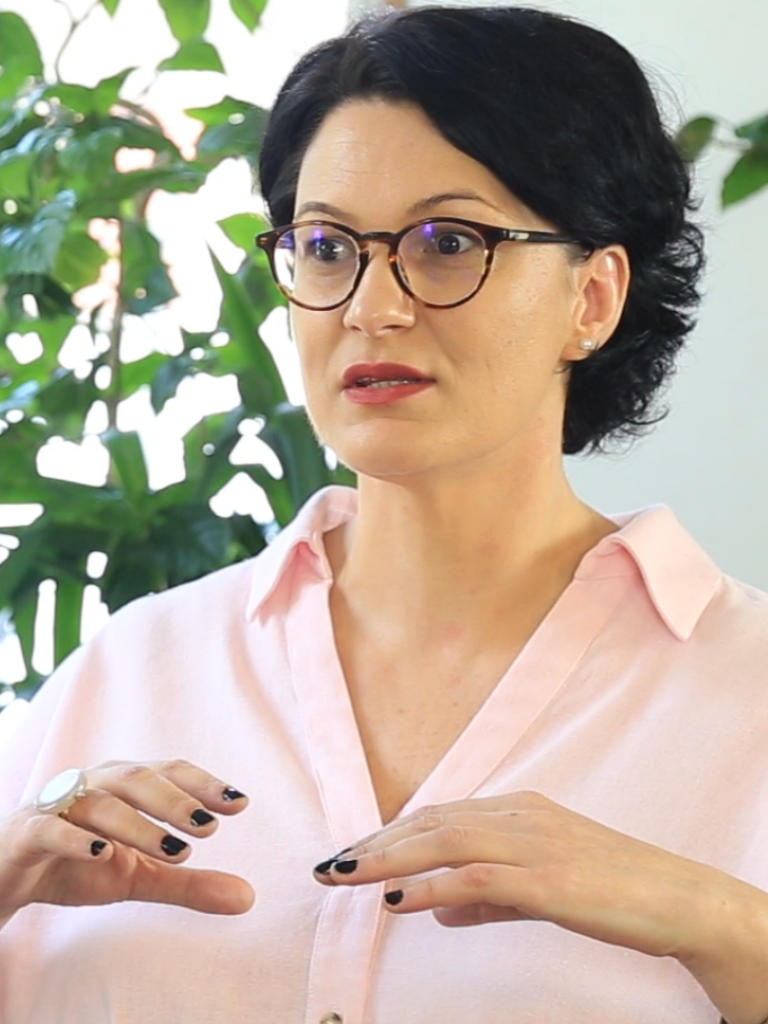
Alexandra Șchianu is a psychologist and facilitator of therapeutic processes, and in the pages of TotUna magazine she has been running the column Glasul Sinelui from the very beginning — the place where depth psychology descends from theory into everyday life, written with a warm voice and anchored in concreteness, from real encounters with people.
In this edition of Self-Vacation, Alexandra gives us perhaps the most appropriate text for the season of quiet: an invitation to stop filling our every void, but to remain, at least for a few minutes a day, curious about who we are when no one is looking. Not as a new project to optimize — but as a small, gentle, repeated practice, from which over time a path back to ourselves is made.
psychotherapist

TotUna is not just a magazine. It is a co-creation space.
Submit your article!
If you feel the call to write, share, or contribute your voice, we are here.




