

Grief – Holistic Healing
Mourning is one of the most profound reconfiguration processes a human being can go through.
In this edition, we approach the topic from two complementary perspectives: a psychological and relational one, which explores the impact of loss on identity and attachment, and a multidisciplinary therapeutic one, which looks at mourning through the lens of the body, the subconscious, and the soul's memory.
Together, these two layers outline a broader understanding of grief—not just as suffering, but as a process of maturation and reorganization of the inner field.

Mourning – a gateway to consciousness
" With my mother, I was given time to dissolve in pain and then return to love. With my father, it was lightning fast and then I delayed the entire grieving process."
This difference made me understand that grief is not just about losing a person. It is about our encounter with the awareness of our own mortality, our own fragility, and our own emotional dependence. When someone we love dies, we don't just lose a person. We lose a relationship. And with the relationship, we lose a part of our identity that was organized around that bond. Grief is a crisis of inner structure.
Interpersonal relationships are an extension of our identity. Every important relationship shapes us. It gives us a place. It gives us a role. It gives us a mirror. In our relationship with our mother, we may have been the child who received protection. In our relationship with our father, we may have been the one who was validated or the one who was trying to be enough. When the person leaves, the role dissolves. And with them, a part of us. The pain comes from this temporary disintegration. But this is where the process of awareness begins.
Grief has familiar phases—denial, anger, bargaining, sadness, acceptance. But beyond the psychological model, each phase is a confrontation with a level of our consciousness.
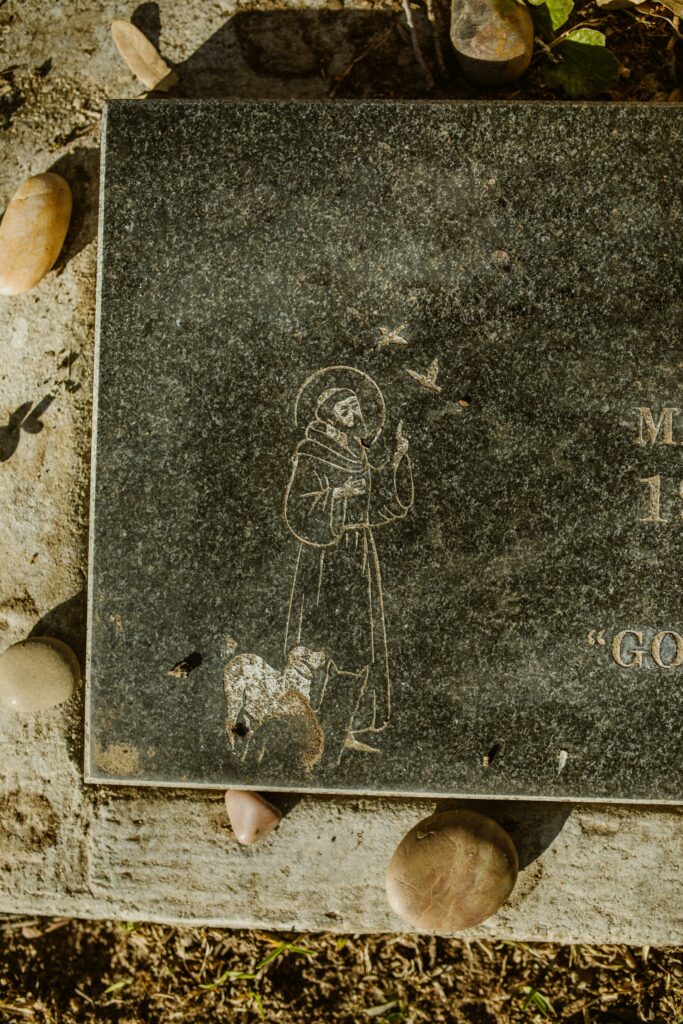
Spiritual bypassing or real maturation?
Denial is the mind's attempt to keep reality stable. Bargaining is the desire to regain control. Anger is the reaction to helplessness. Sadness is the recognition of loss. And acceptance is not resignation. It is expansion. In acceptance, consciousness expands to include the loss.
In holistic healing spaces we often talk about divine plan, soul, karmic lessons. These perspectives can bring meaning. But they can also become a form of avoidance. If we use the idea of “that’s how it was written” to not feel the pain, consciousness doesn’t grow—it protects itself.
Mourning requires presence, not explanations.
What does grief actually show us? If we pause long enough, we discover something surprising. It's not just the loss of the person that hurts. It's the loss of the way we were in that relationship that hurts. Maybe we were loved unconditionally. Maybe we were seen. Maybe we felt safe. Maybe we felt important. Grief brings to the surface our fundamental need for connection and meaning. And here, mourning becomes a process of growing consciousness.
How does mourning help us become more aware?
- 1. It forces us to see our attachments.
- 2. It shows us where we have outsourced our resources.
- 3. It confronts us with our own finitude.
- 4. It invites us to move the relationship from the outside to the inside.
When we start to ask ourselves: What exactly do I miss about that relationship? What part of me felt alive there? We begin to become aware of our inner structure.
At some point, the relationship is no longer physical. It becomes internal. The person is no longer with us, but their influence remains in the way we choose to live. If we have received love, we can begin to cultivate it within us. If we have received security, we can begin to build it within. Mourning thus becomes a transition from dependency to maturity.
Ultimately, grief teaches us something about the nature of life. Everything we love is temporary in form. But it is not temporary in meaning. Our consciousness expands through loss. Not because suffering is the goal, but because encountering it forces us to ask who we are without that relationship. And the answer is not a void. It is a wider space to be.
Maybe mourning isn't just a process of learning to live without someone. Maybe it's a process of learning to live more consciously with ourselves, with others, and with the fragility of existence. And in this awareness, love doesn't disappear. It matures.
The process of reconfiguring the inner field
Mourning is not just sadness. Mourning is a reorganization of the inner field following the loss of a relationship that structured identity, security, and meaning. When someone dear to us dies, we don't just lose a person. We lose a positioning. A role. A mirror. And this loss is not just emotional—it is somatic, energetic, and identitarian.
Psomatic perspective
Grief doesn't just show up as crying. It shows up as shallow breathing. tension in the diaphragm, stiffness in the cervical area, a feeling of emptiness in the solar plexus, and digestive or sleep disturbances. The autonomic nervous system frequently goes into survival mode. The loss is perceived as a threat to stability.
Techniques like Bowen work right here—in the area where the body has become stuck in a protective reaction. By gently working on the fascia and nervous system, the body receives the signal that it is safe to process. Because grief cannot be integrated as long as the body is on alert.
Unconscious beliefs
Beyond the body, mourning activates deep beliefs:
- "I can't live without..."
- "Life is dangerous."
- "I will stay alone."
- "If I love, I will lose."
These beliefs are not always conscious. PSYCH-K works at the subconscious level, where the relationship with the lost person was anchored as a source of identity and security.
Reconfiguring the inner field also means rewriting these structures. Not to erase love, but to transform addiction into maturity.
Soul memory and regression
Sometimes the intensity of grief does not correspond solely to the current loss. In regression therapy, unprocessed early losses, transgenerational traumas, unconscious family loyalties, and unresolved emotional contracts often emerge. Present grief becomes the gateway through which other layers of memory surface. It is not just about the person who has passed. It is about the entire architecture of attachment. And when these layers are brought to awareness, the process is transformed.
Ultimately, mourning is not an anomaly of life, but a stage in its maturation. It disorganizes us in order to reorganize us. It destabilizes us in order to reposition ourselves. It breaks our external attachments in order to invite us to discover our inner resources. What at first seems like absolute loss gradually becomes a reconfiguration of the inner field.

Relationship is no longer external. It becomes an internal structure. Love is no longer addiction. It becomes consciousness.
Mourning doesn't just teach us to live without someone. It teaches us to live more broadly, more lucidly, more maturely. And perhaps, beyond psychological or spiritual explanations, this process leads us to a simple understanding: Form recedes. Connection transforms. Consciousness expands.
And in this broadening, life is not lost. It deepens.
mourning integration ritual
Mourning does not end with explanations, but with conscious crossing. When the external relationship ends, the internal field needs a symbolic gesture through which to accept the transformation.
The ritual below is not a technique for "forgetting" nor a way to rush acceptance.
It is an act of inner maturation.

space preparation
1. Space – Choose a moment of silence. Light a candle or place an object in front of you that reminds you of the departed person. Not to invoke. But to honor. Sit in silence for a few minutes. Breathing becomes slow. Place your right hand on your chest. Notice what emerges. Do not interpret.
2. The Ritual – Say, in a low voice or internally: “I thank you for the form in which you have been present in my life. I allow you to follow your transhumance. And I choose to integrate the dynamics of consciousness that has manifested through your person.” Then imagine that the connection between you is not broken. It withdraws from an external point and settles in the area of your heart. Do not pull. Do not force. Just allow. Take a few deep breaths
3. Integration – Ask yourself: What part of me has grown because of this relationship? What quality can I now cultivate from within?
Stay in the response without formulating it intellectually. Finally, say: “I integrate love. I release form.” Blow out the candle. You are not closing anything. Just transforming.
After the ritual is complete, don't expect an immediate result. Sometimes the integration is peaceful. Other times, tears or inner clarifications may occur.
Mourning is not a linear process, and the reconfiguration of the inner field occurs at its own pace. This symbolic gesture does not replace suffering, but places it in a broader framework of consciousness. It does not break the connection, but transforms it.
Form recedes. Love remains. Consciousness expands.
And, from this amplification, life continues its movement. If you feel stagnation: place your hands on your chest and take a deep breath. Say, if you feel it: “ I allow myself to move at the rhythm of my truth.”
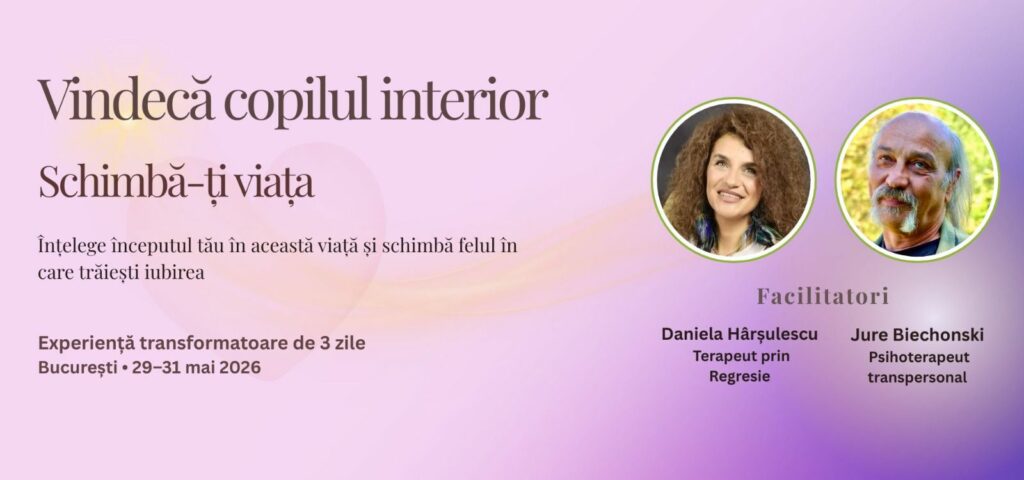
Heal your inner child. Change your life!
holistic healing #15
Mourning is a crisis of inner structure.
Daniela Harsulescu
ARTICLE AUTHOR
Daniela Harsulescu
Daniela Hârșulescu is a regression therapist, PSYCH-K® Facilitator and Bowen Master Therapist dedicated to the integrative approach to inner healing. With over 400 hours of training in regression therapy and recognized credentials, Daniela accompanies people in profound processes of personal transformation, helping them identify and overcome unconscious patterns, emotional blockages and limiting beliefs that affect their lives, relationships and self-perception.
In her practice, Daniela integrates therapeutic techniques that address the mind, body, and subconscious as a whole: reconnective regression, PSYCH-K® for subconscious rewriting, and Bowen therapy for releasing somatic tensions. This combination allows her to provide a safe and gentle framework for exploration, in which emotional challenges can be transformed into resources of inner strength.
Her professional mission is to create a space where people can rediscover themselves, find clarity, and cultivate the courage to live authentically. Through her work, Daniela supports those going through grief, loss, or confusion to find balance, restructure their inner field, and renew their connection to self and life.
REGRESSION THERAPIST. LIFE COACH


TotUna is not just a magazine. It is a co-creation space.
Submit your article!
If you feel the call to write, share, or contribute your voice, we are here.




