
First Contact | Momentum Essence #21
There is a tightness in the air these days. We all feel it, even if few can name it. Time seems to rush, pressing on places we thought were well hidden; things we thought were settled forever are tottering. Something is knocking at the door—and most of us don’t know whether to open it, or lean against it, hoping it will pass.
To understand what this grip is, we must go back to the first grip that every being has known. The one that we don't remember, and yet we carry in every cell.
A pressure that didn't ask if we were ready. We were pushed — through warm darkness into cold light, through a channel so narrow that the entire body had to reshape itself to fit through —
from a world where there was no separation, to a world where the air stings and the light blinds.
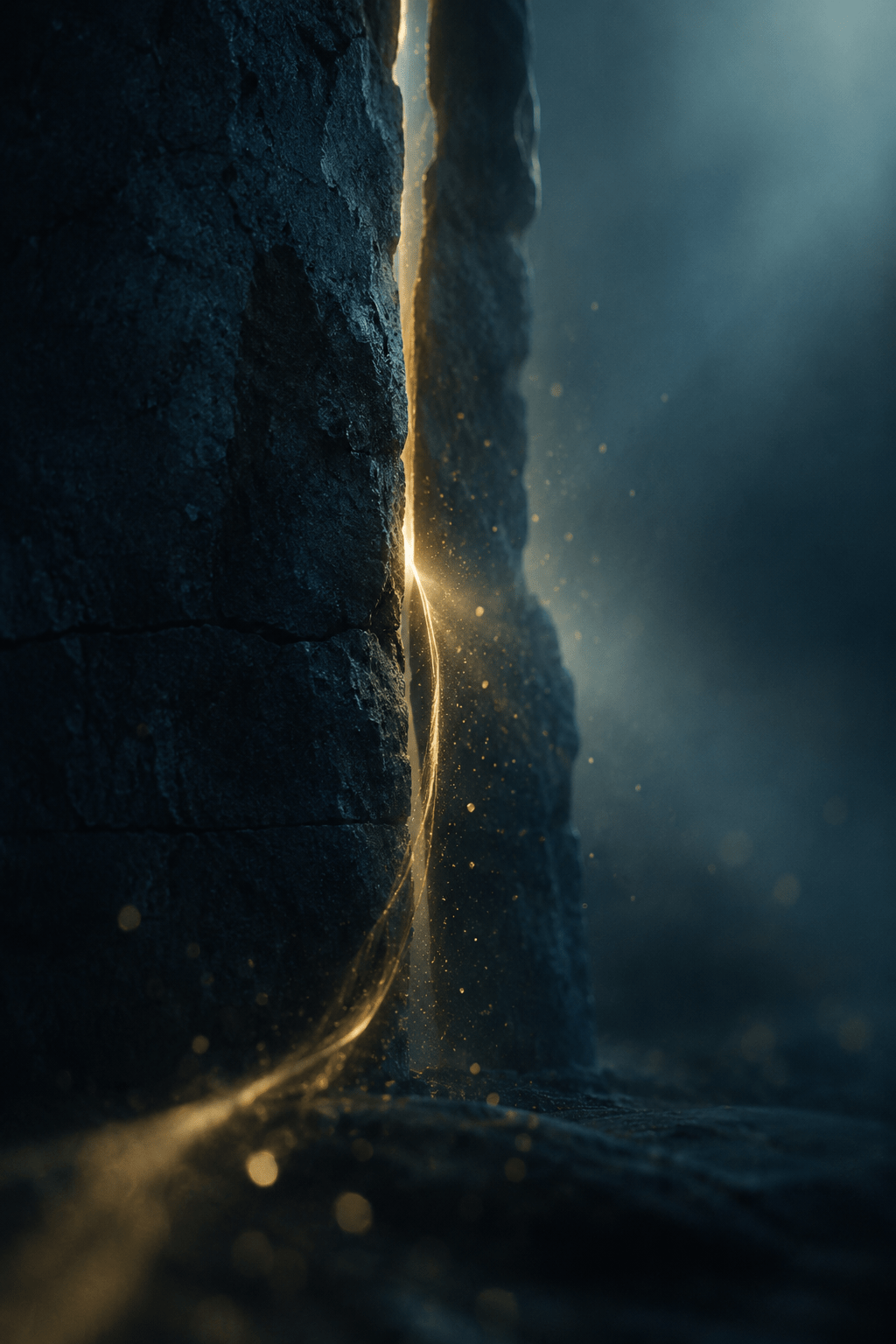
And the first thing we did upon contact wasn't to smile. It was to cry.
This was our first encounter with life. Not gentle. Not chosen. A crisis, in the oldest and purest sense of the word — krisis , the point at which something is decided and nothing can remain as it was. And yet no one, looking at a newborn, would call birth a punishment. We call it a gateway. We call it a beginning. We call it, without dwelling on the word, a miracle.
Here is the first lesson that first contact teaches silently, in the body of every being who has ever come here: that which is born, is born through strait. Not in spite of it. Through it. Pressure is not the obstacle to life—it is the very method by which life brings us into it.
There is a knowledge that comes not from memory, but from deeper layers than memory. There are people who, descending into themselves through gates that we rarely open, have been able to witness their own birth again—not as a memory of the mind, but as the presence of that consciousness that was watching before the body was inhabited. And what I describe is always the same amazement: the soul was not being pushed passively into the world. The soul was watching. It was there, attentive, registering everything—the room, the waiting hands, the care around the little body, the mother's breathing—and only then, in its own moment, did it approach and merge with the body that called it.
What a reversal of our understanding of helplessness. The most helpless moment of a man's existence—birth, when he can neither hold his head up, nor see clearly, nor understand where he has come—is actually watched over by a vigilant, participating presence that chooses to step in. The helplessness was only of the body. Consciousness was whole.
And if the first birth was like this, what does it say about all the births that will follow?
Because life doesn't give birth to us once. It gives birth to us over and over again. Every real threshold we cross has the same form: the strait, the pressure, the exposure, and then—if we don't turn back—a breath we've never taken before. The body is born once. But the consciousness that inhabits the body can be born a second time, and this time it can be awake in its own labor.
Those who have experienced that second birth describe it in language that is disturbingly similar to the first. A burst of light from within—not from without, but from within, as if the entire body had suddenly become transparent to a knowledge that transcended it.
You suddenly become a recipient of all the questions of the world. You feel the immensity of which you are a part. And, what is most difficult to put into words, you touch the very emotion of the living field that participates in every act of creation — in every thought, in every gesture, in every birth.
The body is overwhelmed by such knowledge for the same reason a newborn baby cries: contact with something immense is, at first, beyond our capacity to contain. We don't cry because life is bad. We cry because there is too much of it all at once. Awakening is not gentle for the same reason birth is not gentle—because nothing truly new enters us without reshaping us along the way.
And there is another birth that some of us know from the other side—not as the one being born, but as the one receiving. The moment when you hold the being who has just arrived against your chest. Skin to skin. Pulse to pulse. And in that wordless touch a door opens that the mind alone would never have found: you recognize. You are not meeting a stranger. You recognize. As if that contact had been promised long ago, and now it only confirms what a part of you knew before you knew anything.
Here the first contact shows its most tender face: sometimes you meet for the first time someone whom, on a level deeper than time, you have never left. And then the contact is no longer crises and straits. It is a return. It is home spoken without words, through the warmth of a small body supported by yours.
contact
Contact with the world, at birth. Contact with the Self, at awakening. Contact with the other, in the love that recognizes. Each time, a membrane that kept us separate thins until it disappears, and what was two becomes, for a moment or forever, still one.
And if we understand this, then we can look at what we are experiencing now, in this period, all at once, with different eyes. Because many feel a squeeze. An acceleration of time, as if processes that once took years were now ripening in months. A pressure that presses exactly on the places we have avoided for a lifetime. Structures that are shaking, certainties that are cracking, a feeling that something old no longer fits and something new has not yet taken shape.
Do you recognize the shape? It's the shape of labor.
The strait, the pressure, the feeling that there is no way back—these are not signs that something is going wrong. They are signs that something is being born. The membrane that kept this world separate from what is to come is thinning, as any membrane thins when the time comes. And we are, at once, both the one being born and the one giving birth. We are passing through a channel we cannot yet see, towards a plane we cannot yet name.
The moment of labor
The one who does not know this struggles with pressure. He experiences it as a punishment, as an injustice, as proof that something has gone wrong in the world. And he suffers twice: once from the hardship, and once again from the conviction that the hardship should not exist.
But the one who recognizes the form no longer struggles. He knows that the button pressed is not cruelty—it is the very place where the light enters, because it is the only place he has never cleaned. He knows that he is not being pushed out of his life, but inside, into the one room he has always kept locked. And then he does the one wise thing a newborn cannot do, but we do: he lets himself be born.
He doesn't push against the strait. He doesn't cling to the membrane that's thinning anyway. He breathes into the pressure, the way a mother breathes in labor—not to escape it, but to get through it. Because the third lesson of first contact, after the strait and after the vigil, is this: you don't decide when contact comes. Contact comes when the membrane is ready. You just decide whether you're his wall or his gate.
What weighs you down now doesn't take you out of your life. It births you into it, deeper than you've ever been.
essence momentum #21
You don't decide when contact comes. You only decide whether you are their wall or their gate.
mell
ARTICLE AUTHOR
MELL
Mell is the founder of the magazine TotUna – Essentia Momentum, an editorial space dedicated to the maturation of consciousness through direct experience and integrative reflection. Her writings do not start from theory, but from real journeys — from encountering life in its most fragile and revealing forms.
His interest in traditions such as Advaita Vedanta, Gnosticism, Kabbalah, and anthroposophy is not a comparative one, but an attempt to recognize the same divine thread that runs through different languages. For Mell, creative consciousness is not a concept—it is a living reality, present in all forms of existence, which he explores, writes about, and experiences. He does not direct; he recognizes. And by recognizing, he holds open the door that each reader must pass through for themselves.
editor-in-chief totuna.live


TotUna is not just a magazine. It is a co-creation space.
Submit your article!
If you feel the call to write, share, or contribute your voice, we are here.