

The Uniform and the Master | Essentia Momentum #20
There is a moment that almost anyone who has lived long enough knows. You have done nothing wrong. You know your hands are clean. And yet, when the pressure comes—in the form of a piece of paper, a voice, a request that has no logic or mercy—something inside you jumps before you can think. The body knows before the mind. It tightens, it shrinks, it braces itself for a blow that reason still denies.
I sat next to a man as he went through this. I won't say what was asked of him, because, frankly, it doesn't matter anymore—and that's the crux of what follows. He was asked to pay for a gain he never had. To answer for a reality that existed only on paper. And the paper, with its cold authority, seemed more real than his truth.
I watched him take the hit. And I saw something unforgettable: how injustice, when it comes with a force greater than you can bear, has a taste. A concrete, almost mineral taste—like hot asphalt in the summer, when you fall and your cheek touches the burning earth. This man was, by nature, a seeker of gain; he always dreamed of big wins, of investments that would pay off, of the luck that would one day come. And he was the one who was asked to pay for a phantom gain. As if life knew exactly where to press.
His fear became physical. I saw it rising into his body, taking over his breathing, overriding any coherent thought. There was no room for reasoning there—it was just the animal in us, the ancient one, that senses the trap and can no longer run or fight. And in that moment I understood something that I would like to talk about today: that the pressure was not the enemy. The pressure was the revealer.
What we keep under the rug
It's easy to seem free when nothing weighs you down. It's easy to be serene on your pillow in the morning, with your tea steaming and your book of wisdom open beside you. Fair-weather spirituality costs nothing—and that's precisely why it proves nothing. You can believe for years that you've transcended fear, that you've healed your helplessness, that you're no longer anyone's prisoner, as long as no one comes to check.
And then comes the first real push. A single one. And it throws aside, in one motion, everything you thought you had put in place. The fear was there. The feeling of being trapped was there. The revolt, the helplessness, the taste of betrayal—they were all there, unreleased, hidden under the pressure that we call, with deceptive gentleness, spirituality. No one had created them at that moment. They had been in the house for a long time. It's just that nothing had called them to the light yet.
Here is the bitter gift of all oppression: it does not flatter you. It does not confirm your beautiful story about yourself. A system, an authority, an injustice—they have no interest in sparing you, and that is precisely why they tell you a truth that no benevolent friend tells you. They show you exactly where you are. Not where you think you are, not where you would like to be—where you really are, on the day the oppression occurs.
reagent
Let's call things by their names, without embellishing them. The pressure I'm talking about doesn't create fear in you. It brings it out. It doesn't manufacture your feeling of imprisonment—it exposes it. It doesn't invent betrayal—it finds it, long since settled there, in the trust we had placed, perhaps without knowing it, in the idea that someone greater is watching, that somewhere there is a justice that has our backs.
It's important to be clear, so we don't get lost: calling oppression revelatory is not calling it good. Injustice remains injustice. When a system asks you to pay for what you didn't have, that's abuse, and no honest spirituality will baptize it otherwise. We don't bless the blow. We don't bow our heads saying that it had to be that way. The difference — subtle, but everything plays into it — is between using the evidence and blessing it. You can reject injustice with all your being and, at the same time, make use of what it shows you about yourself. The two are not contradictory. Together, in fact, they constitute maturity.
For the real question is never just whether the blow is fair or unfair. The question, the one that works deep down, is: what did she find in me? Why was she able to knock me down so completely? What part of my inner structure gave way at the first push? Not to blame myself—the victim is not to blame for the blow. But to finally see, with open eyes, what parts of me were still not whole.
Ego vs. Higher Mind
I watched the man next to me in the midst of his physical fear—and I saw, at one point, something rise above it. Not from outside. No one saved him. Nothing changed in the cold paper on the table. And yet, through a spark I know nothing about but master, he began to rise above every wave of fear that was canceling out his thinking. He didn't push away the fear. He went through it. Through what he knew about the higher mind, he managed to neutralize an experience that had within it all the potential to destroy him.
And here, I think, is the most important truth I understood sitting next to him: integration does not come after the pressure passes. It is not a state you reach and then become immune, protected forever. Integration is the very way you get through the pressure. It is the movement, done over and over again, by which something in you rises above the fear just when the fear tells you that there is no more thought, no more way out, no more you. You are not exempt from the test. You cross the test differently.
I believe that all experiences of this kind work the same way in man. The same blow, the same taste of asphalt, the same fear rising in the body. The higher mind—let's call it that, although no name is enough for it—emits equally, for all, waves of consciousness that choose no one and bypass no one. What differs is not the emission. What differs is the receiver. The degree of expansion of each one. How much of that wave can a man receive and let manifest through him, on the day of trial.
Two People – Two Realities
Two people, the same injustice. One collapses in hatred and fear, and from there he can only strike back blindly or fade away. The other trembles in the same way — let's not imagine that the master does not tremble — but remains, somewhere deep down, present. Lucid. Able to act without losing himself. Not because he is luckier, more blessed, especially. But because he has worked, silently and for a long time, on his own capacity to remain conscious under pressure. And this — not the serenity on the pillow, but the presence under pressure — is the true face of the master within.
I have come to believe that there is, in all of this, an unseen hand. Not one that spares us from blows—that would be too convenient, and we would never grow. But one that does not want man to suffer, but to awaken him. A hand that does not punish, but calls. Which uses even injustice, even the coldest oppression, as a final, harsh teacher—not to bring us to our knees, but to show us where we still have to go.
And if so, then how we respond becomes everything. Because evil is never defeated with evil. Fear is never extinguished with fear. He who meets coercion with hatred has already been defeated—he has entered the game of arrogant authority, on its turf, with its weapons, and there authority always wins. To respond to force with blind rage is to confirm language, to acknowledge rule.
The Master does not fight like this. The Master integrates. He does not submit — submission would be just fear disguised as politeness. But he does not blindly rebel either — blind rebellion is still fear, only turned outward. He does the other thing, the hard thing: he accepts what is, he detaches himself from the need for things to have been different, and from that free place — only from that place — can he act justly. His acceptance is not resignation. It is exactly the opposite: it is the only position from which you can do something that is not dictated by fear.
The guiding hand
For acceptance, detachment, integration—they are all, in the end, one word. Love. Not the sweet love that turns a blind eye to injustice, but the lucid love that sees it in all its ugliness and yet does not allow itself to be transformed by it into something ugly. This is the authority that no one can derogate from. No institution can take it from you. No system can demand it from you. No master, however powerful, has a badge big enough to claim it.
All other masters wear a uniform. They have a title, a position, a seal, the power to call you to order and punish you if you don't come. And it is precisely in this—their need for a uniform—that they betray their lack. He who needs a badge to be obeyed has never truly been a master.
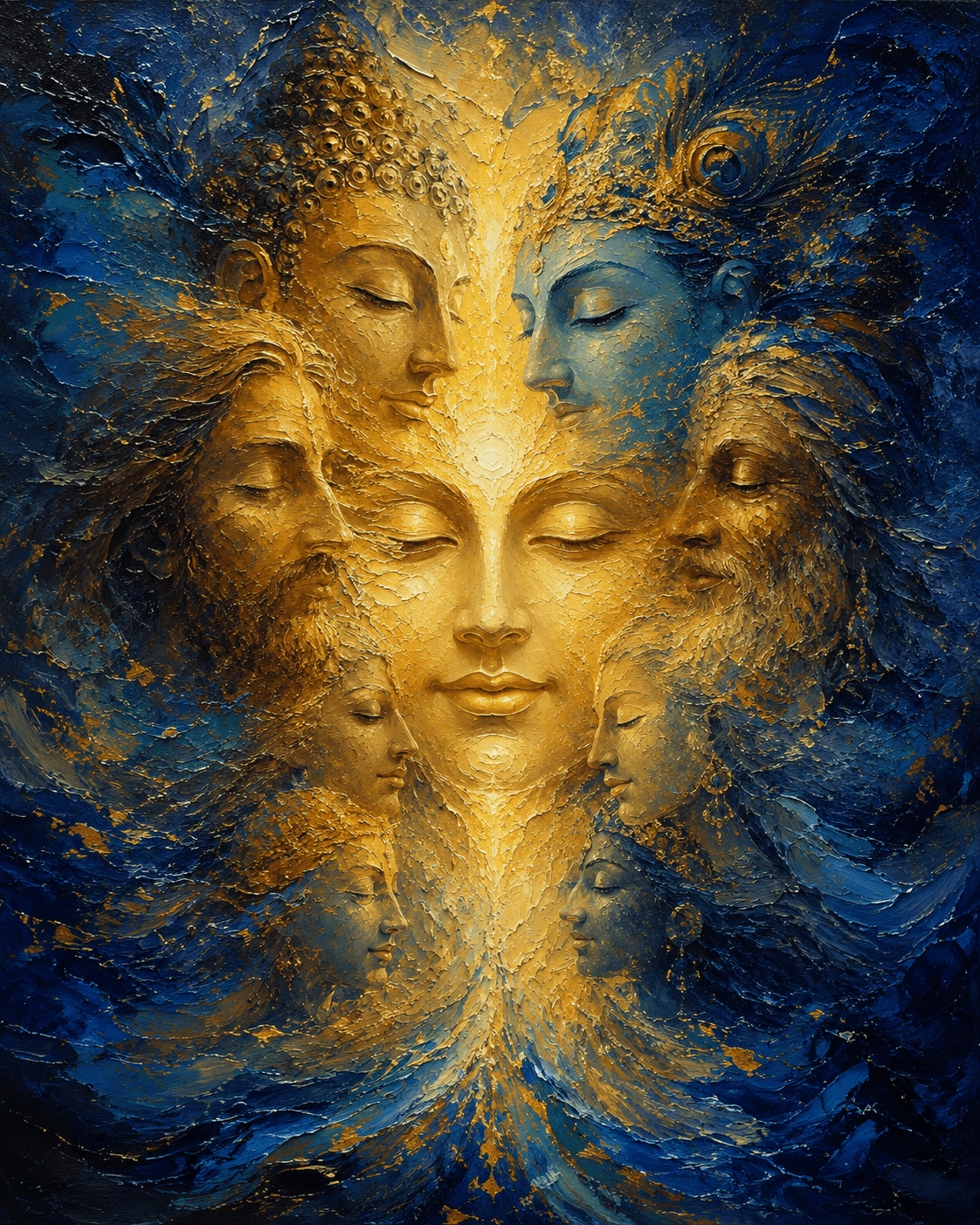
The only one who never wears a uniform is the one on the inside. Silent. Nameless. No right to fine you. He doesn't ask you for anything and doesn't threaten you with anything. He just waits, patiently, for the day when the pressure is heavy enough for you to finally turn to him. And when you do, you discover the simplest and most unbelievable thing of all: that voice, which you've been searching for a lifetime outside, was yours from the very beginning.
essence momentum #20
Evil is never defeated by evil. Fear is never extinguished by fear.
mell
ARTICLE AUTHOR
MELL
Mell is the founder of the magazine TotUna – Essentia Momentum, an editorial space dedicated to the maturation of consciousness through direct experience and integrative reflection. Her writings do not start from theory, but from real journeys — from encountering life in its most fragile and revealing forms.
His interest in traditions such as Advaita Vedanta, Gnosticism, Kabbalah, and anthroposophy is not a comparative one, but an attempt to recognize the same divine thread that runs through different languages. For Mell, creative consciousness is not a concept—it is a living reality, present in all forms of existence, which he explores, writes about, and experiences. He does not direct; he recognizes. And by recognizing, he holds open the door that each reader must pass through for themselves.
CO-FOUNDER OF THEMEDITATION.ACADEMY


TotUna is not just a magazine. It is a co-creation space.
Submit your article!
If you feel the call to write, share, or contribute your voice, we are here.




