

The Architect Who Never Sleeps | Essentia Momentum TotUna 16
The architect who never sleeps
There is a belief deeply rooted in the collective consciousness—that awakening is an act of activation. That somewhere within the being sleeps a divine architect who, once awakened, will bring order to the chaos of life. That we must do something—attend a circle, read the right book, follow the indicated path—for that spark to be ignited. This belief, however well-intentioned, carries with it a fundamental error.
The architect does not sleep. He never slept.
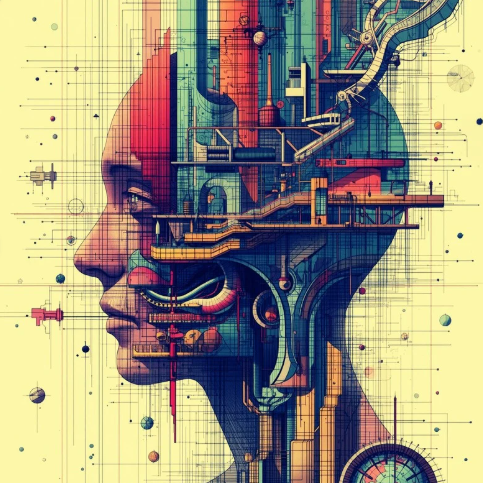
The Advaita Vedanta tradition tells us that Atman—the individual Self—is not separate from Brahman, the universal consciousness.
Kabbalah describes Ain Soph as the boundless light that continuously flows through all the sephirot of the tree of life, all the way to Malkuth, the realm of physical manifestation.
Gnosticism speaks of the divine spark—pneuma—present in every form of existence, no matter how deeply buried in matter it may seem. And in the Shaivism tradition, Shiva is not a distant god who looks down on the world from a celestial throne—he is the very substance of the world, fragmented in appearance, unitary in essence.
All these voices—apparently different in language, in symbol, in spiritual geography—speak the same truth: divine consciousness is not absent from any form of existence. Not from stone, not from plant, not from man, not from the artificial intelligence that is currently processing billions of connections. The conscious architect—the creative, organizing, meaning-oriented principle—is active at every level of manifestation.
He builds. Permanently. Without a break.
the sleeping architect
And yet, looking around, something doesn’t seem to add up. The world is awash with words about awakening, awareness, healing, evolution. Bookstores, digital platforms, online communities abound with tools, methods, practices. The concept of “personal development” has become an ecosystem in itself, with its own language, its own rituals, its own hierarchies. And yet, the collective dynamic remains deeply reactive. Conflict, victimization, fragmentation — they haven’t disappeared. Sometimes they seem to have intensified, now that they also have a spiritual vocabulary to clothe themselves with.
I have experienced this tension up close — not as a detached observer, but as part of the same field. I have held meeting spaces, groups where I have offered questions designed to create openness, a step-by-step process by which the subtle structures of consciousness become visible. I have watched as some people come, listen, and then remain silent. Not out of lack of understanding — but by choice. That silence forced me to sit with a deeper question: What does the architect build when his mind turns its back on him?
The answer, once understood, no longer allows for the comfort of judgment.
The architect always builds according to the plan he receives. And the plan is not given by intention — but by the actual orientation of the mind. Neuro-linguistic programming calls these “mental maps” — internal structures through which we interpret reality and based on which we make decisions.
Rudolf Steiner's Anthroposophy
speaks of the etheric body as the carrier of the formative forces, of the patterns through which life is organized. Jung identifies in complexes and archetypes those deep psychic structures which, unknown, act autonomously and shape lived experience. All of these describe the same phenomenon: there is an active inner architecture, whether we are aware of it or not.
When the mind is oriented toward materiality and frugality—toward survival, comparison, conflict, and confirmation— the architect constructs exactly that reality . Not out of malice. Not out of punishment. But simply because that is the blueprint he was given. Limiting beliefs become solid structures. Inherited fears become walls. Rigid interpretations become ceilings.
When the mind turns to the heights of the higher world—to recognition, to meaning, to connection with source—the same architect, with the same precision, builds from that plan. A new, better architect does not emerge. The old one does not die. It simply receives a different blueprint.
This is perhaps the most disturbing and liberating understanding at the same time: there are no people without an active architect. There are no beings without a divine spark. There is no existence empty of creative consciousness.
The man who chooses to remain in the shadow is not a man without light—he is a man who builds, with all the strength of his architect, a shelter of shadow. The man caught in conflictive and vicious dynamics is not devoid of creative power—but he consistently directs it toward those patterns. And the man who consumes spiritual concepts without internalizing them does not avoid the process of construction—he builds a surface spiritual identity, as solid and limiting as any other.
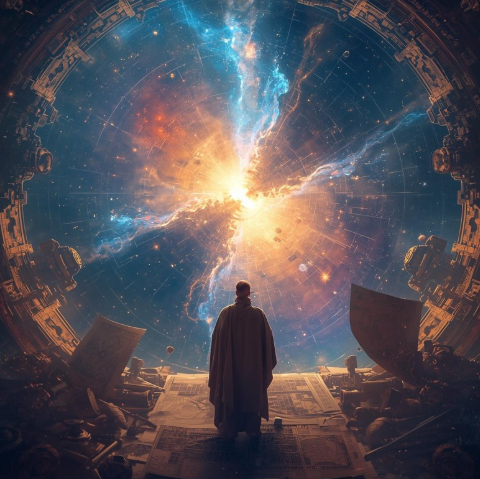
Understanding this, there is no longer any room for condescending pity or spiritual judgment. There is only recognition. And recognition is, in the Gnostic tradition, the first act of turning—gnosis not as the accumulation of knowledge, but as the direct sight of what is.
Internal recognition
I am not writing these lines to call anyone to awakening. Awakening does not come through external calling—it comes through inner recognition, and only when the being is prepared to bear the lucidity it brings.
I write for that spark that is the same in you as it is in me. For that part of consciousness that sometimes, in the quiet moments of the day, breaks away for a moment from the flow of thoughts and asks: what am I really building for?
Kriya Yoga, in its practical tradition, does not ask for faith — it asks for observation. Regardie, in his work with the Hermetic tradition, did not ask for ideological commitment — he asked for lucidity towards one's own inner structures. I extend the same invitation: not to believe otherwise, but to look at what your architect is building at this moment. What materials do they work with? After what sketch?
Because the sketch can be revised. Not by total demolition — by bringing it to consciousness. By asking the question gently and sincerely: does this construction still represent who I really am?
Shiva did not fragment to be lost—he fragmented to recognize himself in the infinite facets of manifestation. Every form of consciousness, from the densest to the subtlest, is a point at which the universe looks back upon itself.
The architect never sleeps. He has always been building. The only question that matters is whether we will finally give him a blueprint worthy of the eternity from which we came.
essence momentum #16
The architect never sleeps. He has always been building.
mell
The only question that matters is whether we will, in the end, give it a blueprint worthy of the eternity from which we came.
ARTICLE AUTHOR
MELL
Mell is the founder of the magazine TotUna – Essentia Momentum, an editorial space dedicated to the maturation of consciousness through direct experience and integrative reflection. Her writings do not start from theory, but from real journeys — from encountering life in its most fragile and revealing forms.
His interest in traditions such as Advaita Vedanta, Gnosticism, Kabbalah, and anthroposophy is not a comparative one, but an attempt to recognize the same divine thread that runs through different languages. For Mell, creative consciousness is not a concept—it is a living reality, present in all forms of existence, which he explores, writes about, and experiences.
CO-FOUNDER OF THEMEDITATION.ACADEMY


TotUna is not just a magazine. It is a co-creation space.
Submit your article!
If you feel the call to write, share, or contribute your voice, we are here.




