

Sofia — Golden Thread #19
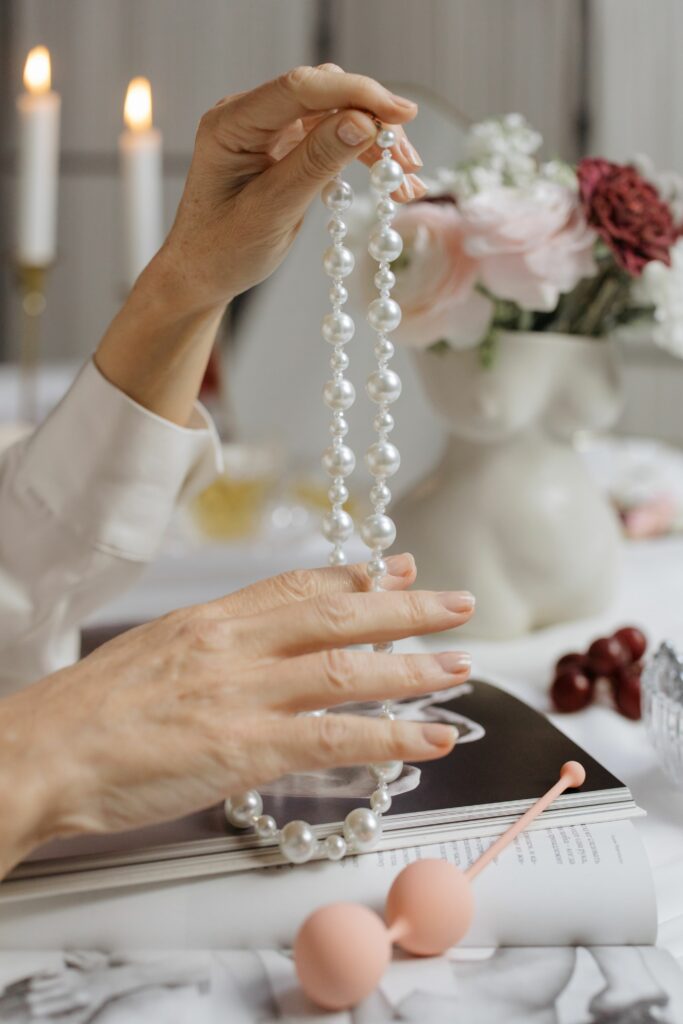
Hold a string of beads in your hand for a moment.
It doesn't matter which one—a string of rosaries, an old necklace from grandma, a wooden bracelet left over from some journey. Look at it. Each bead is separate. It has its own shape, its own color, its own little imperfection. None of them really touch the other. And yet, when you lift the string, they all lift at once. Because the same thread runs through the heart of each one.

The beads do not know about the thread. They see each other, distinct, neighboring, perhaps even rivals. A bead might think it is alone in the world, or it might compare itself to the one next to it, or it might fear that it will fall. But the thread knows. The thread passes silently through everything and holds everything, without any of them seeing it.
The wisdom we speak of in this edition starts from this simple image. And it ascends, through traditions that have never met in history, to a single revelation: that your peace is not yours. That the thread that holds you holds everyone else. And that, when one bead becomes quiet on the thread, that quiet passes through the thread to all the others.
Sutratma — the thread that carries the world
In Sanskrit there is a word for this thread: sutratma. Sutra means thread—the same word that comes from “suture,” the seam that holds together. Atma means soul, Self. Sutratma: the soul-thread. The Self-Thread.
The image comes from the heart of the Vedantic tradition, and the Bhagavad Gita speaks it directly, through the mouth of Krishna: all things are strung on Me like beads on a thread. Not beside Me. Not under Me. On Me. I am the thread that runs through everything.
What this says, if you let it sink in, is dizzying. You are not just the bead. The substance of the thread and the substance of the bead are one—Atman is Brahman, the individual drop and the ocean are of the same water. The Self that holds you is not different from you. It is what you really are, beneath the form, beneath the color, beneath the little imperfection that you call "me."
And then the bead's fear dissipates. The bead is afraid of falling—but how could something that is threaded through fall? The bead believes itself to be alone—but how could it be alone, when the same thread connects it to everything? All the bead's suffering comes from one forgetfulness: it has forgotten the thread. It believes it is holding on to itself. And from the fatigue of holding on to itself comes all its tension.
The Holiday of the Self, which this entire issue is about, is precisely the moment when the bead remembers the thread. And it lets go. There is no need to hold on. It was held on all along.
Kav — the ray through which Infinity descends
But where does the thread come from? How does something from Above come to cross something from below? Here, another tradition, born thousands of kilometers and hundreds of years away from India, tells a disturbingly similar story.
In Kabbalah, before the world, there was only Infinity—Ein Sof, that which has no end, boundless light, with no empty space in which anything could exist. And in order for the world to be possible, Infinity did a paradoxical thing: it withdrew. Tzimtzum—the contraction, the withdrawal by which Infinity left an empty space, a breath, a place in which the world could be. Not by expansion was the world created, but by withdrawal. Not by filling, but by making room.
And then, into that empty space, a single ray descended. Kav—the thread, the thin ray of light by which the Infinite, though withdrawn, remains connected to the world. A single thread of light that runs through all levels of creation, all stages of descent, holding them all connected to the Source from which they came. Without the kav, the world would have remained an empty space, forever separated from light. With the thread, the world is empty and yet connected. Alone and yet held.
See how close the two images are? Vedanta says: you are a bead on the thread of the Self. Kabbalah says: you are an empty world, but a thread of light always connects you to the Infinity from which you come. Both speak of the same thing — a vertical thread, descended from Above, which never breaks, no matter how low you go, no matter how forgotten you are. The anchor in the sky that the Essence spoke of, now seen from the other side: not the hook caught on high, but the ray descended from on high.
The same connection, viewed from two directions.
And there is something else in the Kabbalistic story that touches the very heart of this edition. Creation did not come from effort, from strain, from pushing. It came from retreat. From making room. From the gentle surrender of the Infinite that pulled back so that something else could be. Perhaps our healing, and our peace, come from the same gesture: not from pushing, but from withdrawing enough for the thread of light to have room to descend.
Ariadne's thread — the way out of the labyrinth
The third tradition lowers the thread from metaphysics to our feet, into the concrete path of the lost man.
We all know the story, at least half of it. In the heart of the labyrinth in Crete lived the Minotaur, and no one who entered could ever leave again—not because they were necessarily killed, but because they got lost in the endless corridors and couldn't find their way out. Theseus entered to face the monster. But the thing that saved him wasn't the sword. It was the thread. The thread that Ariadne gave him at the entrance, which he unwound behind him step by step, and which, after he had done what he had to do in the center, he followed back to the light.
Listen to what this myth says about our times. The labyrinth is the collective mind — its endless corridors, its dead ends, its din that you enter with a simple question and get lost hours later, more lost, more tired, no longer knowing where you came from. We are all lost in a labyrinth today. And many believe that the way out is found by knowing the labyrinth better — by reading more, debating more fiercely, mapping every corridor of chaos.
But Theseus didn't come out knowing the labyrinth. He came out following the thread. The thread doesn't explain the labyrinth to you. It takes you out of it. You don't have to understand every corridor of the collective mind to free yourself from it—you just have to hold on to the thread. Your thread is your connection to the center, to the Self, to that vertical stillness that rises from your heart to the top. As long as you hold the thread—or, more precisely, as long as you let it pull you out—no corridor can ever lose you.
And Ariadne's thread is given at the entrance, out of love, as a gift. You don't manufacture it in the middle of the labyrinth, in panic. You receive it beforehand, and then you just don't let go of it. Just like the peace of this edition: you don't produce it when you're already lost. You recognize it as something that was given to you in advance, a thread that was there all along, just waiting for you to follow it.
One thread, under many names
And while we're still holding the thread in our hands, let's listen to how many voices are calling it.
The mystery tradition speaks of the silver cord—the subtle thread that connects the soul to its body and its source, and which, it is said, is unbroken as long as life lasts. Christ used the same image in another way: “I am the vine, you are the branches” —a single sap-thread ascending through all the branches, so that what nourishes one branch nourishes the whole vine, and a branch cut off from the thread withers not because it is bad, but because it has forgotten where its life came from.
And Sufi weavers see the entire world as a canvas: countless weft threads woven over a single warp thread, the basic thread that holds the entire canvas together and without which the carpet would fall apart in your hands.
Bead on a thread. World tied to the ray of light. Lost held by Ariadne's thread. Soul tied to the silver cord. Branch nourished by the vine. Weft woven on the warp. Six images, six worlds, six ages of humanity — and one truth beneath it all: you do not hold yourself alone. You are held. And the thread that holds you connects you, at the same moment, to everything that exists.
Why does it matter now?
Here is where all this touches the pain of our time. If the thread is one, then your peace is not a private matter. When a bead flutters on the thread, its tremor passes through the thread and touches the beads next to it. And when a bead becomes still—when it stops fluttering, when it finally settles on the thread that was holding it anyway—that stillness passes, likewise, through the thread, to all the others.
This is the function that Essentia was talking about, now seen in all its depth. Your settlement does not withdraw you from the world. It makes you a place through which the common thread transmits settlement. You do not have to convince anyone, correct anyone, shout louder than the din. You only have to quiet yourself, deeply, truly, on the thread that holds us all — and the silence will travel by itself through the thread, in ways you will never see.
The Master does not straighten the world by pulling on other beads. He straightens it by sitting so deeply on his own thread that the thread itself transmits his peace further.
Ritual Passing the Thread
Here's a simple ritual you can do whenever you need to remember your thread. You'll need a string of beads — rosary beads, a mala, a necklace, anything with beads that you can count on your fingers. If you don't have one, read the breathing version below.
Hold the string in your hands and sit quietly. Let a few breaths thin out on their own.
Take the first bead between your fingers. Stop there. This is you—here, now, with everything you're wearing today. Don't rush it. Just acknowledge: I am a bead on a string.
Then she feels the thread running through her. The bead is not holding itself—the thread is holding it. She says silently, once: I am not holding myself. The thread is holding me.
Now move slowly to the next bead. And with each bead you touch, think of someone—someone dear, someone strange, someone hard to love, someone suffering somewhere in the world right now. Each one is a bead on the same thread. Touch the bead, think of it, and silently acknowledge: he too is held by the same thread as I am.
You go like this, bead by bead, without haste, until you feel that you are no longer counting the beads—you feel the thread. The continuous thread that runs through everything, uninterrupted, the same in every form.
And at the end, when you have gone through the entire string, stop. Take a deep breath, and as you exhale, let your peace descend down the thread. Simply imagine how the peace within you passes through the common thread to all the beads you have touched — to all those you have thought of, and beyond, to all those you will never know.
You didn't send anything with effort. You just let the thread do its job, which is to bind.
(No string: follow the same path with your breaths. Each breath is a bead; the thread that strings them all together is the very life that breathes within you. With each exhalation, a bead passed; with the last, silence lowered on the thread that holds us all.)
Sophia, the wisdom of the soul #19
I'm not holding on. The thread is holding me up.
mell
ARTICLE AUTHOR
MELL
Mell is the founder of the magazine TotUna – Essentia Momentum, an editorial space dedicated to the maturation of consciousness through direct experience and integrative reflection. Her writings do not start from theory, but from real journeys – from the encounter with life in its most fragile and revealing forms.
His interest in traditions such as Advaita Vedanta, anthroposophy, Kabbalah or Christian spirituality is not a comparative one, but an attempt to recognize the same thread of continuity that runs through different languages. For Mell, death, suffering and transformation are not abstract themes, but living processes of integration of consciousness into its own vastness.
Through the magazine TotUna and the spaces created around The Meditation Academy, she supports a lucid spirituality, devoid of drama and escapism, anchored in concrete life and open to its subtle dimension. Her approach does not seek followers, but inner maturity; it does not propose doctrines, but invites experience and assumption.
CO-FOUNDER OF THEMEDITATION.ACADEMY


TotUna is not just a magazine. It is a co-creation space.
Submit your article!
If you feel the call to write, share, or contribute your voice, we are here.




