

Quince | Conscious Food #22
Eating also means receiving, transforming, integrating. That is why the way we eat sometimes says more about our relationship with ourselves than about what is on our plate. Consciousness begins where choice no longer comes only from automatism, fear or control, but from a more attentive listening to the body and the life that expresses itself through it.
This column is not looking for the perfect formula, but for a more lively, gentle, and responsible relationship with food — one in which balance is built through presence, discernment, and respect for one's own body.
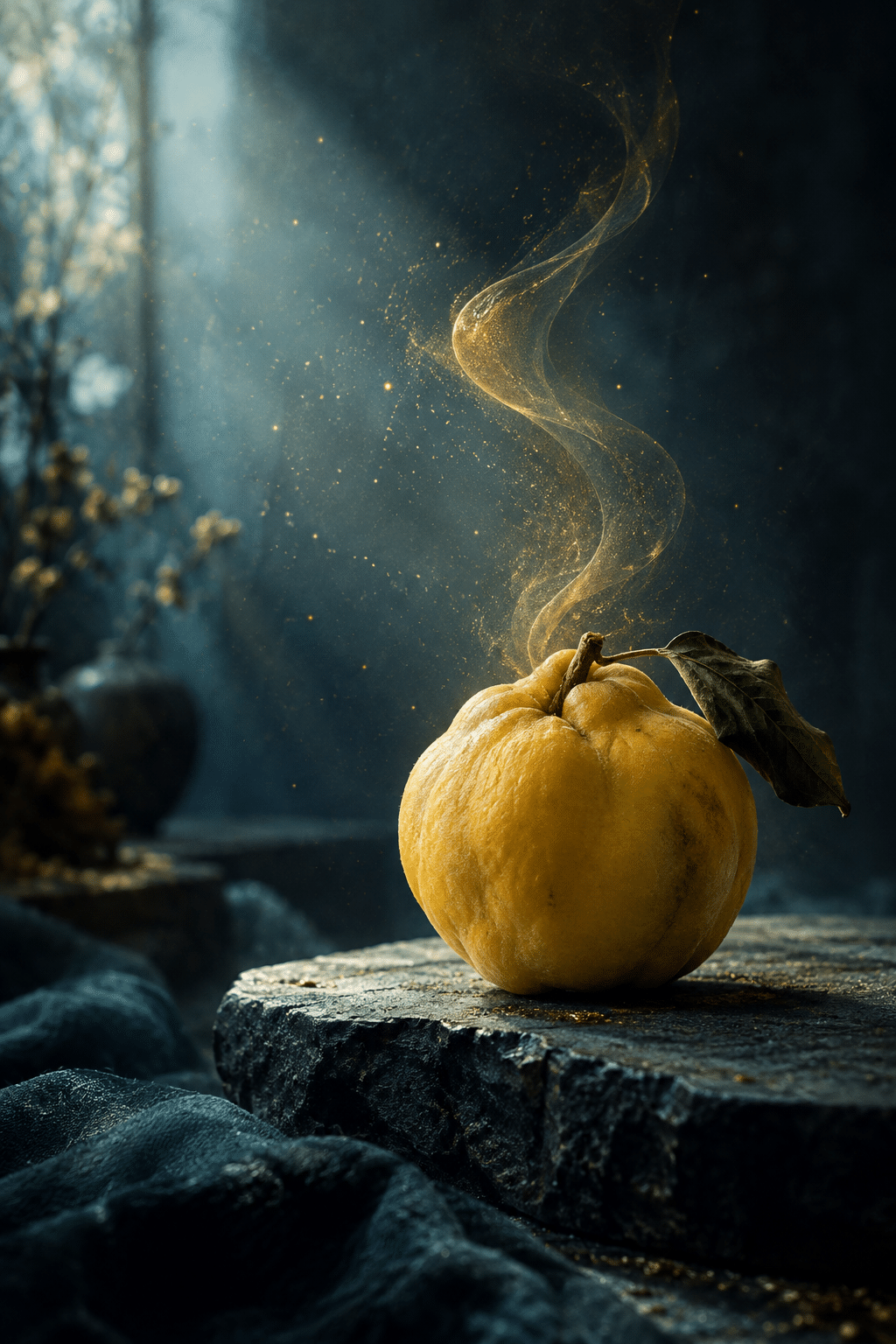
quince
There are fruits that immediately captivate you. Quince is not one of them. You see it yellow, heavy, almost solar. You bring it closer to you and its fragrance fills the air before you taste it. But if you try to bite into it as you would an apple or a pear, you encounter a hard, astringent, sometimes almost unfriendly pulp. It seems to say to you: not yet.
Quince demands something else from us. Time. Heat. Patience. And maybe that's why it's such a perfect fruit for fall.
Quince, Cydonia, is part of the Rosaceae family, along with the apple and pear. It is a relatively small tree or shrub, with white or pale pink flowers and aromatic, golden-yellow fruits, which ripen in autumn. It originated in the Caucasus and Central Asia, from where it spread over time to Europe and other regions.
Although it is less present on our tables today than apples or pears, quince is a fruit that has been cultivated for thousands of years. The USDA describes it as one of the ancient fruit crops that has become less commercially important in the modern era, without losing its gastronomic and genetic value.
It's also one of those fruits that transforms the room before it even reaches your plate.
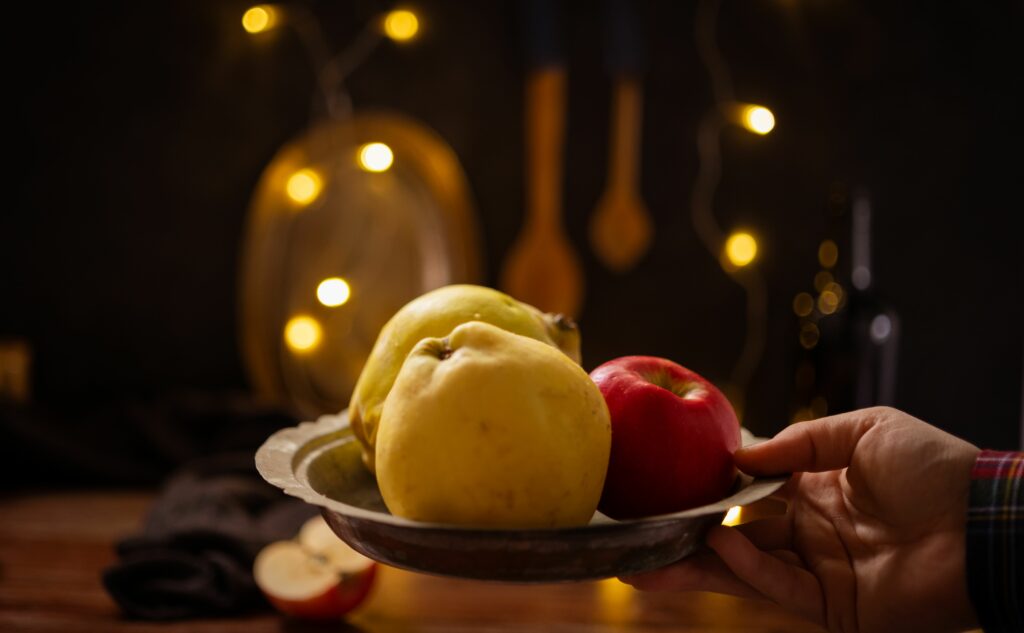
A journey through time
Generations have placed quinces in rooms or among laundry for their intense fragrance. In the past, the fruit was even used to scent spaces and breath.
Quince has traveled extensively with humans. From its region of origin in western and central Asia, it spread in antiquity to the Mediterranean lands and Europe.
In the Greek world it came to be associated with marriage. A tradition attributed to the legislation of Solon required that the bride and groom eat quince together after the wedding ceremony, a gesture interpreted as a symbol of the sweetness of conversation and of shared life. Perhaps the ancients saw in it what we sometimes risk forgetting: sweetness is not always the first form of things.
Sometimes it's what time brings to the surface.
There is even a hypothesis that some of the "golden apples" of Greek mythology may have actually been quinces—the fruit being cultivated in the region before certain apple varieties became widespread. However, this is a historical interpretation, not a definite identification.
The symbol of a ripening abundance
Quince doesn’t speak of abundance through excess. A single fruit is heavy. Dense. Fragrant. It doesn’t need to fill an entire basket to make its presence felt. Perhaps this is also one of the more subtle images of sufficiency. No more. But the fullness of what already exists. In ancient culture, the quince’s connection to weddings brought it closer to love, union, and fertility. But we can look at the symbol differently today. The fruit seems almost constructed to remind us that not everything that is ready to become food is ready to be consumed now. Some things need to be allowed to ripen. Some need fire. Some need time. And some just need us to stop rushing them. In a culture where almost everything is designed for the immediate—the answer, the shopping, the information, the pleasure—the quince retains a little resilience.
Its characteristics also explain how it was used in the kitchen.
Many varieties have a hard, sour pulp when raw. Cooking softens the texture, develops the flavor, and can turn a reddish-pink hue. Quince is also high in natural pectin, making it particularly suitable for jams, jellies, marmalades, and fruit pastes.
In different cuisines of the world we find it: in compotes and jams, baked in the oven, in dense fruit pastes such as quince jam, but also in savory dishes or with meat. Quince also has a less visible use: it is used in horticulture as a rootstock for certain varieties of quince, including to obtain smaller trees. A practical detail: during preparation, the seeds and the hard part of the core are removed; horticultural sources warn that the seeds contain toxic compounds and are not intended for consumption.
THE CONSCIOUS RECIPE
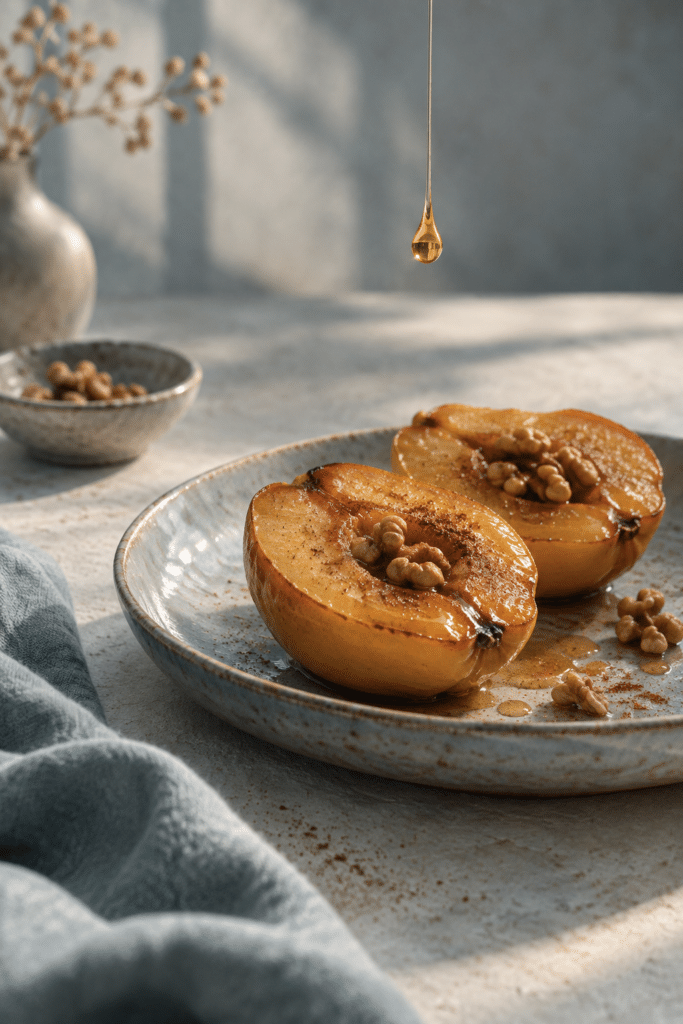
Baked quinces with honey, walnuts and cinnamon
- 2 large quinces
- 2–3 teaspoons of honey
- a small handful of coarsely chopped walnuts
- ½ teaspoon cinnamon
- a little finely grated lemon or orange peel
- about 100 ml water
- optional, a few drops of lemon juice
Ritual preparation
- Training:
- Wash the quinces thoroughly and remove the fluff from the peel.
- Cut them into halves or quarters and carefully remove the core and seeds.
- Place the pieces in a heatproof bowl, add the water and a little lemon juice, then cover the bowl.
- Let them cook slowly, at around 175–180°C, until the flesh is tender. Depending on the variety and the size of the pieces, this can take around 45–70 minutes.
- Towards the end, they discover the vessel.
- Add the honey, cinnamon, and nuts and let the quinces cook for a few more minutes to lightly brown.
- The citrus peel is added at the end, while the fruit is still hot.
conscious food – living life #22
When we no longer force the word to demonstrate who we are, it can begin to show us something about who we are.
mell
ARTICLE AUTHOR
MELL
Mell is the initiator of the magazine TotUna – Essentia Momentum, an author and artist, concerned with how lived experience can become a space of knowledge, creation and return to oneself.
His writings are born from a direct encounter with life — from fragility, transformation, silence, relationship, and those moments when what we thought we knew about ourselves begins to unravel, giving way to a more vivid perception.
Through word, image, sound and movement, his creation seeks to open spaces, not to provide definitive answers. It does not propose a path to follow, but invites to that type of encounter in which everyone can hear, once again, something that has always belonged to them.
editor-in-chief totuna.live


TotUna is not just a magazine. It is a co-creation space.
Submit your article!
If you feel the call to write, share, or contribute your voice, we are here.




