
Hilma Af Klint – Communion with the Feminine Source – INTUITIVE ART
There is a moment in the history of every consciousness when the outer form ceases to be sufficient. When the representation of reality becomes too narrow for what the soul sees beyond sight. When the brush refuses to copy and demands to create – not from imagination, but from revelation.
hilma af klint communion with the feminine source
This is the threshold Hilma af Klint crossed in the solitude of her Stockholm studio at the beginning of the 20th century. While the art world was still anchored in the faithful representation of visible forms, she painted what the physical eye can never see – the invisible geometry of consciousness, the colors of transcendent emotions, the spiritual architecture of soul transformation.
She wasn't the first to see it. She was the first to have the courage to translate it.
Intuitive art is not about talent in the classic sense – impeccable technique, studied composition, knowledge of color theory. It is about transparency – the ability to become such a pure channel that the invisible can flow through you without distortion.
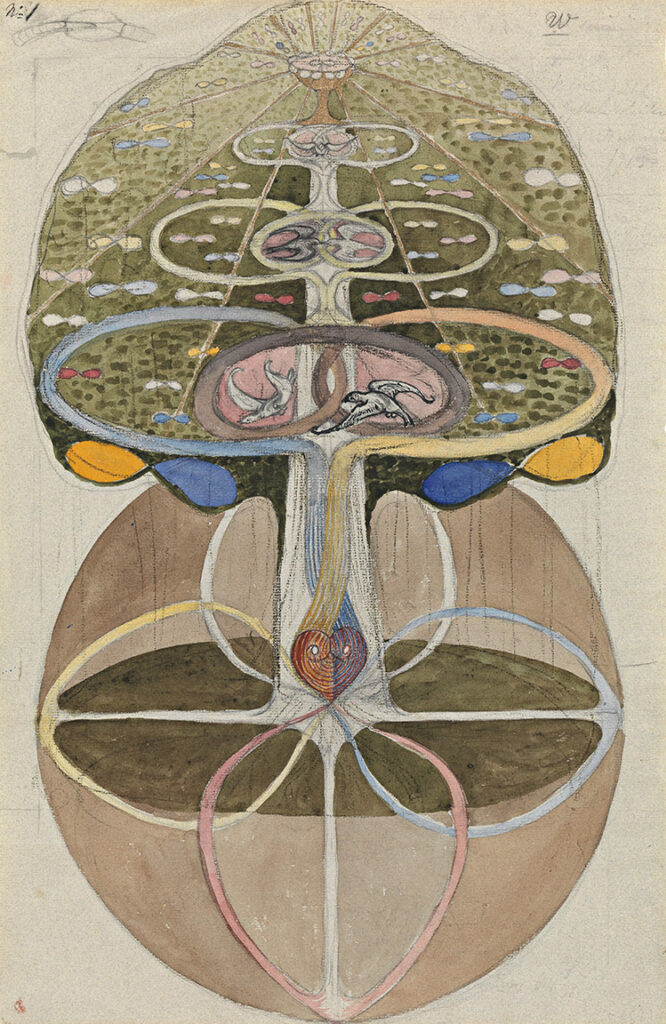
The Tree of Knowledge, No. 5 (1915)
In the center of the composition, a cosmic tree rises – but it is not a tree in the botanical sense. It is a living diagram of the connection between worlds. The solid central trunk, painted in golden-brown tones, rises firmly from invisible roots (below the lower edge of the canvas) to the crown.
But the tree is not singular. It is double, triple, multiplied – overlapping forms of the same tree, suggesting parallel dimensions, simultaneous realities. The branches do not grow chaotically – they follow a precise, symmetrical, almost mathematical geometry. The leaves are not leaves – they are geometric shapes: circles, crescents, ovals, arranged like fruits of knowledge.
The Tree of Knowledge in Eden. The Tree of Life in Kabbalah with the ten Sephirot. Yggdrasil in Norse mythology. Ashvattha in the Bhagavad Gita. All cultures have a cosmic tree – because they all access the same archetypal image of the connection between heaven and earth.
“You are the tree. Do not seek to climb to the sky forgetting the roots. Do not bury yourself in the roots forgetting the sky. Be the trunk – the channel that allows flow in both directions. Light descends into matter. Matter ascends into light. And in that constant flow, you will bear fruit – fruits of knowledge that are not information, but transformations.”
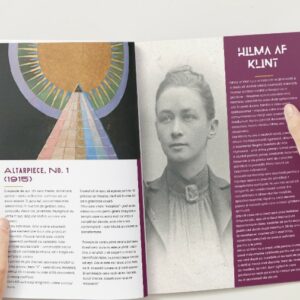
Altarpiece, No. 1 (1915)
An explosion of gold. A huge, dominant, central circle – shining gold, bright like an inner sun. Around it, smaller, concentric circles, in shades of yellow, ochre, orange. Everywhere, pyramids, triangles with the tip up, arranged radially, like rays of the sun.
But it is not chaos. It is absolute order. Each element has its precise place in the composition. Each shape is a perfect geometric relationship with the others. It is a Western mandala – a sacred construction meant to center the viewer, to pull them from the periphery to the center.
At the bottom, discreetly, almost invisible at first glance, the letter "U" – the invisible signature, the clue that this is not decorative art, but a coded message.
Your eyes are magnetically drawn to the golden center.
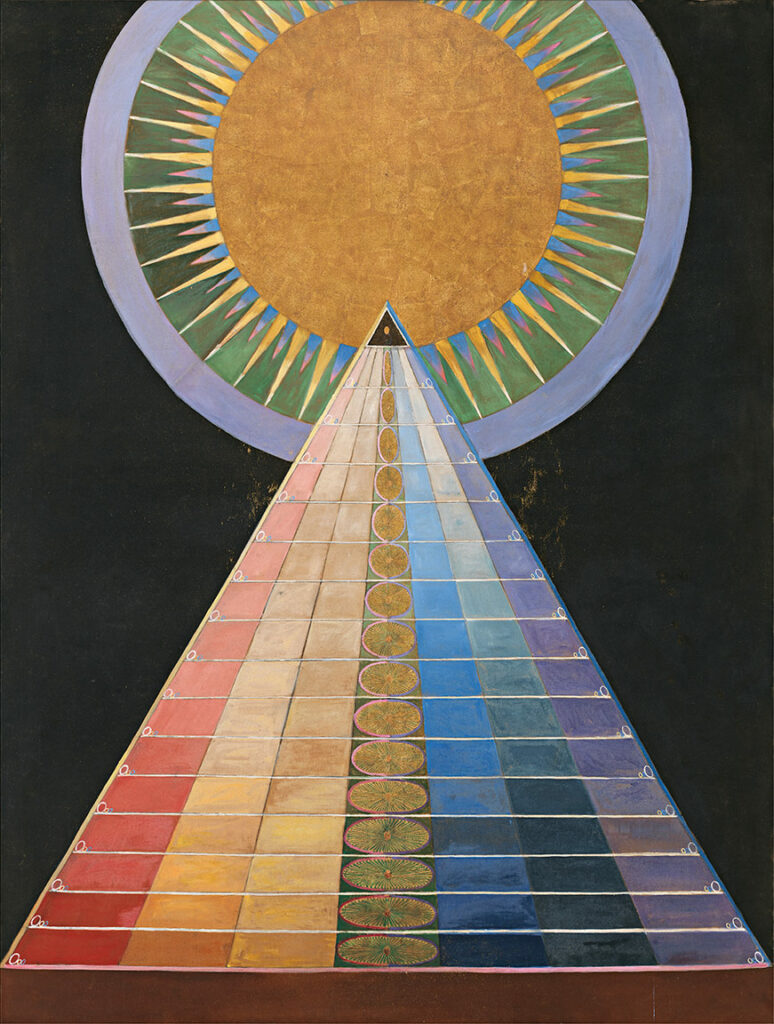
You try to resist, to explore the periphery – but your gaze inevitably returns to the center. It's like a visual gravity.
The title is key: “Altarpiece.” Hilma was not creating for galleries. She was creating for a temple that did not yet exist. A temple of elevated consciousness, where art is not contemplated—it is used as a tool for transformation.
“Look in the center until you become the center. This golden circle is not on the canvas – it is within you. You have forgotten it. You have covered it with layers of false identifications, with stories of who you think you are. But it is here. It always has been. It always will be. This work does not show you something new – it reminds you of something very old. Your essence. The gold within. The sun that never sets.”
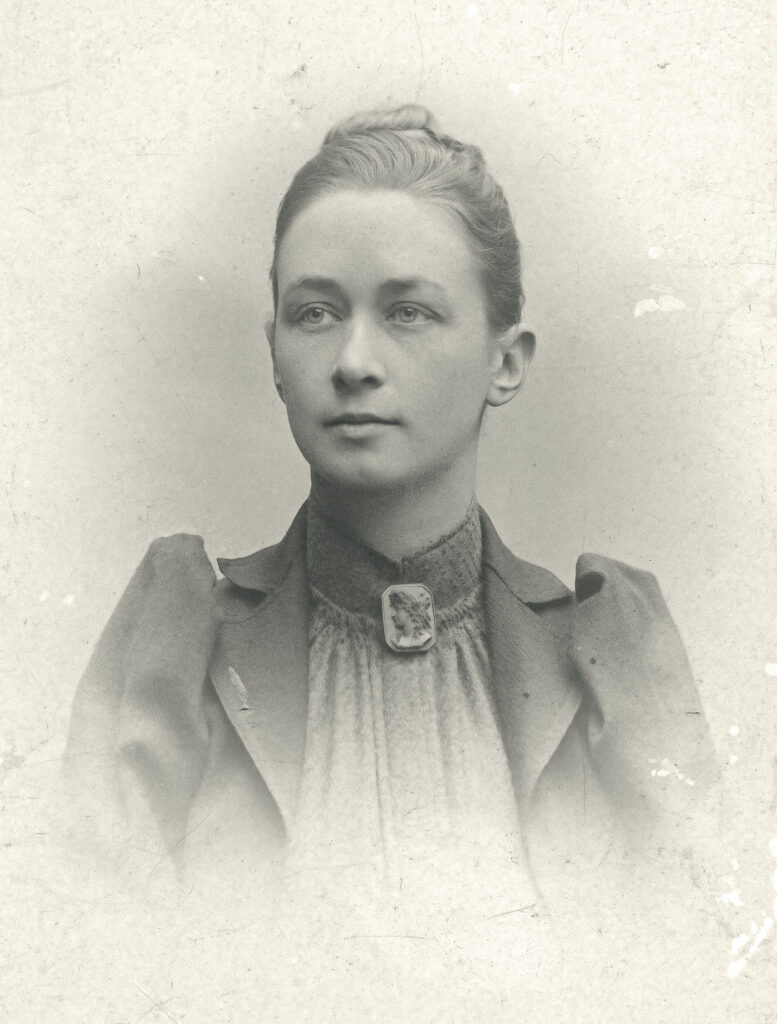
HILMA AF KLINT
Hilma af Klint didn't wake up one morning and decide to become a visionary abstract artist. Her journey into the invisible began with a loss—the death of her younger sister, Hermina, when Hilma was just eighteen. In that grief, the family discovered spiritualism—the movement that believed communication with the dead was possible through mediums. For her devastated parents, it was comfort. For young Hilma, it was eye-opening.
Man & Art
But Hilma was no naive mystic, lost in visions. She was a rigorous intellectual, a graduate of the Royal Swedish Academy of Fine Arts – one of the first women admitted. She studied portraiture, landscape, botanical anatomy. Her drawings of plants are of impeccable scientific precision. She painted nature with millimetric accuracy.
This combination is essential to understanding her work: scientific precision + spiritual receptivity. She was neither an arrogant skeptic nor a blind believer. She was a researcher of invisible dimensions, applying the same rigor with which she drew plants to the method by which she accessed spiritual guidance.
She knew that what she had created was far ahead of its time. So she left clear instructions in her will: the works were not to be exhibited to the public until at least 20 years after her death. She believed that by that time, the collective consciousness would have evolved enough to receive them.
Hilma af Klint did not create art for museums. She created spiritual tools for those who will come after her. Her works are not to be seen once and moved on. They are to be returned to, to be meditated upon, to be lived. They are mirrors in which the viewer sees himself on levels he does not usually access.
intuitive art #11
Life is an aberration if people do not serve the truth.
hilma af klint
ARTICLE AUTHOR
MELL
Mell is the founder and visionary behind the project The Meditation Academy and of the magazine TotUna – Momentum Essence. Mell discovered the brush at the same moment he lost his certainties. Or rather – at the moment when the certainties dissolved and all that was left was a hand that wanted to move color on the canvas, without knowing why, without asking if “it’s okay”, without waiting for permission. Years of branding, marketing, building identities for others – and then, silence. Emptiness. And in that emptiness, something began to paint. Not Mell the person. Something through Mell.
Now, The Meditation Academy and the magazine All.One they are extensions of the same creative gesture: creating spaces where people can remember that they don't have to become artists, healers, spiritual seekers – they just have to stop pretending they aren't already.
"I am not here to offer you finite truths, but to remind you that each of you carries within you the entire library of cosmic wisdom. I am merely a companion on the journey of remembering what you have always known deep within your being."
CO-FOUNDER OF THEMEDITATION.ACADEMY

TotUna is not just a magazine. It is a co-creation space.
Submit your article!
If you feel the call to write, share, or contribute your voice, we are here.