

Asparagus — The Arrow That Connects Earth and Heaven | Conscious Food TotUna 17
Each month, we choose a food not just for what it nourishes the body — but for what it speaks to the soul. This month's choice came naturally, almost like recognition: asparagus is, of all the seasonal plants, the only one that carries within its own biology the mystery we explore in this edition. A plant in which the masculine and feminine exist separately — and yet belong to the same field, the same root, the same earth.
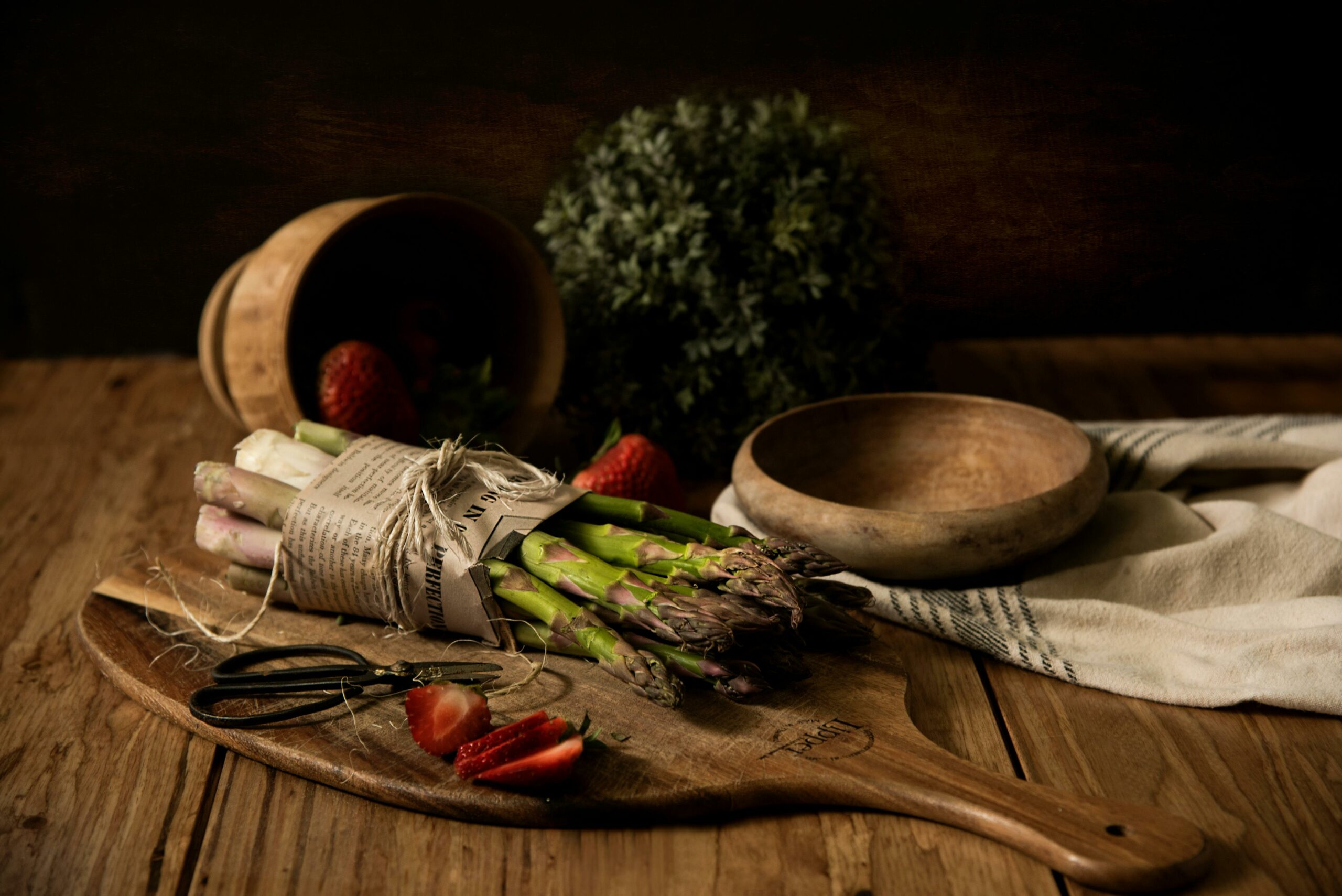
asparagus
There is something unusual about the biology of asparagus that few people know about.
Unlike most plants—which bear both male and female flowers on the same individual—asparagus is a dioecious plant. There are male and female plants, growing separately, from the same underground roots, in the same field. Male plants produce thinner, more numerous, more vigorous shoots. Female plants produce thicker, sparser, fleshier shoots—and when mature, bright red berries that carry the seeds of the next generation.
Same root. Two expressions. Masculine and feminine not as opposites — as different ways of being alive from the same place.
Botanists call this characteristic androdiecy in its complex forms—and consider it one of the most fascinating evolutionary adaptations of the plant kingdom. Ancient traditions saw it differently: as a sign. As a mirror of the human mystery.
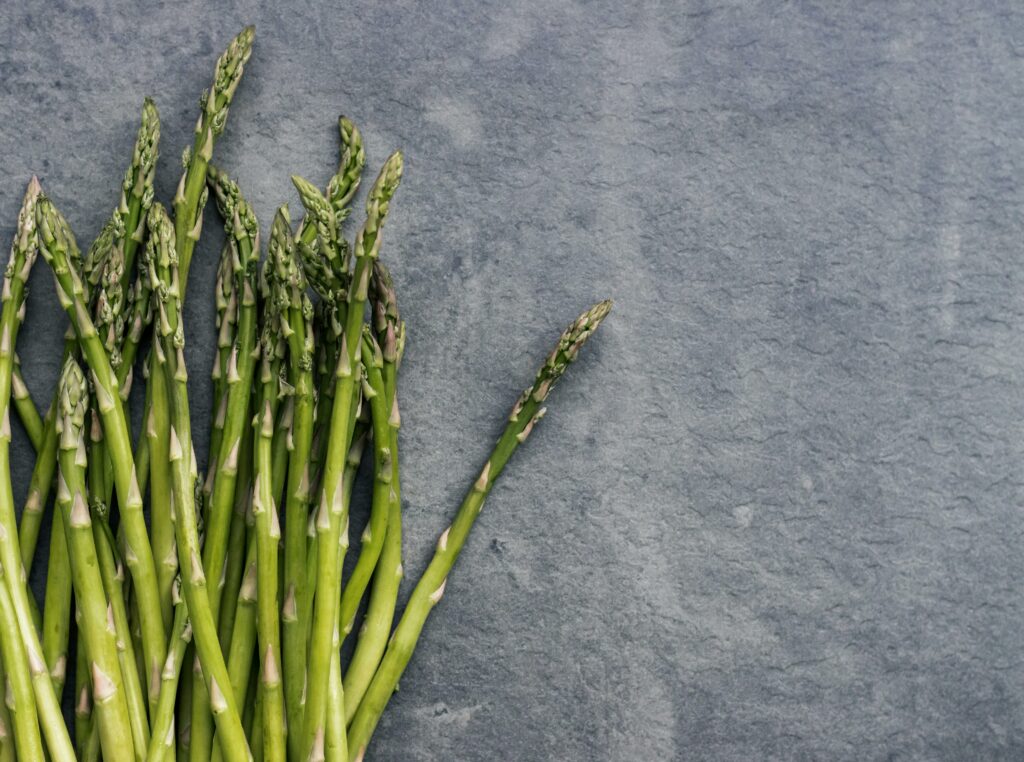
Through Time and Civilizations
Ancient Egypt — food of the gods
The first known depictions of asparagus date back to ancient Egypt—in offerings to the gods, in paintings on temple walls, in medical papyri that recommended it as a tonic for vitality and fertility. The Egyptians had cultivated it for over 5000 years and considered it a sacred plant—not for its rarity, but for the way it grew: straight, fast, with a strength that seemed to come from somewhere other than ordinary soil.
Its shape — that green arrow emerging from the darkness of the ground towards the light of the sky — was read as a symbol of the connection between the two worlds. The root in the ground, the tip towards the sky. Matter and spirit in the same thread.
Ancient Greece—Aphrodite's Gift
The Greeks knew asparagus under the name asparagos — a term that designated any young shoot, any bud freshly sprouted from the ground. They associated it with Aphrodite — the goddess of love, beauty, the feminine principle in its most refined form — and considered it a powerful aphrodisiac.
But the association with Aphrodite was not just about eros in the physical sense. In Greek tradition, Aphrodite represented the principle that attracts—the force that causes opposites to seek each other, the separated to desire reunification. Asparagus, as Aphrodite's plant, was the plant of sacred attraction—not of blind desire, but of recognition.
Ancient Rome — luxury and medicine
The Romans cultivated it with an almost obsessive passion. Emperor Augustus — according to historical accounts — had a favorite expression for things that had to be done quickly: velocius quam asparagi coquantur — faster than asparagus is boiled. An expression that has survived two millennia and tells us, among other things, that the Romans boiled it briefly — a sign that they knew how to value it.
Pliny the Elder, in his Naturalis Historia, dedicates an entire chapter to it — describing the varieties, the cultivation methods, the medical benefits. The Romans recommended it for the kidneys, for the joints, for vitality. And they exported it — dried, preserved, sent to all corners of the empire as a sign of refinement and power.
Ayurvedic Medicine — Shatavari, the root with a hundred husbands
In India, a close relative of European asparagus—Asparagus racemosus, called Shatavari—has occupied a central place in Ayurvedic medicine for over 3000 years.
The name itself is revealing: Shatavari means in Sanskrit the one who has a hundred husbands — a reference not to promiscuity, but to the plant’s ability to nourish and sustain — to be present, available, nourishing to many. It is considered one of the most important feminine tonics in Ayurvedic medicine — nourishing reproductive tissues, balancing hormones, supporting transitions — from puberty to motherhood to menopause.
But the same Shatavari is also used for men — as a tonic for the male reproductive system, as an adaptogen that balances excess heat and aggression, as a plant that brings gentleness where there is rigidity.
A plant with a hundred husbands — which nourishes both the feminine and the masculine. The androgyne of the ancient pharmacopoeia.
Medieval Europe and the Renaissance — the return to gardens
After disappearing from European gardens with the fall of Rome, asparagus made a comeback in the Renaissance — brought from the Near East by Arabs in Spain, replanted in the royal gardens of France, England, and the Netherlands. Louis XIV of France grew it in special greenhouses so he could eat it all year round — and demanded that the shoots be served with a butter sauce in which every fiber would melt.
It was a symbol of luxury, of spring, of the return to life after the long winter.
Science — Asparagus in the body
Asparagus is one of the most nutritionally dense foods in terms of calories. One hundred grams of fresh asparagus provides significant amounts of vitamin K, vitamin C, folate, vitamin A, vitamin E, iron, calcium, magnesium, and zinc — all essential for optimal body function.
Asparagine — the amino acid that was named after this plant because it was first isolated from asparagus juice in 1806 — plays a central role in protein synthesis and the functioning of the nervous system.
Glutathione — one of the most powerful antioxidants produced by the body — is present in asparagus in remarkable concentrations. Glutathione protects cells from oxidative stress, supports liver function, and has a documented role in cellular detoxification processes.
Inulin —a prebiotic fiber found in asparagus—feeds the beneficial bacteria in your microbiome, supporting gut health and, through it, immune health and emotional balance. Recent research on the gut-brain axis confirms what traditional medicine intuitively knew: a healthy gut is the foundation of a balanced mind.
Rutin and flavonoids — compounds with anti-inflammatory and cardiovascular protective effects — make asparagus a food documented in the prevention of chronic diseases.
And — returning to the aphrodisiac tradition of the Greeks — modern research has confirmed that asparagus contains compounds that support the production of steroid hormones, including testosterone and estrogen. Not as a medicine — as a food that supports the body's natural hormonal balance. Masculine and feminine, on a biochemical level, in the same green thread.
Before you eat—wait a minute!
Look at the asparagus shoots on your plate. Notice how each one has grown from the darkness of the earth into the light of day—straight, with a clear direction, without hesitation.
Hold a sprout in your palm a second before taking your first bite. Feel its weight—heavier than you'd think for something so thin. Feel its temperature—hot from the pan, alive.
And think—or feel, without words—that what you are eating now has always known how to grow. That in it, the masculine and the feminine have never contradicted each other. That the root from which it came did not choose—it simply offered what was needed.
Eat present. Every bite — an acknowledgement.
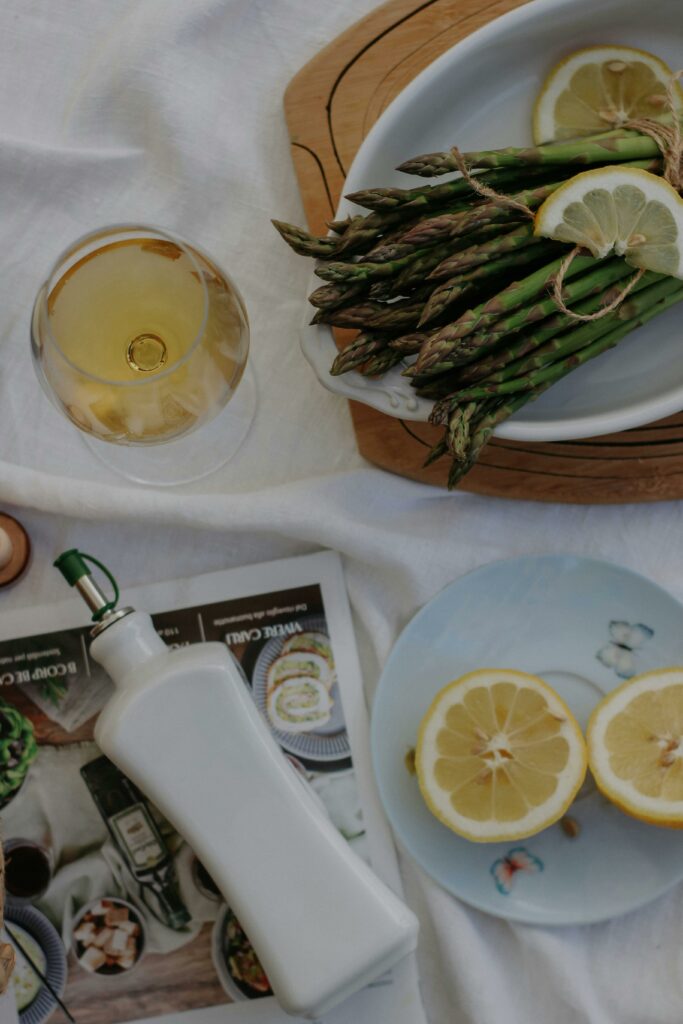
Asparagus with Brown Butter, Lemon and Almonds
- 500g fresh asparagus — choose shoots of medium thickness, neither too thin nor too thick
- 50g unsalted butter — good quality, at least 82% fat
- One lemon — grated zest and juice
- A handful of sliced almonds — lightly toasted
- Sea salt and freshly ground black pepper
- A few fresh mint leaves — optional, but nice
Ritualized preparation :
Snap off the woody end of each asparagus spear—don't cut it, break it. The asparagus knows where the line between brittle and fibrous is. This natural break is the first conscious gesture of the recipe.
Boil the sprouts in salted water — 3-4 minutes for thin ones, 5-6 for thicker ones. You want them to stay green, firm, and vibrant. Drain and immediately plunge into ice water — to stop the cooking and preserve the color.
In a heavy-bottomed pan, melt the butter over medium heat. Let it go beyond melting — until it turns golden, with a nutty aroma, with little brown dots on the bottom. This is beurre noisette — brown butter — and its transformation is a small miracle of chemistry and patience. Add the asparagus shoots, drained and lightly dried. Sauté for 2-3 minutes, until they take on a light golden color. Add the grated lemon zest, a splash of its juice, and the toasted almonds. Season with salt and pepper.
Serve immediately — on a simple plate, without complicated decorations.
A few mint leaves if you want a refreshing contrast.
A Recipe for Wholeness
conscious food – living life #17
The Conscious Architect also knows how to work with bitter materials.
mell
ARTICLE AUTHOR
MELL
Mell is the founder of the magazine TotUna – Essentia Momentum, an editorial space dedicated to the maturation of consciousness through direct experience and integrative reflection. Her writings do not start from theory, but from real journeys — from encountering life in its most fragile and revealing forms.
His interest in traditions such as Advaita Vedanta, Gnosticism, Kabbalah, and anthroposophy is not a comparative one, but an attempt to recognize the same divine thread that runs through different languages. For Mell, creative consciousness is not a concept—it is a living reality, present in all forms of existence, which he explores, writes about, and experiences.
CO-FOUNDER OF THEMEDITATION.ACADEMY


TotUna is not just a magazine. It is a co-creation space.
Submit your article!
If you feel the call to write, share, or contribute your voice, we are here.





Thank you with gratitude for the magazine's exceptional documentaries!