

Between fantasy and reality | Psychosomatic #22 | Ana Maria Mavru
An article about the fine line between fantasy, impulse, and automatism — and about that inner space where we can become aware of what drives us and regain our freedom of choice.

When the mind rules our lives – About obsession, fantasy and freedom of choice
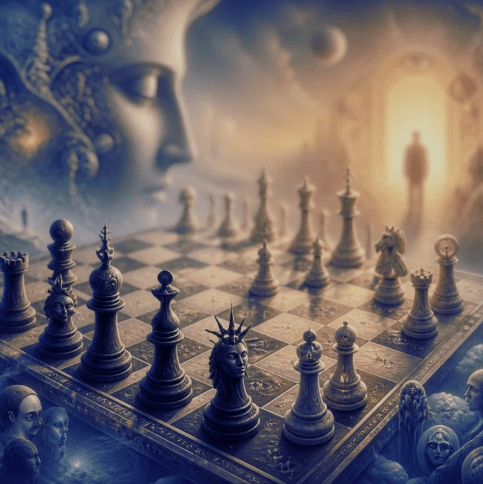
The mind is what often gives us trouble. It is what blocks emotion, what blocks intuition, maybe even purely creative imagination. Our mind is divided into two layers: the Lower Mind and the Higher Mind. That is, more precisely, the Lower Mind is occupied with negative thoughts, limiting beliefs, while the Higher Mind is occupied with higher-order thoughts, such as revelations, awareness and correct thinking about life situations. At a deeper level, the Mind is divided into three types: the sensory mind, the intermediate mind and the conscious mind. The sensory mind is the one through which we filter our experiences, feelings and emotions. The intermediate mind is the one that is related to life beliefs. The conscious mind is that union with God.
First of all, to access this conscious mind, we need three necessary ingredients: first there is imagination, then inspiration, and then intuition.
Let's not forget that in the lower mind reside gossip, obsessions, and fantasies. Based heavily on Hollywood movies, envy, jealousy, pride, and an absolutely absurd sense of meaning in life, these forms of manifestation are still part of our lives, but they are not an integral part of current reality.
At some point, we've all had an obsession, a fantasy. Whether it's related to the financial side, or to the relationship side – maybe someone has fallen for us, as the metaphor goes. Having an obsession with conquering someone or obtaining something material at any cost orients the individual towards a superficial sense, full of pride and conceit.
Our inner regions, our ego, will do everything possible to tempt us to lose sight of the true meaning of our mission and our soul.
But let's take a closer look at why we are sometimes blinded by these obsessions, fantasies, and compulsive behaviors on a personal level.
When what we think begins to lead us
These are not necessarily different things, but can be different ways in which the psyche tries to achieve something: pleasure, reassurance, regulation, closeness, control, stimulation, discharge or even avoid a certain feeling. Sometimes we eat more than we are hungry. Other times we turn on the TV and stay in front of a screen for hours, even though we know we need rest. We take refuge in our phone, social media, shopping, pornography, work or a certain person. We think obsessively about something or someone and, without realizing it, all our energy begins to gravitate around that thing.
At first it seems like we choose. Then, slowly, the choice begins to disappear.
And perhaps this is one of the most important moments when it is worth stopping and asking ourselves: Am I choosing this or has this started to choose me?
A fantasy, a thought, or a behavior is not, in itself, a problem. They are part of human nature. But it becomes important when we can no longer get out of them, when they become rigid, repetitive, and consume our energy, time, and inner freedom.
Because the problem isn't always what we do. Sometimes the problem is that we can no longer not do it.
The loop we enter without realizing it
We can look at obsession or compulsive behavior as a psychic loop:
tension → thought or fantasy → anticipation → behavior → pleasure/release → temporary relief → recurrence of tension.
E.g: I feel lonely. → the need to take refuge in something arises → I look for the phone → for a few minutes I feel better → the tension decreases → then it comes back.
I am anxious. → I want to eat → I eat more than I need → for the moment I calm down → then guilt appears → anxiety increases again.
I'm exhausted → I watch one series after another → for a few hours I don't have to feel anything → I fall asleep late → the next day I'm even more tired.
From the outside, the behaviors appear completely different. From the inside, however, they can serve the same function. And this is where the real psychological exploration begins. It is no longer enough to ask ourselves: "Why do I do this?"We can ask: "What is this behavior trying to do for me?"
Richard Erskine: what need is he trying to fulfill?
I will, as usual, bring to the fore two views of my favorite authors. Richard Erskine is very interesting from this point of view. In integrative psychotherapy, he looks at repetitive behaviors not just as things that need to be eliminated, but as behaviors that have acquired, at some point, a certain psychological function . A repetitive behavior can give us predictability, stability, continuity, or even a certain sense of who we are. And then a much gentler and deeper question arises than "Why can't you stop?" : "What does this give you?"
Maybe it gives me peace. Maybe it gives me an escape. Maybe it helps me not feel lonely. Maybe it gives me a sense of control. Maybe it allows me to avoid pain. Maybe, for a few moments, it makes me feel alive. Maybe somewhere inside, there is a need that has not yet found a healthier way to express itself.
Peter Levine: before the story there is the body
And we come to Peter Levine, where the perspective becomes very close to the psychosomatic area. Levine places an important emphasis on what happens in the body and how the nervous system responds to stress and overwhelming experiences. Sometimes, what we call an "impulse" can be preceded by a bodily state that we don't even notice. It can be an uneasiness in the abdomen. A pressure in the chest. A lump in the throat. An agitation. A void. A tension. A need to do something immediately to make that state disappear. And then the mind comes up with the solution it knows: “Eat.” “Open your phone.” “Look for it.” “Watch something.” “Buy something.” “Do something to stop feeling.”
The impulse can sometimes start in the body before it becomes a mental story. And if we are not connected to our body, we only observe the end of the process: the behavior. We say: "I don't know why I did it. I just found myself doing it."
But maybe that "simply" hides many things that happened before and that we didn't notice.
The conscious mind – where choice occurs
And here we go back to the beginning. Maybe our true power is not in not having thoughts, fantasies, desires, or impulses. I don't think we can live like that. Maybe true power is in becoming aware enough to notice them without being immediately led by them. To be able to notice that I am jealous without becoming my jealousy. To notice that I want to eat without automatically turning the desire into action. To notice that I want to escape into a TV show without condemning myself. To notice that I am thinking obsessively about a person without confusing the intensity of the thought with love. To notice that a part of me wants something and to be able to ask, "What do you really need?"
This is, perhaps, the difference between a mind that leads us and a mind that serves us.
Conclusion: not everything you think has to become reality
Perhaps one of our greatest maturations is learning to stop believing everything our mind tells us. The mind can produce extraordinary scenarios. It can create stories, it can relive the past, it can build entire worlds. It can transform a desire into a necessity and a thought into an obsession.
Not every desire should be followed.
Not every thought is to be believed. Not every fantasy is to be lived. Because sometimes what we call an obsession is just a part of us that has been screaming for so long that we've forgotten to listen. And when we start to really listen to it, we don't need to fight with ourselves anymore.
We are slowly starting to come back to ourselves.
Psychosomatics #22
Am I choosing this or has this started to choose me?
Ana Maria Mavru
ARTICLE AUTHOR
Ana Maria Mavru
Ana Maria Mavru is a psychotherapist and the editor of the Psychosomatics column in TotUna Magazine. In her texts, she explores the deep connection between body, emotion and inner life, looking at the human being beyond the symptom. The body thus becomes a space of listening, in which our emotional stories, regulatory mechanisms and the need for reconnection can be recognized and understood.
psychotherapist

TotUna is not just a magazine. It is a co-creation space.
Submit your article!
If you feel the call to write, share, or contribute your voice, we are here.