

Ioana Alexandra Șomîtcă – Interview
There are people who not only teach, but inspire. People for whom education is not just a transmission of information, but an art of shaping character, awakening consciousness and guiding towards a brighter future. Among these leaders of the new generation, Ioana Alexandra Șomîtcă stands out for a clear vision on education and a deep devotion to the formation of young people. Mathematics teacher, author of the book You Have a Life. Make It Extraordinary!, Ioana is an example of verticality, clarity and inner strength, values that we want to see in the leaders of tomorrow.
Through every lesson, every project, and every shared thought, she brings not only knowledge but also inspiration. Her students don't just learn math, but discover within the lessons a space where human values are as important as logical reasoning. She understood that true education begins beyond the curriculum, in the area where the teacher becomes a mentor, support, and guide.
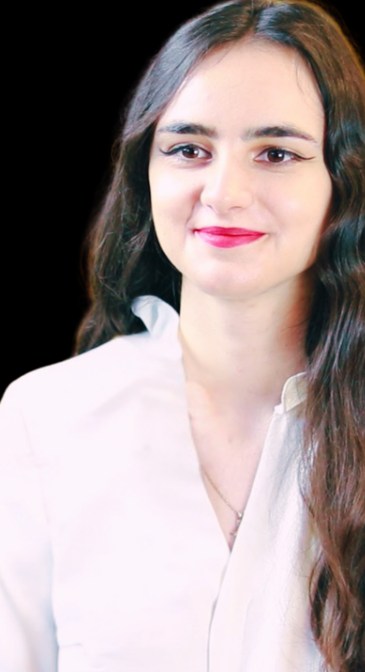
on the path of human values
Every journey has a beginning. How did this journey in education begin for you and what inspired you to write about core values?
I taught for the first time during the pandemic. So my first contact with students was through a laptop. I quickly discovered that in order to get students to learn in my classes, I needed to bring something different and good to the classes at the same time. Something from which they could learn both mathematics and healthy behaviors in society. I was inspired by their openness to my well-being, and then I discovered that they actually needed an authentic teacher who could teach them quality information, including through her behavior in the classroom. Students want to feel included in projects, they want to feel responsible and important. Only by highlighting their human values and their skills/abilities in classes have I managed to create lessons that I have kept in my memory even now. Shortly after, we created a questionnaire called The Model Teacher of the Current Generation , and in the first question, “What qualities would you like in your teacher?” the students mentioned many human values. Later, we invited them to tell us about moments when they felt supported, encouraged, and appreciated by their teachers. That's when I noticed how much a teacher who truly sees the Good in them and helps them develop it matters in their eyes.
The path of mathematics is often considered rigorous and logical. How has your training as a mathematician influenced your vision of education and human values?
I have met both types of teachers, both strict teachers and creative teachers. I have gathered the best values from both typologies. I feel that these experiences have balanced me as a person. Because I am strict when necessary, I joke when I feel that this is the best option to create a learning atmosphere in the classroom.
What does "the path of a Man" mean to you, and how can core values support and shape it?
I truly believe that people develop beautifully when they have good role models around them to inspire them. At a very high level (conferences, educational events, famous teachers, important people in society who change various aspects of life for the better) I have seen that human values matter in the eyes of quality people, much more than any material things. In short, a person's personality and thinking matter more than appearances which can be easily deceived compared to personal mental values.
For me, the journey of a man means discovering the path through which he becomes a better version of himself. The desire to develop myself daily brings beauty to my life. It is something that personally keeps my mind in a state that I really enjoy every day.
I believe that only by having human values can you be with special people who inspire you so that each one can learn something useful from the other. We are sociable beings, we evolve together.
Young people often feel lost on their own path. How can parents and teachers guide them to find their authentic direction?
I truly believe that we can help young people quickly find their own path if we make the effort to see what they are good at, if we see traces of qualities in them and then support them to develop them further. It is essential to have the openness to see the good and uniqueness in each child and to avoid attaching labels like "I know better what their patron saint is". The goal is to discover, to see what you have not seen good before and to support the development of that behavior for the better. It is not enough to "know what their patron saint is" if that information does not bring you solutions. Young people aspire to the highest heights, if we look in the same healthy direction as them then we have the chance to inspire them. Personally, my heart melted the first time I heard the expression "for a child, mom and dad are the princess and prince in his story". And bonus, later through a questionnaire I found out how much a teacher matters to young people. That's how I came to the conclusion that it is our duty, as adults, to be responsible, so that these children grow up in an environment of mental safety that is beneficial for their development and learning.
In your book you talk about “waypoints.” What are these points and how can we use them to more easily navigate the path of life?
I wrote in my book about Points-Human Values and State Points. Looking at students as a teacher, you can clearly see young people who have a healthy predetermined path and you can clearly see young people who need support to find a healthy path for themselves. In class, you can beautifully organize their values because you look at them and see clearly what each one needs. Someone needs a better state one day. You take them to the board and tell them that you are rewarding them with Points-Goodwill. Someone else is more shy, you can reward them with Points-Courage, someone else with Points-Perseverance or Ambition, or any quality or state that you notice as a scale of support for the student at that time. Young people notice this quickly. Their self-esteem increases and in their eyes, respect for the teacher increases. We truly do not know what is hidden in the life story of each of us, sensitivity has different degrees in everyone's soul. That's why I try every day to make people aware of what's good about them and around them, supporting them through mathematics to develop their critical thinking: to see clearly that there is a balance around them and that we learn something from less happy events as well as from events with a happy ending. It is their responsibility to analyze things deeply so that they see in each event a life lesson that will be useful to them in the future. Only in this way can they improve the quality of their destiny.
Our paths are sometimes marked by obstacles like bullying or lack of self-confidence. How can students overcome these barriers?
Kindness. Kindness is the key. Intelligent kindness. It teams up with Patience and thus they provide a favorable learning environment for young people. There are recordings on the internet of how bullying dissolves when the victim leaves the victim state and also offers appreciation for what is good about the aggressor in order to make him aware that good aspects can also be found within him. Kindness often disarms. There are studies on the internet in this regard.
I believe that aggressors overlook how the victim feels and only superficially observe their behavior. And the fear in the eyes of the other gives them an artificial sense of power. I was recently talking to a teacher and she told me about the following educational game that she tested in class. The game went like this: Each student received a label that was stuck on their forehead. The students behaved with each other based on the label they saw stuck on their colleague's forehead. If the label had the word "creative" on it, then that student was chosen by their peers to play a more important role in the project. If the label said "smart," then that young person was asked for their opinion more often. If the label said "stupid," then the child was often neglected by the others.
The labels were chosen so that each student would learn a lesson about how they made their classmates feel. The bullies understood at the end of the game that they could have behaved better in the past towards their classmates.
What is the "values map" you propose in your book and how can it be applied to guide young people, but also the adults who support them?
In my book I talked about 10 Human Values. They are presented in the following order: Finding solutions in life, Curiosity, Courage, Optimism, Justice, Attention to others, Analysis, Intuition, Goal-setting, Perseverance. My goal is for each person who reads the book to discover the qualities they have, because they can bring advantages to the classroom, in this way, in the long run, those qualities develop harmoniously. It often happens that in life, either through an event or through a book, we discover new things (or ideas) about ourselves. In short, the map of values that I propose is like a game in which, during the journey of the protagonist, he discovers new treasures that help him successfully fulfill his mission.
On the path of education and life, what do you consider to be a person's greatest achievement?
To realize that education is not limited to the institution called School.
Education is everywhere from the moment you open your eyes in the morning. Education represents everything that a person does or follows every day: the way they value their time, the habits they have, the information they assimilate (which they seek out to read), the people they spend time with, etc. School is just the first step to learning more about themselves and the external environment, and to understanding more, to learning useful information from teachers and peers. School is what makes connections because during it, people and neurons connect.
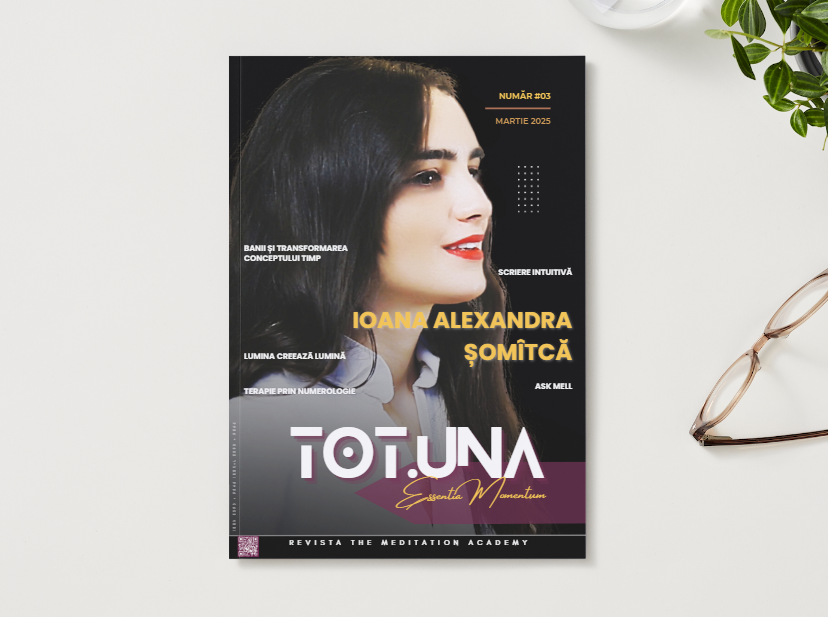
interview of edition #03
For a child, mom and dad are the princess and prince in his story.
Ioana Alexandra Somîtcă
ARTICLE AUTHOR
MELL
Mell is the co-founder of The Meditation Academy , an expert meditator and spiritual guide with over 10 years of intensive practice in meditation and awareness. Her studies include Theosophy, Kaballah, Vedanta and Christianity, approaching all these disciplines with an authentic openness to exploring the self and the inner universe. Through the numerous awareness programs and courses developed, she has helped hundreds of people discover their essence and live their lives in harmony with their own soul.
CO-FOUNDER OF THEMEDITATION.ACADEMY


TotUna is not just a magazine. It is a co-creation space.
Submit your article!
If you feel the call to write, share, or contribute your voice, we are here.




