

The Labyrinth at the Tip of a Pencil | EssentiaMomentum TotUna #18
Labyrinth
I often find myself marveling at the ability of a 5-year-old child who seems completely absorbed in the colors of building blocks, or the pages of a book, or a maze that he intuitively solves with a single glance, only to then easily get lost when he has to draw the path with the tip of a pencil. As if between the moment of the first glance and the moment of the carbon tip on the paper, the personalities, or at least the perspective, have changed. From embracing everything without borders, to becoming important in reducing everything to the tip of a pencil.
This, I think, is the first indication of where overmentalization is taking us. The place where the "shoulds," "needs," "would be better ifs" begin to slowly and politely cover up the connection to the source center of life—the one that puts us here, in this now, in this context, whatever that may be.
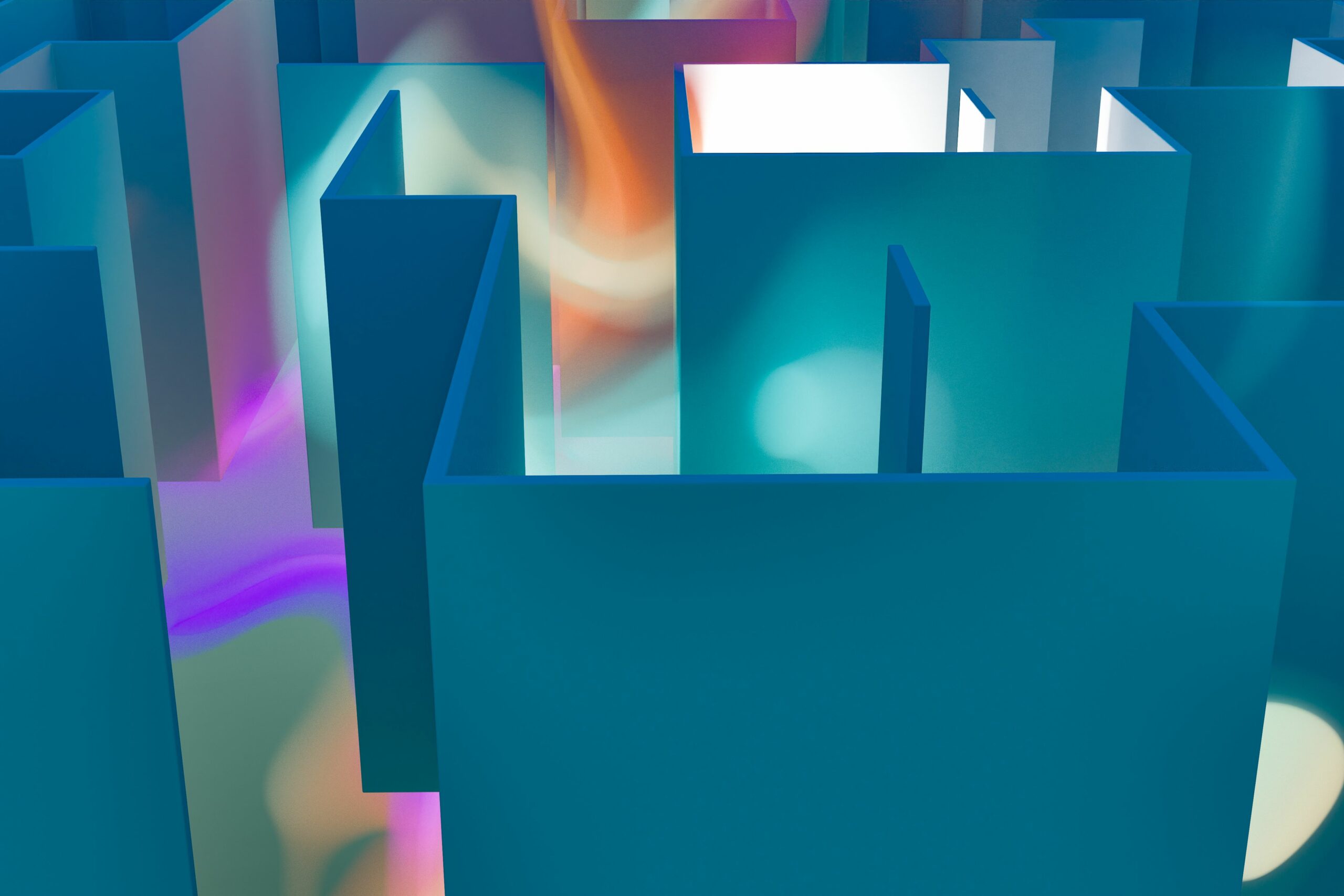
The child saw the entire maze in one glance. Not because he was a genius. Because his gaze had not yet been trained to sharpen. Then we put the pencil in his hand. And we asked for the route. And with the pencil we asked, without realizing it, that he become someone else - someone who reduces, someone who chooses, someone who answers, someone responsible for a single thread in a field. And he, obediently, became that. Because he loved us enough to receive the form we asked for.
The tip of the pencil — the one with which we began to trace the path in the labyrinth — has become, over the years, the tip of our entire life. A life lived with the tip. With that sharp point that chooses, separates, decides, remembers, plans, recaps. A life in which the breadth of vision has been sacrificed for the precision of touch.
And it was necessary. It must be said. This is not an article against the pencil. The pencil has built cathedrals, translated poems, operated on hearts, taught children to read. The tip of the pencil is not the mistake. The mistake is that we forgot that there was a look before it. And that this look did not go away — it was just covered by too much touching.
less conflict...
We are living, at this point in 2026, what commentators call a mental fracture. In Romania, seventy-six percent of people believe the country is heading in the wrong direction. More than half expect this year to be harder than last. Public discourse has become radicalized, social trust has eroded, the productive middle class feels trapped in a fiscal sandwich it didn’t order. And — the quietest point of all the data, but also the most telling — one in five Romanians says that what they want most from this year is less conflict and more coherence.
Less conflict and more coherence. This is not a political demand. It is an ontological hunger. It is a hunger to see the whole labyrinth again.
Because this fracture is not, in its depth, an economic or political one. It is the fracture of the mentality that has tried, for decades, to solve the labyrinth with the tip of a pencil — instead of first re-establishing itself in the gaze that sees it. And precisely because the tip of a pencil can no longer, right now, withstand the complexity of real life, the fracture becomes visible. All systems built on the assumption that we can reduce everything to a sharp decision — the economy, politics, institutions, even personal relationships — have reached the limit of their own contraction. And they are cracking exactly where they need to be cracked.
It's not bad news. It is, if we look patiently enough, the good news of the moment. Because through the crack, another light enters.
This other light is not new. It is the same light that the five-year-old held within him when he looked at the maze. He holds it even now, underneath, beneath all the layers of "shoulds" that life has laid down on him to make him useful, productive, foresightful, responsible. And the most delicate layer that has been laid down, I think, is the one that taught him to believe that his gaze back then was naive. That he had to grow up. That maturity means losing the ability to take in at a glance — to gain the ability to draw the path, step by step, with that worried tip.
It was the biggest lie of our culture—and it was told with the best of intentions. There is no such thing as childlike naivety. There is only perception before contraction. And true maturity—the only maturity worth calling maturity—is not the abandonment of that broad gaze for the tip of the pencil. It is the integration of the two. It is the pencil that remembers that before drawing, the gaze encompasses.
Ancestral tradition
All well-founded initiatory traditions knew this.
In alchemy, the great work does not end with the mature man who has mastered the world, but with the appearance of the divine child— filius philosophorum —who appears in the last stage of the work, after all the transformations have been completed. The child is not the starting point of the spiritual journey. It is the arrival point. With the amazing remark: it is the same child. The five-year-old. Only now he is recognized.
In Kabbalah , the spark that descends through all the sefirot—through the intelligible world, through feeling, through form, through action—keeps its original light intact. Yesod, the sefirot just before manifestation in the world, holds this spark within itself like a living fire. Nothing in the descent into matter extinguishes it. It cannot be extinguished. It is simply forgotten.
In the Heart Sutra , the most radical part of Mahayana Buddhism, it says that what is deep within you is neither born nor dies, is neither tainted nor pure, neither increases nor decreases. Much more concrete than it seems. It means that that gaze that encompassed the labyrinth in a single glance cannot be lost. Not because it is stubborn. Because it has never been separated from the one who looks.
And Jung , who watched the dreams of thousands of adults with great care, noticed something that should give us pause: the most common image of the self in the dreams of mature people approaching their own integrity is not the bearded sage. It is the child. The divine child. Because the self has not aged with us. It has waited to be recognized.
Here is a question that, if we let it sit, can change the way we carry the collective fracture of this moment. The question is this: Who do we think we bring to the table of our decisions, when we make decisions? That tense adult, in whose mind all the "shoulds" collide? Or that child who took in the maze at a glance?
It's not a rhetorical question. It doesn't demand that the answer be "the child" and that's it. It demands an honest look at who is fighting inside us for each decision. Because if the one who decides is the pencil, we will continue to produce solutions that fragment. And if the one who decides is the gaze, we will begin to produce solutions that hold the whole.
Mental fracture
This is why inner work is not a luxury for those who have time. It is, in this century, the condition of civilized survival. The world built with the tip of the pencil has reached its limit. Not because the pencil is bad — but because it alone cannot do it. It needs the gaze.
I am not asking the reader, through this article, to do anything. Not because there is nothing to do, but because what can be done cannot be asked in the form of an instruction. That would be another pencil on top of an already tired pencil.
I'm just going to make the observation that maybe that feeling that nothing works anymore, that everything creaks, that public speaking exhausts you, that daily decisions drain you, is not the symptom of a failed life. It's the sound of a contraction that can no longer be sustained.
And beneath this contraction, intact, untouched, unexhausted, forgotten in any real sense, is the same gaze that saw the labyrinth in a single glance. It doesn't demand it. It doesn't teach it. It just reminds you, when everything gets too sharp, that you once saw without limits.
That light that lasted a whole day didn't go out. It was just covered with days.
And the fracture of the mentality of this moment — both collective and personal — is not the bad news. It is the noise of layers that can no longer support themselves. Beneath, the child waits. Not to be healed. To be recognized.
essence momentum #18
A question that, if we let it sit, can change the way we carry the collective fracture of this moment:
mell
Who do we think we bring to the table when we make decisions?
ARTICLE AUTHOR
MELL
Mell is the founder of the magazine TotUna – Essentia Momentum, an editorial space dedicated to the maturation of consciousness through direct experience and integrative reflection. Her writings do not start from theory, but from real journeys — from encountering life in its most fragile and revealing forms.
His interest in traditions such as Advaita Vedanta, Gnosticism, Kabbalah, and anthroposophy is not a comparative one, but an attempt to recognize the same divine thread that runs through different languages. For Mell, creative consciousness is not a concept—it is a living reality, present in all forms of existence, which he explores, writes about, and experiences. He does not direct; he recognizes. And by recognizing, he holds open the door that each reader must pass through for themselves.
CO-FOUNDER OF THEMEDITATION.ACADEMY


TotUna is not just a magazine. It is a co-creation space.
Submit your article!
If you feel the call to write, share, or contribute your voice, we are here.




