

The Things I Never Said | The Voice of the Self TotUna 18 | Alexandra Șchianu
From the office of psychologist Alexandra Șchianu comes, for this edition, one of the most delicate distinctions that someone who works with human wounds can make: that between wound and value, between what scares us and what matters to us. At first glance, they seem to be the same thing — and it is precisely here, in that apparent overlap, that some of the greatest confusions of contemporary therapeutic culture arise.
The article below shows, with the clarity that only practice brings, why healing does not mean diminishing our values, but being able to carry them without fear defending them for us. A reading that naturally fits into the theme of the edition — the sovereign child is not reduced to his wound. It is also what he has chosen to value from it.

The things I never said
There are things you have never said to the person next to you.
Not because you wanted to hide something, not because you didn't have the opportunity, not because you didn't have the words, but because at the moment you were about to say them, something inside you quickly calculated that it was safer to remain silent. That if you told them, you might change something. That if you told them, the other person might get upset, or move away, or see you differently, and none of those options seemed like a risk you were willing to take.
And then you were silent. And the day passed. And the moment passed with it. And that unspoken thing remained somewhere inside you, small and compact, alongside all the other unspoken things, gathered together in a place that you don't show anyone and that, sometimes, you barely show to yourself.
The silence that looks like care
I know what this silence looks like from within, not as the absence of words, but as the presence of something that has no place to exist, as a thought you hold on your shoulders instead of putting it down, as the energy spent on not saying instead of being used in being present, in loving, in building something real with the person in front of you.
Maybe you've never told him that you're lonely sometimes right next to him, that there are times when you're in the same room and you feel invisible not because he's doing something wrong, but because something in your connection has thinned so imperceptibly that you don't even know exactly when it happened and you don't know how to bring it back without seeming like you're accusing something or someone.
Maybe you didn't tell him that you're tired, not from specific situations, not from a hard day, but from a way of being together that always demands more than you receive, and that this fatigue is old and accumulated and that you no longer know if it's about you or about both of you or about the way you've gotten used to being together over the years.
Maybe you didn't tell her that you miss her even when she's next to you, that there's a version of you from the beginning or from a specific moment that you miss and that you don't know how to bring her back and that you're not even sure it's possible, and that it's precisely this uncertainty that stops you from saying anything.
Or maybe you didn't tell him simpler and harder things at the same time, that you need to be asked how you are and receive an answer that shows that the question was real, that you need to be visibly chosen and not just assumed, that you need him to sometimes come to you without you having first created the context in which he can do so.

Why are you silent and why is it so hard? don't do it
The reason you didn't say any of these things is almost always a form of love.
You kept quiet to protect. To avoid worrying, to avoid creating a conflict that could destabilize something that works, not perfectly, not completely, but enough that you don't want to risk it.
You kept quiet because you love the relationship and you're afraid of what might happen to it if you bring everything you really feel into it, because you're not sure it's solid enough to bear these things, and because this uncertainty is easier to bear in silence than put to the test through a real conversation.
And there's nothing wrong with the intention. But there's something deeply painful in the effect, because repeated silence doesn't protect the relationship, it slowly contracts it, makes it smaller than it could be, builds a distance between you that neither of you explicitly chose and that, after a while, you don't even know how you got there.
How to build distance. From nothing, little by little
The distance between two people who love each other is not built from big conflicts and harsh words. It is built from all the small moments in which each one chose not to say, not to ask, not to show, from all the evenings in which you felt something and decided it was not the right time, from all the mornings in which you wanted to say something and you let it pass, from all the energy invested in managing the distance instead of addressing it.
And one day you wake up and the distance is there, real and concrete, and you don't know exactly what it's made of because it's not made of one big thing, it's made of a thousand small, unspoken things, accumulated over time with a lot of care and a lot of goodwill and a lot of fear.
The hardest thing is not to say it, it's to believe it's worth it
The hardest thing is not saying what you feel. The hardest thing is believing that it's worth it, that the relationship can carry your truth, that the other person can accept you in that vulnerable place and not leave, that real intimacy is possible and not just a promise that you've seen in others but hasn't fully translated into your life.
This fear is real and it is wise in its own way, because you have evidence, perhaps, that not always when you said something it was well received, that not always when you opened a door there was someone on the other side, that vulnerability is not always met with kindness. And then silence seems safer. And it is safer, in the short term. But in the long term, silence is the only place you can live, because it means being surrounded by people who love you in a version of you that you have chosen for them, not the complete version, the one with all the doubts and the needs and the tiredness and the longing and the things you never said.
What happens if you say
I don't know if there's a perfect time to say the unsaid things. I don't know if the conversation you've been putting off for months or years will turn out the way you imagine or fear. I don't know if the other person will be able to receive you exactly as you need them to or if your relationship can carry everything you've gathered in silence.
But I know that the alternative, to continue carrying everything you didn't say alone, to live in a relationship with a part of yourself always outside of it, to love someone from the distance you've built for yourself to be safe, is not a solution, it's a postponement, and its cost is paid every day little by little, so imperceptibly that you barely notice it until it becomes too big to ignore.
And maybe the first step isn't the big conversation, it's not all at once, it's not saying everything you've been silent about in one evening, but saying one thing, the smallest, the least scary, the one that sits closest to the surface. And see what happens. And give your relationship a chance to be bigger than your fear of it.
You don't need to say everything, you need to start somewhere.
The solution is not a big, full conversation where you say everything you've been silent about for the past few years, because a conversation like that doesn't exist in a functional form, it's too much weight put into a single moment, it's too much for both of us to carry at once, and it overwhelms rather than opens.
The solution is smaller and more accessible than you might think. It's to say just one thing, the smallest, the one that sits closest to the surface and doesn't scare you as much as the others, not because it's the most important, but because it's the first, and the first is the only thing that matters right now. Maybe it's "I've had a rough day and I need to be listened to, not advised," or " I miss us from a while ago and I don't know how to say it," or simply "I want to tell you something and I'm having a hard time doing it." That last sentence is actually one of the bravest you can say, because it names exactly what's going on without pretending it's not hard.
It's about differentiating between the right moment and the perfect moment, because the perfect moment doesn't exist, and waiting for it is one of the subtlest ways you're endlessly procrastinating. The right moment is any moment when you're both present, not in a rush, not in the middle of another conflict, not completely exhausted, and if you're waiting for all the perfect conditions to appear at the same time, you're going to be waiting a long time.
It's letting go of the need to know in advance how what you say will be received, because you can't, and seeking certainty before speaking is essentially another form of silence. Real vulnerability doesn't come with guarantees. It comes with risk, and with the hope that the risk is worth not certainty, but hope.
It's about allowing yourself to be awkward in conversation, because things that go unsaid for a long time never come out perfectly formulated, they don't sound like the script you've been rehearsing in your head, they're unhinged and a little bit angular, and you may not convey exactly what you want to convey the first time. And that's okay. A real conversation is not a prepared speech, it's a living, imperfect exchange that builds as it happens, and its imperfection is proof that it's authentic.
And perhaps most importantly, allow yourself to observe what happens afterwards. Not to analyze, not to judge whether it went well or badly according to strict criteria, but simply to observe: how do you feel after saying something you've never said before? What has changed, even imperceptibly, in the space between you?
Sometimes the first effect of a real conversation isn't resolution, it's a relief in the body, a kind of lightness you feel after putting down something you've been carrying for a long time, and that relief is, in itself, enough to make a second step possible.
The silence you use to protect your relationship is often the same thing as the distance that separates you. And the only thing that can bridge that distance is exactly what you choose not to say.
still recommends
The One Talk Podcast
Why is it hard for us to be vulnerable in relationships? The psychology of intimacy in authentic relationships with emotional vulnerability with Alexandra Șchianu
voice of self #18
There is a wound.
alexandra schianu
There is value. There is impact.
ARTICLE AUTHOR
ALEXANDRA SCHIANU
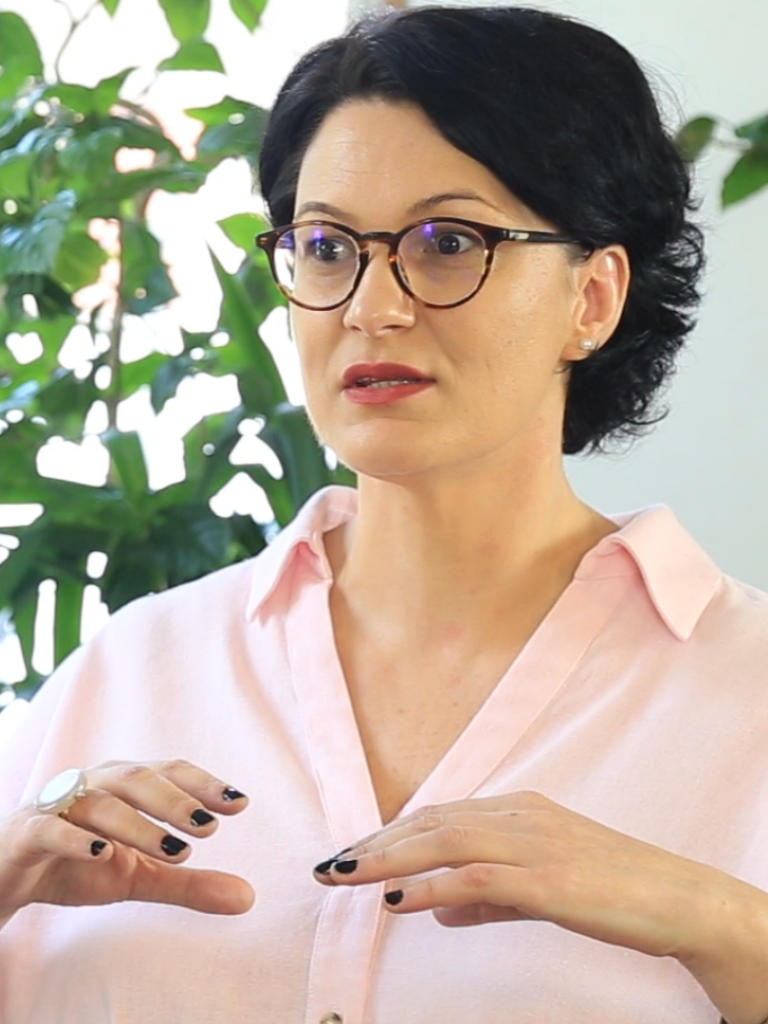
Alexandra Șchianu is a psychologist and facilitator of therapeutic processes. She works with adults who are seeking clarity in their relationships, in their own history, and in the space between them — where most blockages arise, but also the greatest openings.
Her writings are based on live office observation, not theory. Her voice simultaneously maintains conceptual rigor and the warmth of real-life encounters—a rare but essential combination when therapeutic work is to remain grounded in everyday life.
For Alexandra, healing is not a destination, but an ability: to carry what matters to us without fear deciding for us.
psychotherapist

TotUna is not just a magazine. It is a co-creation space.
Submit your article!
If you feel the call to write, share, or contribute your voice, we are here.




