

The Little Prince — Antoine de Saint-Exupéry | Reading & Inspiration TotUna 18
My Dear Conscious Reader/Listener,
The Reading & Recommendation section in this edition is not an invitation to accumulation, but to crossing.
There are books that do not open as an object, but as a threshold. Texts that do not add information, but place us in front of our own inner weight. Readings that do not explain death, but strip it of fear. Which do not glorify life, but bring it into a simpler and truer light.
If there are books that have accompanied you in moments of inner reconfiguration, that have helped you understand how you construct the reality you live in, or that have shown you the architect within you in a moment of unexpected clarity, we invite you to share them with us.
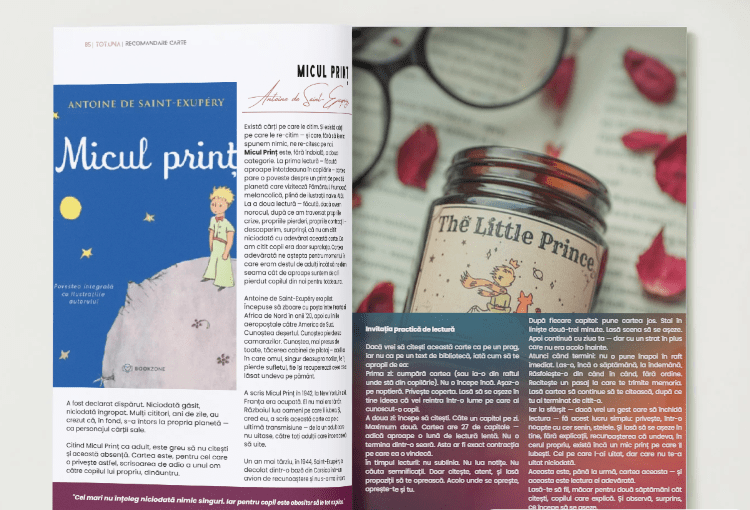
The Little Prince – Antoine de Saint-Exupéry
There are books that we read. And there are books that we re-read — and which, without us saying anything to them, re-read us.
The Little Prince is, without a doubt, the second category. At first reading — almost always done in childhood — the book seems like a story about a prince from another planet who visits Earth. Beautiful, melancholic, full of naive illustrations. That's it.
On the second reading—done, if we are lucky, after we have gone through our own crises, our own losses, our own contractions—we discover, with surprise, that we never really read this book. What we read as children was only the surface. The real book awaited us for the moment when we were old enough to realize how close we were to having lost the child in us forever.
Antoine de Saint-Exupéry
The author was a pilot. He had started flying mail between France and North Africa in the 20s, then with airmail to South America. He knew the desert. He knew the loss of comrades. He knew, above all, the silence of the cockpit — that place where man, alone above the clouds, either loses his soul or recovers what he has left somewhere on earth.
He wrote The Little Prince in 1942, in New York, in exile. France was occupied. He was no longer young. The war was taking people he loved. And, I think, he wrote this book as a final transmission — from an adult who had not forgotten, to all the adults who had tried to forget.
A year later, in 1944, Saint-Exupéry took off from a base in Corsica in a reconnaissance plane and never returned.
He was declared missing. Never found, never buried. Many readers, for years, believed that he had, after all, returned to his own planet—like the character in his book.
Reading The Little Prince as an adult, it is hard not to read this absence as well. The book is, for the one who looks at it this way, a man's farewell letter to his own child within.
Ipractical reading invitation
If you want to read this book as a threshold, and not as a library text, here's how to approach it:
Day one: buy the book (or take it off the shelf where it's been since childhood). Don't start it yet. Put it on your nightstand. Look at the cover. Let the idea settle in that you're about to re-enter a world you knew as a child.
The next day: start reading. One chapter a day. Two at most. The book has 27 chapters — that's almost a month of slow reading. Don't finish it in one evening. That would be exactly the contraction it cures.
While reading: don't underline. Don't take notes. Don't look for meanings. Just read, attentively, and let sentences stop you. Where they stop, stop too.
After each chapter: Put the book down. Sit quietly for two or three minutes. Let the scene settle. Then go about your day—but with an extra layer that wasn't there before.
When you finish: don't put it back on the shelf right away. Leave it for another week, within reach. Flip through it from time to time, in no particular order. Reread a passage that your memory takes you to. Let the book continue to read you, after you've finished reading it.
And at the end — if you want a gesture to close the reading — do this simple thing: look at the stars on a clear night. And let the recognition settle within you, without explanation, that somewhere, in your own sky, there is still a little prince that you love. The one you have forgotten, but who has never forgotten you.
This is, after all, this book—and this is its true reading.
Let yourself be, at least for two weeks while you read, the child who explains. And notice, surprised, what begins to settle.
If there are books that have accompanied you in moments of transition, that have changed your perspective or brought you closer to an inner truth, we invite you to share them with us. Together, we can cultivate a reading space that nourishes not only the mind, but also the silence from which understanding is born.
Together, we can create a reading space that nourishes the mind and soul.
Reading & inspiration #18
"Adults never understand anything on their own. And for children it's tiring to keep explaining it to them."
Antoine de Saint-Exupéry
ARTICLE AUTHOR
MELL
Mell is the founder of the magazine TotUna – Essentia Momentum, an editorial space dedicated to the maturation of consciousness through direct experience and integrative reflection. Her writings do not start from theory, but from real journeys – from the encounter with life in its most fragile and revealing forms.
His interest in traditions such as Advaita Vedanta, anthroposophy, Kabbalah or Christian spirituality is not a comparative one, but an attempt to recognize the same thread of continuity that runs through different languages. For Mell, death, suffering and transformation are not abstract themes, but living processes of integration of consciousness into its own vastness.
Through the magazine TotUna and the spaces created around The Meditation Academy, she supports a lucid spirituality, devoid of drama and escapism, anchored in concrete life and open to its subtle dimension. Her approach does not seek followers, but inner maturity; it does not propose doctrines, but invites experience and assumption.
CO-FOUNDER OF THEMEDITATION.ACADEMY


TotUna is not just a magazine. It is a co-creation space.
Submit your article!
If you feel the call to write, share, or contribute your voice, we are here.




