

Never Chained – Sofia #22
Sofia is the space where the ancient ideas of humanity are viewed beyond era, doctrine, or form. Philosophers, contemplative traditions, and symbols meet here not to provide definitive answers, but to reveal that inner place from which the mind ceases to separate and begins to recognize the whole.
In this edition, Sofia pursues one of the oldest questions of being: what is freedom when it is no longer seen simply as the absence of constraint? From ancient India to Taoism, Stoicism, Neoplatonism, and Christian mysticism, the common thread seems to point towards a freedom that is not acquired, but recognized—one that forms of life can cover but cannot essentially touch.
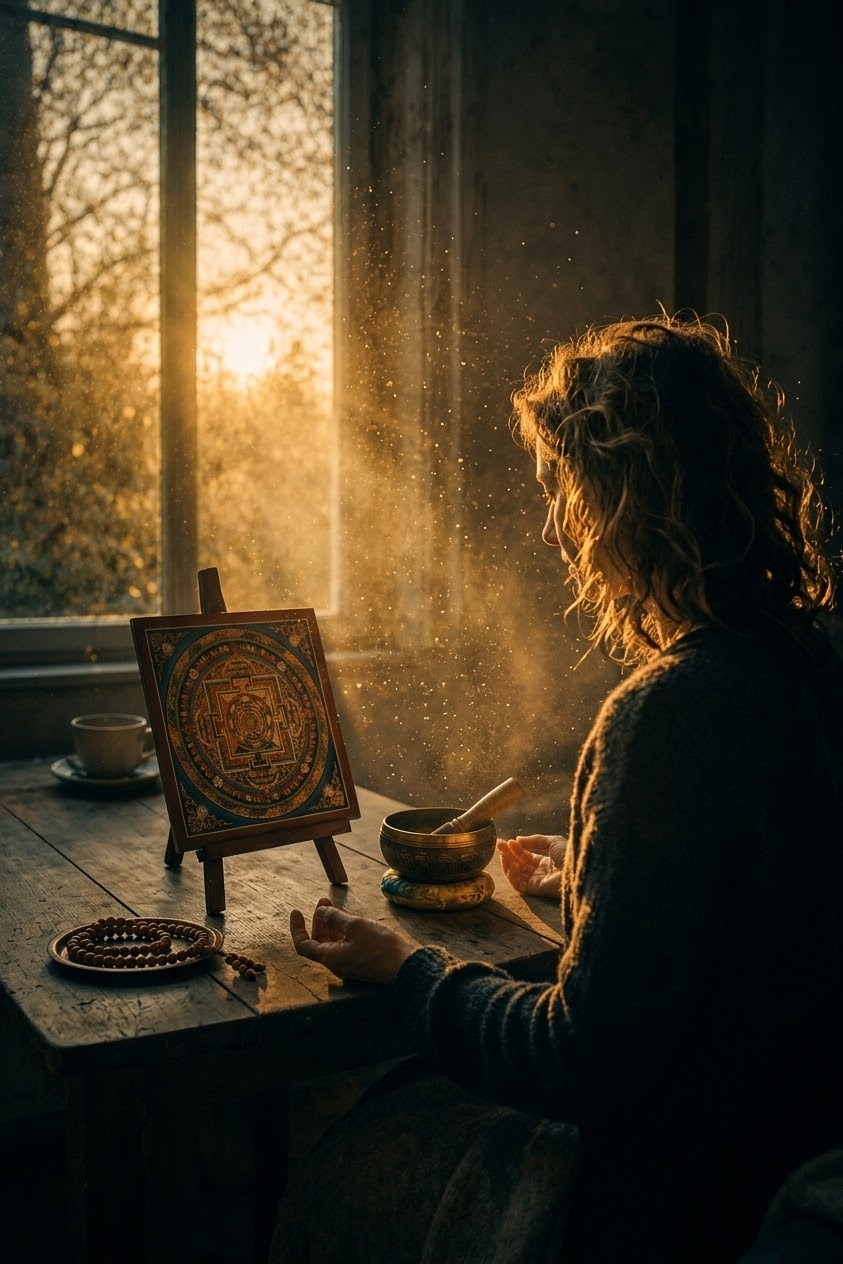
What was never chained
Long before freedom became a right enshrined in law, it was a question of the soul. People have always known walls. They have known captivity, exile, submission, poverty, and loss. But they have also known a more difficult to name form of unfreedom: that in which the gates are open, but man continues to carry his own prison within him. Perhaps that is why, in so many of the ancient traditions, the question of freedom did not stop at the circumstances of life. It went deeper.
What can truly be chained?
The one who looks at change
In ancient India, the sages of the Upanishads turned their gaze from things that come and go to that Atman, which they said is neither born with the body nor disappears with the change of forms. The body changes. Thoughts change. Desires, fears, roles, and circumstances of life change. And yet, in the midst of all these transformations, man can sometimes feel a continuity that is difficult to explain.
A simple one: I am.
Before any explanation of who I am.
Later, nondual thinking will take this intuition to the end: what we seek as ultimate truth is not somewhere outside of us, because the very separation between the seeker and what is sought belongs to the veil.
There is no need to turn this idea into a belief. We can only observe.
The child I was no longer exists in the same form. His body has changed. His mind has changed. His life has changed. And yet, that simple sense of existence seems to have remained.
Maybe the ancient sages weren't trying to give us a definition. Maybe they were just trying to turn our gaze back to what had been there all along.
Water that does not resist
In another part of the world, the sages of Taoism watched the river. Water does not fight with the rock and yet continues on its way. It does not ask the stone to disappear. It does not rebel against the banks. It touches them, it follows them, sometimes it transforms them — and remains water.
Perhaps this is one of the oldest images of freedom: not the absence of form, but the loss of one's own nature within form.
Modern man often associates freedom with the number of possibilities he has. Being able to leave. Being able to choose. Being able to say no. Being able to have. All of these are real and precious forms of freedom.
But Tao seems to be talking about something more subtle. About the freedom that does not require the world to take a certain form in order for it to exist.
Water is not free because it has no banks.
It is free because it does not forget to flow.
The territory that no one can take
The Greeks explored the same question in other ways. For the Stoics, the external world could not be entirely controlled. Wealth could be lost. Reputation could be changed by the words of others. The body could be injured. Power could be taken.
But there remained an inner territory over which the world could not have full control: the way in which man related to what was given to him. It was not an invitation to passivity. The Stoic could act, build, lead, protest, love. But he tried not to put his entire being in the hands of things he could not control. Perhaps here appears one of the most important distinctions of freedom: there is what happens to us and there is what we are.
For most of life, the two seem to be one and the same. We say: I am hurt, I am abandoned, I am poor, I am strong, I am loved, I am free. But all of this changes. Sometimes in a single day. And yet, through each of them, something continues to say silently: are. Before the adjective.
The overflowing fullness
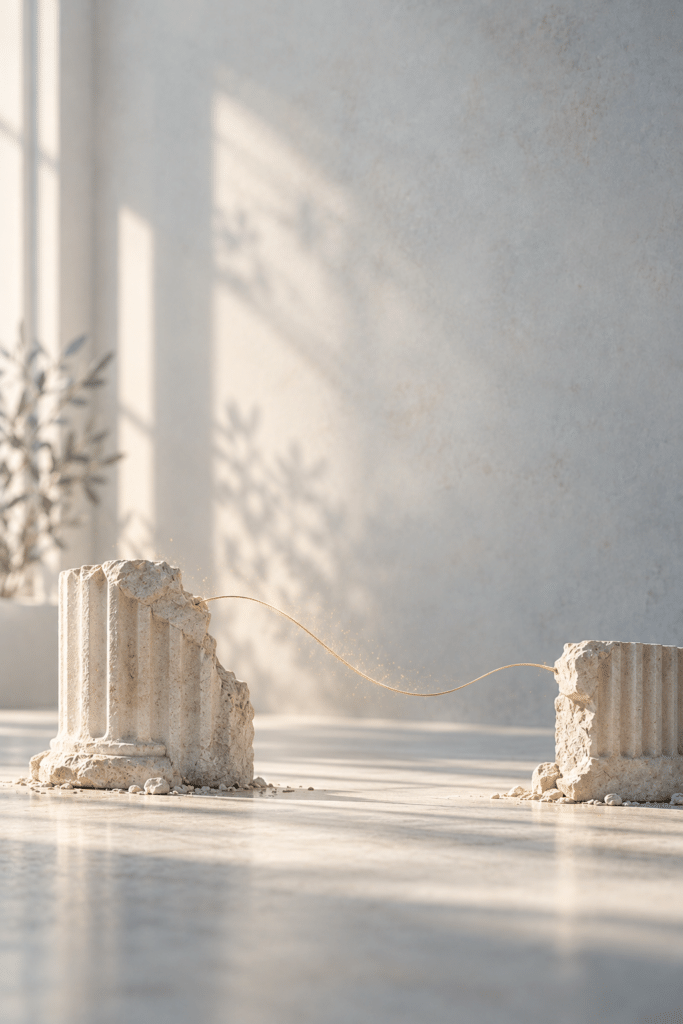
A few centuries later, Plotinus will speak of the One . Not as a being that accumulates. But as a plenitude so complete that it overflows without diminishing.
This is where freedom begins to meet, perhaps unexpectedly, with abundance. Because what is truly full does not need to keep everything to itself.
The sun does not lose light because it shines. The spring does not become less of a spring because its water flows. The flower does not negotiate its fragrance.
Only man, perhaps, has learned to believe that to be whole he must add. And so we began to count. How much we have. How much it is worth. How much we have lost. How much we still lack. How much we must become before we can rest in our own existence. But the ancient traditions of wisdom seem to repeat, in different languages and images, a disturbingly simple thing: what is essential cannot be added.
Poverty that does not mean lack
In Christian mysticism, an idea appears that, viewed superficially, may seem strange: poverty of the spirit. Master Eckhart, this poverty does not simply speak of the absence of things.
It's about letting go of the need for things to define us. You can have without being possessed by what you have. You can love without making love a guarantee of your existence. You can know without making knowledge a fortress. You can even seek God without trying to make Him an object of the mind.
There is an almost paradoxical freedom here. Not the freedom of the one who has nothing. But the freedom of the one who no longer has to use anything to prove who he is. In that inner place, fullness and emptiness cease to be opposites.
The empty vessel can receive. Silence can contain.
The space can become fertile.
Ritual: the inner gate
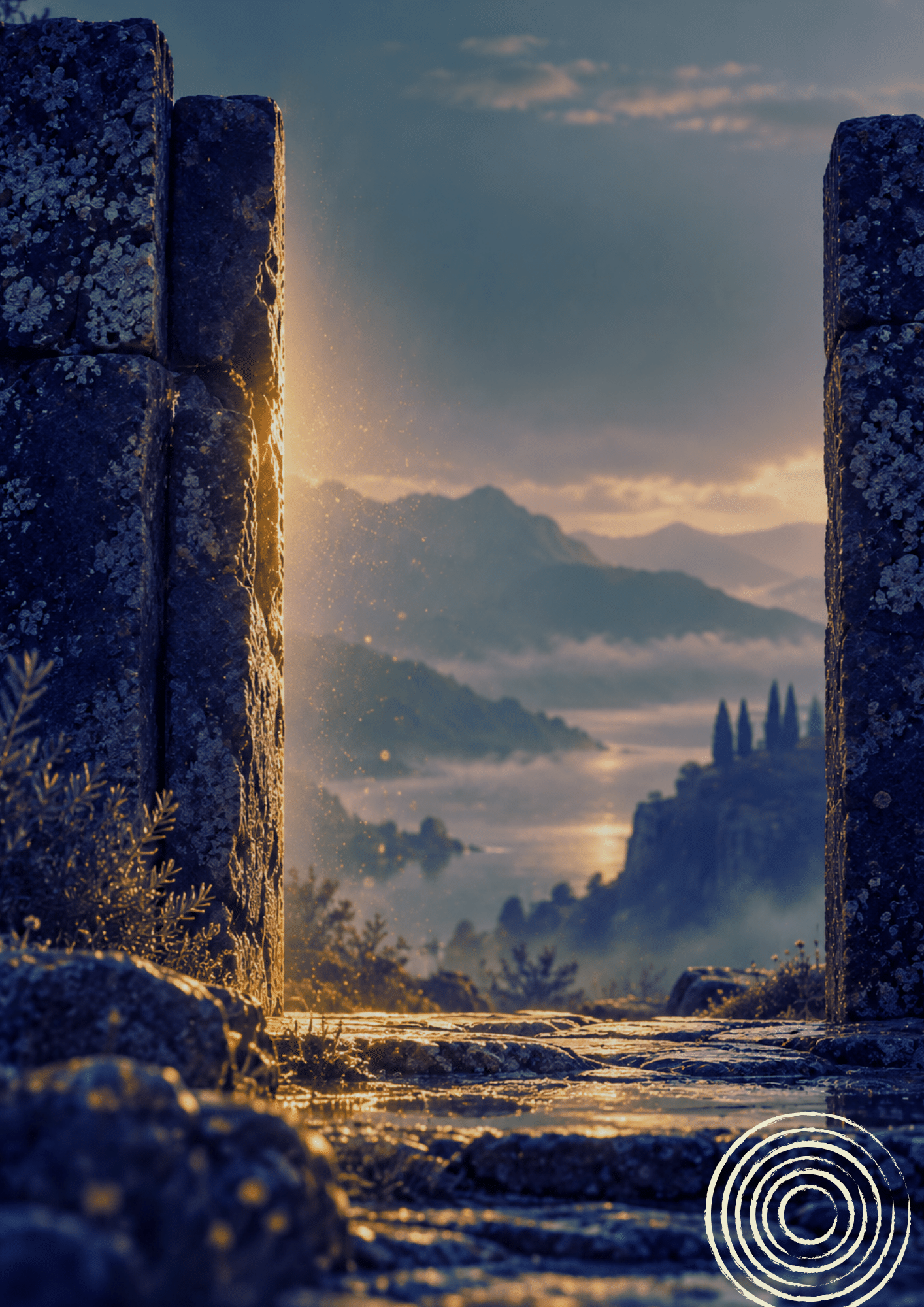
Perhaps we have been looking for freedom for too long as a gate to be opened.
I collected keys.
I learned techniques.
We changed paths.
We tried to become stronger, more aware, better, more healed.
Some of all this was useful to us.
But, every now and then, maybe it's worth stopping in front of the gate and taking a closer look.
Is there really a door?
Or are there just two edges between which the mind has learned to see a limit?
Sofia, the old one, might not answer us.
Maybe he would stay with us in silence.
And, after a long time, he would ask:
Who is that standing in front of the gate?
And the question would remain there.
Not to be solved.
But to open, perhaps, something that had never been closed.
sofia, perspective of the higher mind #22
Perhaps we have been looking for freedom for too long as a gate to be opened.
mell
ARTICLE AUTHOR
MELL
Mell is the initiator of the magazine TotUna – Essentia Momentum, an author and artist, concerned with how lived experience can become a space of knowledge, creation and return to oneself.
His writings are born from a direct encounter with life — from fragility, transformation, silence, relationship, and those moments when what we thought we knew about ourselves begins to unravel, giving way to a more vivid perception.
Through word, image, sound and movement, his creation seeks to open spaces, not to provide definitive answers. It does not propose a path to follow, but invites to that type of encounter in which everyone can hear, once again, something that has always belonged to them.
editor-in-chief totuna.live


TotUna is not just a magazine. It is a co-creation space.
Submit your article!
If you feel the call to write, share, or contribute your voice, we are here.




