

Dandelion – Conscious Food – Living Life
Spring doesn't just begin in nature. It begins inside, in the way we choose to nourish ourselves, cleanse ourselves, and resettle ourselves. Food is not just fuel. It is biological information, metabolic rhythm, chemical message, and sometimes symbolic gesture. Every food brings with it a direction: it can support stagnation or activate movement, it can charge or it can liberate.
In this section, the dandelion becomes the central guest—not just as food, but as a symbol of turning bitterness into clarity and moving from stagnation to flow. Because sometimes, before we can bloom, we just need to let go.
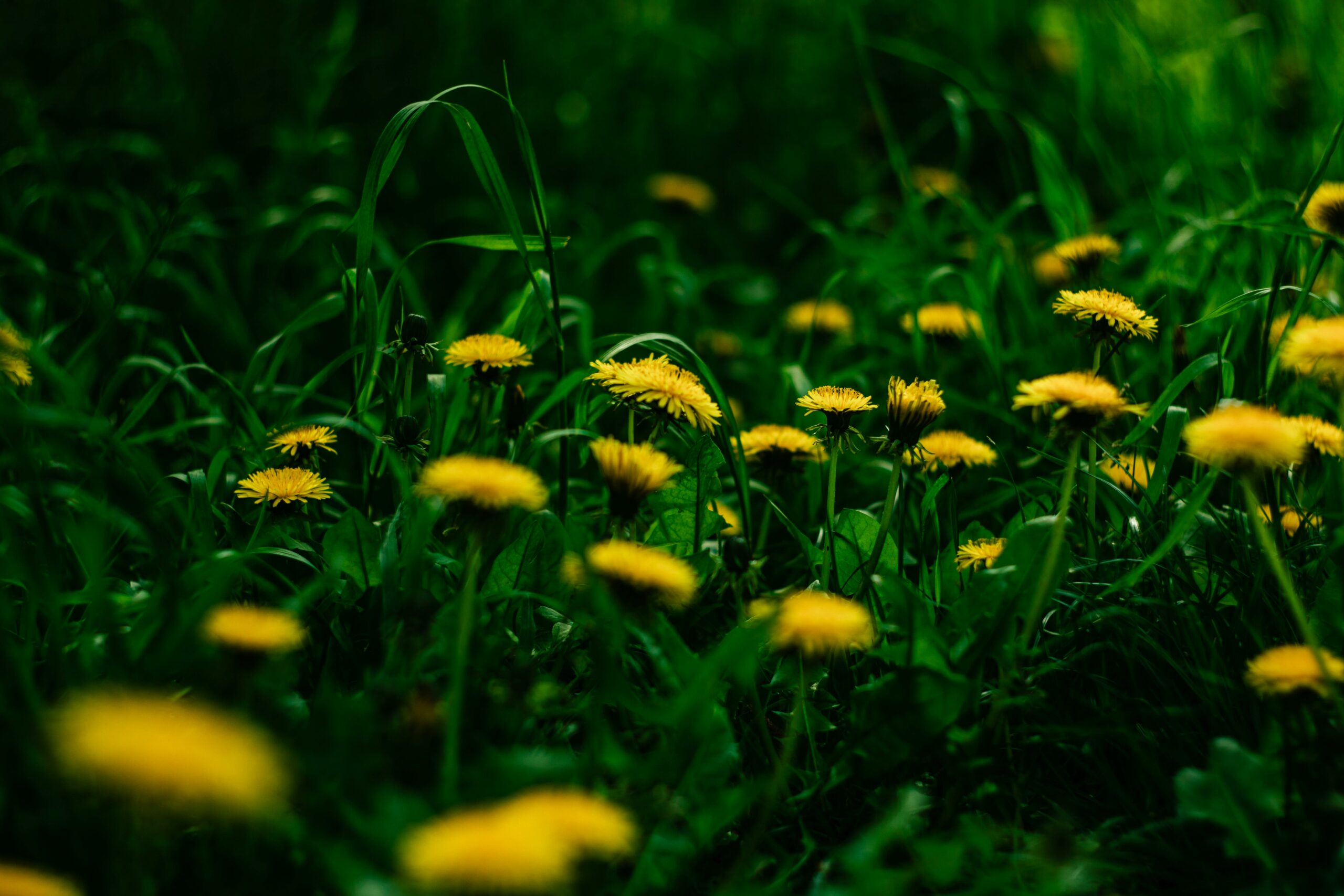
dandelion
In this edition dedicated to rebirth and the balance between light and dark, we choose to look at food as a partner in transformation. Detoxification is not a rigid concept or a sudden intervention, but a natural process of reconfiguration — like spring that does not force flowering, but creates the conditions for it.
Spring doesn't begin with spectacular flowers. It begins with simple, sometimes ignored plants that quietly sprout from the still cold ground.
Dandelion (Taraxacum officinale) is one of them. Often considered a “weed,” it is actually one of the most complex and valuable detoxifying and regenerating plants.
In an edition dedicated to rebirth, transformation and balance, the dandelion becomes a living symbol of the process by which the body and consciousness cleanse themselves to make way for the new.
Dandelion is a perennial plant in the Asteraceae family. Every part of it is usable: the leaves, root, flowers, and stem.
From an archetypal point of view, garlic is pure fire: hot, penetrating, direct, masculine. It is the food that cuts, separates, clarifies and dissolves what stagnates. But this fire is not destructive, because it is naturally enveloped in a watery structure, rich in juices, sulfur compounds and a vegetal intelligence that knows how to carry combustion without transforming it into violence.

The bitter substances in dandelion stimulate bile secretion. Bile is essential for:
– fat digestion
– elimination of fat-soluble toxins
– supporting the intestinal microbiome
The liver converts toxins into soluble compounds for elimination. Dandelion supports this process naturally and gently. It is a choleretic and cholagogue plant — it stimulates the production and flow of bile. In symbolic language: Bile is the vehicle through which we eliminate what no longer serves us.
Modern society has almost completely eliminated the bitter taste from our diet. However, bitters stimulate digestive secretions, liver detoxification, glycemic balance, and activate the vagus nerve through digestive reflexes.
Symbolically, bitterness is the acceptance of difficult experiences. We don't avoid bitterness. We integrate it. We transform it.
In traditional Chinese medicine, spring belongs to the liver and the Wood element — expansion, growth, direction.
When the liver is harmonious there is clarity, initiative, and flexibility.
When it is blocked, irritability, stagnation and frustration occur.
Dandelion supports the movement of stagnant energy.
It is a plant of the stream.
Physical and mental detoxification
Chronic inflammation and metabolic imbalance affect mood. The liver is involved in hormone metabolism, blood sugar regulation, and neurotransmitter processing. An overworked liver can contribute to fatigue, irritability, and mental fog. Detoxification isn’t just about elimination. It’s about regulation.
The plant has proven effects on:
– liver
– gallbladder
– digestion
– kidneys
– glucose metabolism
Dandelion – Archetype of Transformation
Taraxacum officinale is a plant widespread on almost every continent. It is precisely this universality that has made it discreetly enter the symbolism of several civilizations.
Its name comes from the Greek taraxis (disorder) and akos (remedy) – “that which cures disorder”. In medieval Latin it appears as dens leonis – “lion's tooth”, a reference to the shape of the leaves, but also to the solar force associated with it.
The plant that grows spontaneously, without asking permission, becomes in many cultures a symbol of resilience and life that pierces matter.
In European folk traditions, dandelion was associated with clairvoyance, prophetic dreams, and finding hidden answers.
In medieval England and France, blowing on dandelion seeds was said to reveal the time remaining until a wish would be granted. It wasn't just a game. It was a symbolic form of consulting the wind—an element associated with spirit.
The white sphere of seeds represented the totality of potential. Their dispersion — surrender to the cosmic will.
It is impossible not to see the parallel with the idea of the separation of the soul from the body.
In Celtic cosmology, yellow plants were associated with solar energy and inner fire.
The dandelion, through its intense color, was linked to vitality, willpower, and regeneration.
Solar energy was considered a purifying force. Consuming solar plants in spring meant renewing the connection with the cycle of life. Spring was the time when the "inner fire" had to be rekindled.
Eliminating toxic heat
In traditional Chinese medicine, dandelion is used to eliminate "toxic heat", support the liver, and purify the blood.
The Liver, associated with the element Wood and spring, symbolizes direction, planning, and expansion. When Wood is blocked, frustration arises. When it flows, creativity arises.
The dandelion thus becomes the plant that reopens the flow.
There is no direct evidence that the dandelion had a dedicated cult in Egypt , but the yellow and solar plants were associated with Ra , with the daily rebirth of the sun, and with the cycle of death and rebirth.
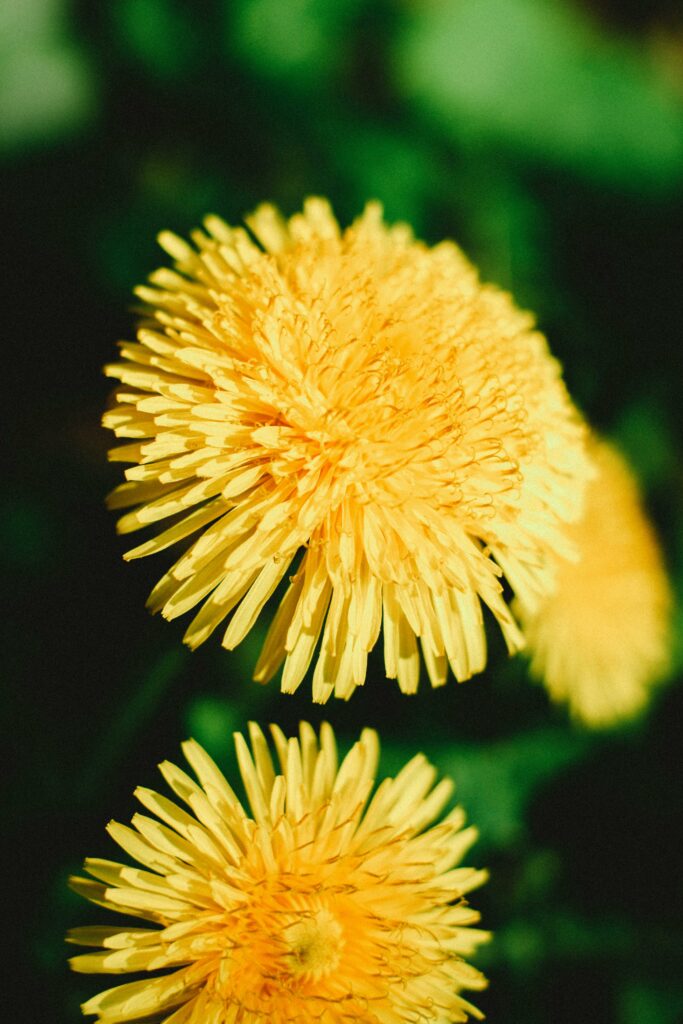
The radial shape of the dandelion flower is reminiscent of the solar disk.
The daily opening and closing of the flower reflects the cosmic rhythm of light-dark alternation.
It is a plant that breathes with the sky.
Mystery Schools and Alchemical Symbolism
In the European alchemical tradition, the process of transformation was described through three main stages:
- Nigredo – decomposition
- Albedo – purification
- Rubedo – enlightenment
The dandelion symbolically contains two of these phases: the solar yellow (Rubedo – illumination) and the white of the mature sphere (Albedo – purification)
The bitterness of the plant represents the confrontation with raw matter — Nigredo.
It is a complete plant in the symbolism of transformation.
The dandelion flower is made up of hundreds of small individual flowers. Unity in multiplicity.
Numerological:
– solar yellow is associated with vibration 1 (the sun, the beginning)
– the perfect sphere is associated with 0 (infinite potential)
– seed dispersion reflects 3 (creation, expansion)
The dandelion goes from 1 to 0 to 3. From center to potential to manifestation. A complete cycle of creation.

Folk magic and healing
In popular traditions, it was worn for protection, or used in cleansing rituals, being considered a plant of transition between worlds.
The fact that it grew on the border of roads and fields made it a symbol of the threshold.
It is a plant of transition.
Dandelion as a metaphor for the transhumance of the soul
Yellow flower – embodied life.
White sphere – released potential.
Wind – spirit.
Dispersion – continuity.
Nothing is lost. It is transformed.
Dandelion is not a showy plant. But it is one of the most intelligent. It reminds us that detoxification is not a violent act. It is a natural process of resettlement. Just as spring does not force flowering, but allows it, supporting the liver with simple plants helps us create the biological ground where joy can return. Because sometimes, before we can bloom, we just need to release.
Although dandelion is generally considered a safe and well-tolerated herb, its use should be done with caution. People with cholelithiasis (gallstones), bile duct obstructions, or severe liver disease should consult a doctor before starting a regimen, as stimulating bile secretion may exacerbate symptoms.
Contraindications and precautions
Dandelion may also interact with certain diuretics, anticoagulants, or blood sugar treatments, having a mild diuretic effect and influencing glucose metabolism. People with allergies to plants in the Asteraceae family (chamomile, marigold, ragweed) should exercise caution.
Like any intervention on the body, herbal liver support should be viewed as part of a balanced lifestyle, not as a singular solution or substitute for medical treatment.
Authentic detoxification is a gradual, gentle, and responsible process.
Just as on an inner level, integration requires patience and discernment, on a biological level, transformation requires rhythm and measure.
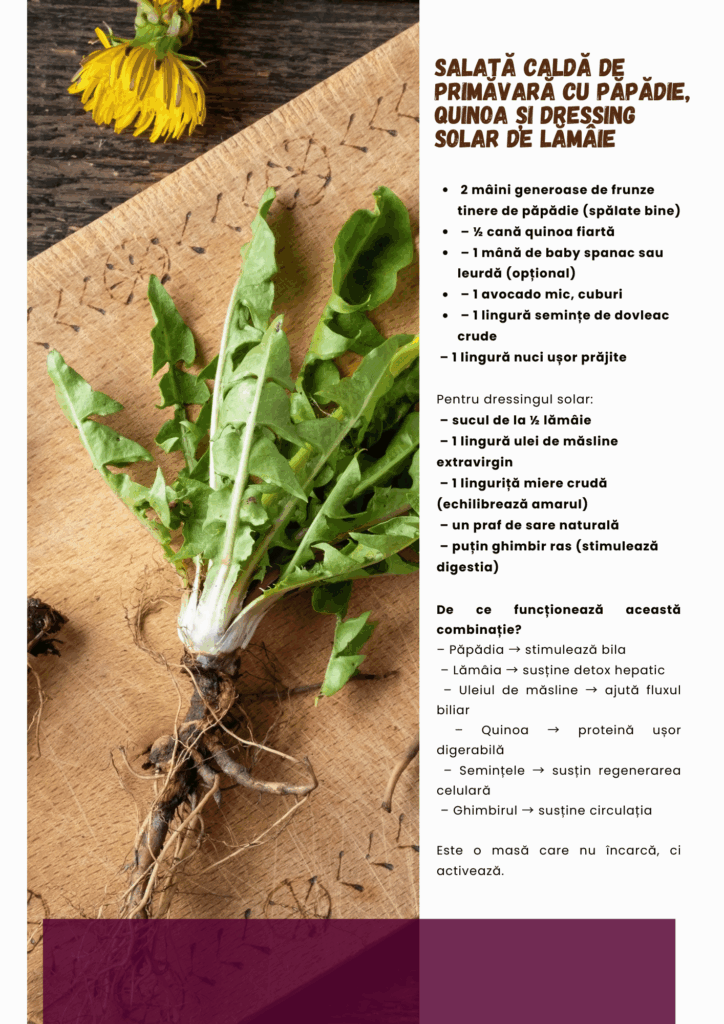
- 2 generous handfuls of young dandelion leaves (washed well)
- – ½ cup cooked quinoa
- – 1 handful of baby spinach or chard (optional)
- – 1 small avocado, diced
- – 1 tablespoon raw pumpkin seeds
- – 1 tablespoon lightly toasted walnuts
For the solar dressing: - – juice of ½ lemon
- – 1 tablespoon extra virgin olive oil
- – 1 teaspoon raw honey (balances the bitterness)
- – a pinch of natural salt
- – a little grated ginger (stimulates digestion)
Ritualized preparation :
- Ritualized preparation:
- Boil the quinoa and let it cool slightly.
- Mix dandelion leaves with spinach or kale.
- Add lukewarm quinoa over the leaves—the gentle heat slightly softens the bitterness.
- Add the avocado, nuts and seeds.
- Mix the dressing ingredients separately and pour it over the salad just before serving.
- Before the first bite:
- Look at the green. Notice the texture of the leaves. Take a deep breath.
- Say inside: "I transform what is difficult."I choose clarity.I nourish life within me.”
- Taste the bitterness without rejecting it.
- Let it become a part of you.
How can we integrate it into our diet?
– young leaf salad
– tea from leaves or roots
– tincture (under specialized guidance)
– dandelion root coffee
Spring is the ideal time for a gentle 2–3 week cleanse.
conscious food – living life #15
I integrate what is bitter. I transform what is hard. I choose clarity.
mell
ARTICLE AUTHOR
MELL
Mell is the founder of the magazine TotUna – Essentia Momentum, an editorial space dedicated to the maturation of consciousness through direct experience and integrative reflection. Her writings do not start from theory, but from real journeys – from the encounter with life in its most fragile and revealing forms.
His interest in traditions such as Advaita Vedanta, anthroposophy, Kabbalah or Christian spirituality is not a comparative one, but an attempt to recognize the same thread of continuity that runs through different languages. For Mell, death, suffering and transformation are not abstract themes, but living processes of integration of consciousness into its own vastness.
Through the magazine TotUna and the spaces created around The Meditation Academy, she supports a lucid spirituality, devoid of drama and escapism, anchored in concrete life and open to its subtle dimension. Her approach does not seek followers, but inner maturity; it does not propose doctrines, but invites experience and assumption.
CO-FOUNDER OF THEMEDITATION.ACADEMY


TotUna is not just a magazine. It is a co-creation space.
Submit your article!
If you feel the call to write, share, or contribute your voice, we are here.




