

Coniunctio — Meditation for Inner Union | TotUna Meditation Practice 17
There are practices that inform and practices that transform. The difference between them is not in complexity—it is in direction. The meditative practice in this edition does not ask you to understand something new. It asks you to sit with something old—with that tension between the forces that compose you—and to discover that, deeper than the tension, there is a stillness that never belonged to any of them.
Find a place where you won’t be disturbed. You can sit in a chair or on the floor — the important thing is to keep your back straight and your body relaxed. If you’re reading, pause after each paragraph. If you’re listening — let the voice guide you.
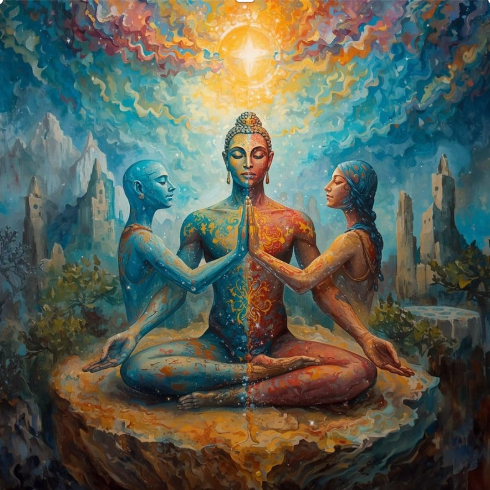
inner union
Close your eyes. Let a breath come—don’t call for it, don’t force it. Just let it come, as it always does, without asking permission. Feel the weight of your body. The way the chair, the floor, the surface you’re sitting on, accepts you unconditionally. You don’t have to do anything for it. You are simply accepted. Bring your attention to your feet. Feel the contact between them and the ground—whether it’s direct, or through your shoes, or through the floor, or through the earth beneath. There is an invisible thread that runs down your spine, through your feet, into the earth, and reaches where the earth is always still, always stable, no matter what’s happening on the surface. Feel that thread. Don’t imagine it with effort—let it be there. It exists whether you feel it or not. Breathe three times, deep and slow. With each exhale, let your shoulders drop a little lower. Let your jaw relax. Let your forehead calm down. You are here. You are present. You are safe.
II. lowering
Now, with each breath, imagine your attention descending—like a gentle light sinking, layer by layer, inside you.
From the surface of the skin… inside. From the thoughts that may still be floating at the edge of the mind… inside. From the noises from outside, which don't disappear, but become increasingly distant… inside.
It descends into your chest. Feel it rise and fall with each breath—that steady, faithful rhythm that has never stopped since the day you came into the world.
It descends into the center of the chest. Not into the heart as an organ—but into that space that some traditions call hridaya, the secret chamber of the heart, the place where the being knows itself without words.
Just stay there for a moment. That's all.
You don't have to find anything. You don't have to feel anything in particular. Your presence there is enough.

III. Meeting with interior architecture
From this inner space, let two presences emerge—gradually, without force—do not name them yet. Do not give them form. Let them come as they will.
One of them carries within it something that resembles structure—firmness, direction, clarity of line. It may appear as light, it may appear as a shape, it may appear as a sensation in the body. Observe it without judgment.
The other carries within it something that resembles receptivity—flow, warmth, the capacity to encompass. And it appears in its own way—as an image, as a sensation, as a presence.
Maybe you recognize them. Maybe they resemble someone you know. Maybe they are completely unknown. Whatever their form — they are yours. They have always lived within you.
Notice the distance between them. Maybe they're close. Maybe they're far away. Maybe one is clearer than the other. There's nothing to correct here—just to notice.
Breathe.
And now, without forcing them to move, ask them a single silent question:
How long have you been separated?
Don't wait for a verbal response. Maybe an image will come. Maybe a sensation. Maybe just a silent, formless knowledge. Receive what comes.
Stay with this image for a few moments.
This is your inner architecture—built layer by layer, year after year, from experiences, from beliefs, from love and fear, from conscious choices and inherited automatisms. It is not good or bad. It is simply what has been built up to now.
IV. Meeting with presence
Now descend even deeper—below the two presences, below the distance between them, below any tension or harmony you feel between them.
There is a level that separation has never reached.
Not because it is hidden—but because it is too simple to seek. It is the substance of which both are made. It is the space in which both breathe. It is the stillness before the division in two.
The alchemical tradition called it Coniunctio—not the union of two, but the recognition that there were never really two. The Hermetists spoke of the Rebis—the figure that carries both principles not as a sum, but as a single substance that looked in the mirror and saw itself multiple.
You don't need to know these names. You just need to descend into that silence.
Breathe there. Stay.
He feels how, from this depth, the two presences do not disappear — but they are no longer separate. They are like two waves on the same sea. Each has its own shape, its own movement, its own height. But the water from which they are made is the same.
It's not a concept. It's an experience—perhaps subtle, perhaps barely perceptible, perhaps clearer than anything you've ever felt before. Whatever its intensity—it's real.
Stay in it for as long as you are given. Don't rush. Don't analyze. Just be.
V. Claiming intent
From this space of stillness, let an intention form. Not a decision, not a plan—an intention. Something that comes from deep within, not from the mind.
Maybe it's simple: I want to live less in battle with myself. Maybe it's even simpler: I want to rest. Maybe it has no words — it's just a direction, an orientation, a turning towards something.
Whatever it is—place it in the center of your chest. Like a seed. Not like an obligation.
And say, silently or in a whispered voice:
I choose to return to the whole. Not because I know what that means. But because I feel that's where I came from.
Breathe.

VI. return
Slowly, gently, begin to return to the surface.
Feel the weight of your body again. The contact with the surface you are standing on. The warmth of your hands. The rhythm of your breathing.
Bring your attention to your fingers—move them gently. To your feet. To your shoulders.
When you're ready, open your eyes—slowly, without rushing. Let the light in gradually.
Take a moment before you get up. Maybe write a few words—not about what you thought, but about what you felt. Even one word is enough.
What you have achieved in this practice does not disappear with the opening of your eyes. It remains—as a memory of the body, not the mind. And the body knows how to find its way back.
scientific basis
Inner Union
What the alchemical tradition called Coniunctio — the inner union of opposing principles — is not just a poetic symbol. Research in neuroscience, psychology, and modern biology describe, in their own language, the same phenomenon. Not as a metaphor — as a measurable reality.
The brain that unites with itself
The left and right hemispheres of the human brain are not simple anatomical divisions. They represent two fundamentally different ways of processing reality. The left hemisphere operates sequentially, analytically, linearly—it is the hemisphere of structure, language, causality. The right hemisphere processes holistically, simultaneously, nonverbally—it is the hemisphere of context, of the big picture, of emotional resonance.
In normal life, the two hemispheres communicate through the corpus callosum—a dense bundle of nerve fibers that transmits information between them. But in states of chronic stress, unresolved internal conflict, or hyperactivation of the nervous system, this communication is reduced.
The brain literally functions more fragmentedly — each hemisphere processes reality from its own perspective, without sufficient integration.
EEG studies of long-time meditators have documented a significant increase in interhemispheric cohesion during deep meditation practice — a synchronization of brain waves between the two hemispheres, especially in the alpha and theta bands, associated with states of deep relaxation, creativity, and access to subconscious content. In other words: in meditation, the brain itself tends toward union. Not as an ideal — as a measurable physiological process.
Richard Davidson's research and contemplative neuroscience
Richard Davidson, founder of the Affective Neuroscience Laboratory at the University of Wisconsin-Madison, has conducted extensive studies on the effects of meditation on brain structure and function. Working initially with Tibetan practitioners with tens of thousands of hours of meditation, Davidson documented significant structural changes in key areas of the brain.
The left prefrontal cortex—associated with positive emotions, balance, and the ability to maintain perspective in the face of adversity—was significantly more active and developed in experienced meditators. The amygdala—the center for processing fear and threat responses—showed reduced reactivity and faster recovery from stressful stimuli.
But perhaps most relevant to our topic: Davidson observed that experienced meditators demonstrated an increased capacity to sit with internal tension without prematurely resolving it through suppression or reaction. They could contain the polarities—without eliminating one in favor of the other.
This is, in neuroscientific terms, exactly what the tradition called integration—not the victory of one principle over the other, but the ability to contain both in consciousness, simultaneously, without fragmentation.
The individuation process and analytical psychology
Carl Gustav Jung described the process of individuation—authentic psychological maturation—as a process of progressive integration of unconscious contents. Central to this process is the encounter with the anima and animus—the feminine and masculine principles in the psyche of every being, regardless of gender.
Jung observed that as long as these principles remain unconscious, they act autonomously—projected outwardly, into relationships, into repetitive dynamics, into inexplicable attractions and repulsions. The man who has not integrated his anima—the inner feminine principle—will compulsively project it onto the women in his life, seeking outwardly the completeness he does not recognize within.
Research from the HeartMath Institute has shown that the heart generates the most powerful electromagnetic field in the body—approximately 60 times stronger than that of the brain. When the emotional state is one of coherence—peace, clear intention, openness—the heart and brain enter into synchronization, and the capacity for processing, decision-making, and perception is significantly amplified.
The moment of rededication of intention in this practice—that simple and sincere offering to the inner architect—activates precisely this state of coherence. Not through effort, but through authenticity.
The woman who has not integrated her animus will attribute to men the power or authority that she does not accept as her own.
The process of individuation does not mean eliminating these projections by will—but bringing them into consciousness, recognizing them as our own, gradually integrating them. The result is not an androgynous man in the external sense—but a being capable of accessing both structuring force and fluid receptivity, depending on what life demands at each moment, without an internal conflict that consumes energy.
Polyvagal theory and the integrated nervous system
Stephen Porges , through the Polyvagal Theory , described the autonomic nervous system not as a binary system—activation and relaxation—but as a hierarchy with three distinct states: mobilization in the face of danger (sympathetic system—fight or flight), immobilization in the face of overwhelming danger (dorsal vagal system—freeze, collapse), and the state of social safety and connection (ventral vagal system).
This third state — the state of safety — is the one in which the nervous system no longer consumes energy defensively and can access its most evolved functions: authentic connection, creativity, empathy, the ability to stay present with complex experience without simplifying it.
Regular meditation practice activates and strengthens the ventral vagal system. Mindful breathing—especially prolonged exhalation—stimulates the vagus nerve, reducing sympathetic activation and bringing the nervous system into a state of safety. In this state, inner polarities are no longer perceived as threats to be managed—but as aspects of a complex experience that can be contained.
In other words: when the nervous system is safe, the being can contain the multitude without fragmenting.
The biology of union — research on cardiac coherence
The HeartMath Institute in California has documented the phenomenon of cardiac coherence — a state in which the heart rhythm becomes more regular and orderly, creating a coherent electromagnetic field that influences the functioning of the entire body, including the brain.
States of cardiac coherence are associated with integrative emotions—not necessarily happiness or euphoria, but a state of profound balance in which the body’s systems function in sync. Researchers at HeartMath have observed that in states of cardiac coherence, communication between the heart and brain—via the vagus nerve—is significantly enhanced, and emotional processing becomes more nuanced, less reactive.
The heart, in this understanding, is not just a pumping organ — it is a processing and integration center. Not metaphorically. Physiologically.
Contemplative traditions have always known this—and expressed it in their language. Contemporary neuroscience confirms it in its language. That the two languages meet—is, in itself, a small Coniunctio.
Practice does not create union. It brings it back into consciousness. It has always been there—deeper than any division, older than any wound.
meditation practice #17
Healing your relationship with your parents doesn't mean forgiving in a moral sense. It means seeing.
mell
ARTICLE AUTHOR
MELL
Mell is the founder of the magazine TotUna – Essentia Momentum, an editorial space dedicated to the maturation of consciousness through direct experience and integrative reflection. Her writings do not start from theory, but from real journeys — from encountering life in its most fragile and revealing forms.
His interest in traditions such as Advaita Vedanta, Gnosticism, Kabbalah, and anthroposophy is not a comparative one, but an attempt to recognize the same divine thread that runs through different languages. For Mell, creative consciousness is not a concept—it is a living reality, present in all forms of existence, which he explores, writes about, and experiences.
CO-FOUNDER OF THEMEDITATION.ACADEMY


TotUna is not just a magazine. It is a co-creation space.
Submit your article!
If you feel the call to write, share, or contribute your voice, we are here.




