

Reconnecting with Otilia Deak #20 – The Master Sequence
There are encounters that are not told, they are transmitted. And my conversations with Otilia Deak are, every time, more than an exchange of words — they are a resetting of perception, a silent expansion of inner space that happens by itself, just by being around her.

MASTER SEQUENCE
We returned to her in this issue dedicated to the Master not by chance. Because Otilia is, herself, a rare way of embodying the theme: the therapist who does not attribute the healing to herself, who simply says that she does nothing — that through her, what the person already carries within themselves only passes. She does not lead, does not save, does not create addiction. She awakens. And in the conversation that follows, we descended together to things that we rarely say out loud: how something dormant in the other is activated, through simple presence; how we are made, sequence by sequence, aware of a single field in which we are all parts of the same whole; and how even what the world fearfully calls “entities” reveal themselves, in her gaze, as codes that we ourselves activate — and which, precisely for that reason, we can deactivate.
The following text is not a faithful transcription, but a reconstruction—my words conveying, as closely as I could, the essence of what she said. I invite you to read it not as an interview, but as a conversation in which you are, now, the third person present.
Talking to her, my perception expands. The field around my head becomes, for me, observable—like a delicate volume of attention that goes beyond the edges of my skull and extends a few centimeters around. And as I remain in this space, I begin to distinguish the planes through which the words, emotions, and images that arise between us pass. Not just one.
CONVERSATION II
Otilia and I met again a few months after our first conversation. This time I was unable to record what we said, so the following text is not a transcription, but a reconstruction—my words, carrying as closely as I could the essence of what she said. I have preserved, where I remembered them exactly, her exact phrases. The rest is the water in which they float.
As always when I'm around her, my perception broadened by itself. And, as always, I felt that phenomenon that only now, with the theme of this edition in mind, I was able to name. In Otilia's presence, something in me awakens. Not because she gives me something. But because, being in her field, a chord in me begins to vibrate — the chord that was already there, tuned from the beginning, just waiting for another equally tuned one to resonate. I called it, in my mind, the Master's sequence. And we talked about it, in fact, all afternoon.
I asked her directly, because it was the question I wanted to start everything with. Otilia, when someone walks into your office and something changes in them before they even say a word — do you do something to them? Or does something awaken in them?
I don't do anything. It's done through me.
She said it simply, without any grandeur, as you say something that you have verified thousands of times. I understood then that it is exactly the movement that we are writing about in this entire edition. Otilia has, to use the language that we arrived at together that day, the Master's sequence activated in her own field. And when a man enters her proximity, this sequence activates, by simple resonance, the same sequence asleep in him. It does not transmit it to him. It awakens him. Like a tuning fork that makes the string tuned to the same note play, at a distance.
And from that moment on — this is the beautiful thing — the work is no longer hers. The spontaneous, individual process begins, through which man heals and understands himself from his own field. Otilia does not heal anyone. She awakens in the other the healer who has always been sleeping there. The master in the office is not her. There is something in the patient that finally remembers.
Here I touched on a point that Otilia often repeats to her clients, and that she wanted me to make clear in the text, because many people sit on a therapist's couch like they would on a dentist's chair — waiting for it to be resolved.
I tell clients that they have to work, that it's for their own good.
It seems like a simple phrase. It is, in fact, a line of demarcation. Because, she says, most people wait to be saved — precisely so that they do not take on the process of integration. They want healing, but without crossing. They want the fruit, but they do not want to go through the fire. And here is the difference between a true master and a savior figure: the true one gently refuses to save you — because he knows that saving you from the outside would leave you just as helpless on the inside.
I told her that this is the very thread of our entire edition: the master who does not create addiction, but dissolves it. Who does not make you feel whole in his presence, but teaches you to be whole without him. She nodded. For her, this is not a theory — it is the way she works every day, patiently turning over responsibility to the one who came to hand it over.
Most people wait to be saved, so as not to take on the integration process.
As we talked, the conversation descended into something larger. We both came, by different paths, to the same recognition: that there are no separate fields. There is only one field, in which everything happens. And the others—all the others—are not strangers to us, but fragmented parts of our own whole. What you see outside is a piece of yourself that you have not yet recognized.
Otilia sees this, she doesn't believe it from books. And the process by which a person becomes aware of this unity of the One does not happen all at once, like a sudden enlightenment. It happens, she said, sequence of code by sequence of code. Code after code is recognized, realigned, reintegrated into the whole. Healing is, after all, this slow recollection of unity—an awakening that is written line by line, not in a single sentence.
I found here, with silent joy, what Sofia says on another page of this edition: that the master looks through the multitude of forms and sees the same individual . And what Anniel whispers: that the boundaries between you and the rest are drawn by the mind, not real. Otilia arrives at the same truth coming from the body, from the field, from years of hands placed on people's suffering. Three roads, the same place.
ENTITIES OR CODES
And since we were talking about codes, we naturally came to a subject that many avoid or cover up with fear. What are, I asked her, the things that the uninitiated world calls entities—those presences that are spoken of with fear, as if they were something attacking you from without?
Her answer was disarmingly clear and, in its own way, deeply liberating. What is called an entity is not, in her vision, a foreign being that has come from outside to torment you. It is a sequence of code that the person himself activates and sustains in his own field — through programs and negative thought patterns repeated for so long that it acquires its own, almost autonomous structure, which ends up parasitizing the system of the whole. Not a demon that found you. A pattern that you have nurtured until it took shape.
I felt the need to lay this out well, because it is delicate, and I told him. The message behind it is not one of guilt, but of power. If the entity were an external attacker, you would be powerless—a victim of something greater than yourself. But if it is a code that you activate and sustain, then something fundamental changes: what you have activated, you can deactivate. The power has never been outside of you. You are not attacked. You are responsible—and precisely because of that, free. Otilia confirmed: all her work goes in this direction, of returning power to the field of the one who had believed himself to be the victim.
— It depends on each of us what we will experience, by how we relate to our own fears.
From here we slide into the final thread of the conversation, perhaps the most practical of all. If a thought pattern can gain such power that it parasitizes the whole, then what we tell ourselves, day in and day out, is not without consequences.
Otilia was categorical—and made a distinction that I was careful to remember exactly.
It is through the words we tell ourselves that we create our reality—not through the desires we mentalize.
This is worth weighing. It is not your desire that creates the world—not the beautifully formulated thought, the mechanically repeated affirmation, the picture of visions taped to the wall. But the intimate, often unnoticed word that you say to yourself about yourself in your head: I am not capable, I do not deserve, it always happens to me, I will not succeed. That creates. Because that is the code that you are truly activating, beyond what you are mentalizing on the surface. You can visualize abundance for an hour a day, but if you call yourself, in a whisper, a man who always loses—the code that runs is the second, not the first.
This is why, in Otilia's vision, the real work is not to wish for more or more beauty. It is to become aware of the silent words with which you build yourself, moment by moment.
There, in the intimate conversation with yourself, the reality that you then experience is written sequence by sequence. The inner master is not the one who dreams the most beautiful. He is the one who watches over the words with which he speaks to himself.
We parted, as usual, without a conclusion — because her work does not end in sentences, but continues silently, in the field, long after the words have stopped. But I was left with a phrase of hers that, I think, encompasses everything we tried to say that afternoon about the master who does not declare himself, about the code that wakes up on its own, about the power returned home. I let it close, as I did the one in our first conversation:
"I don't do anything. It's done through me."
And everything that follows in this series is, in essence, a long exploration of that "through me" — of what goes through each of us when we finally make room for it.
conversations with otilia deak #20
It depends on each of us what we will experience, through how we relate to our own fears.
Otilia Deak
protagonist ARTICLE
Otilia Deak
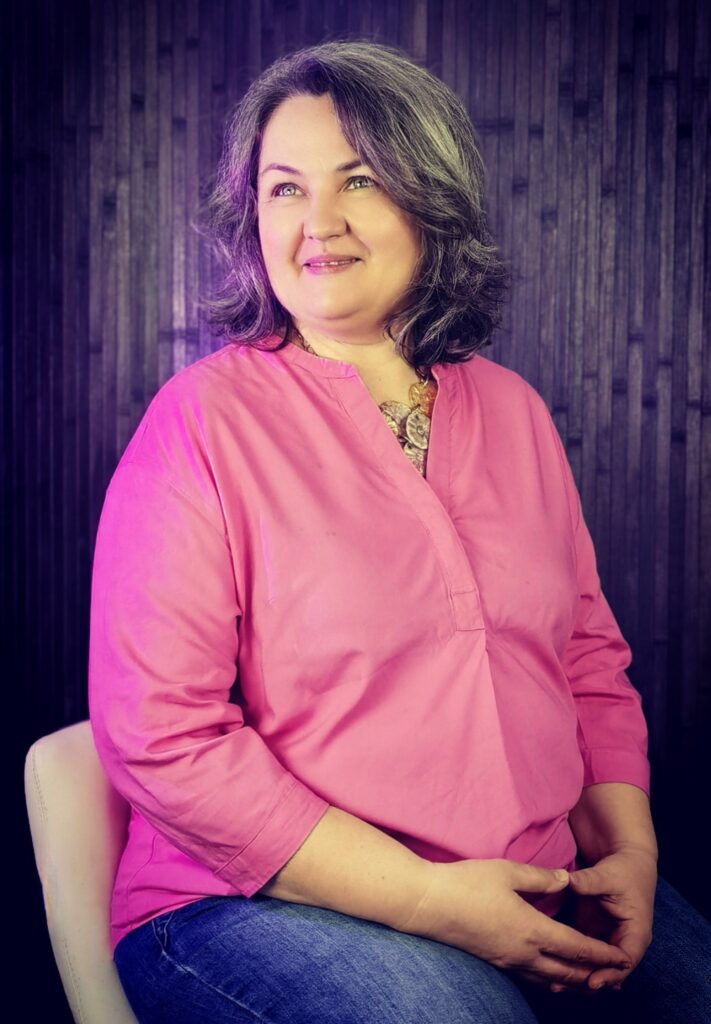
Otilia Deak is a bioenergetic therapist and creator of the Reconnection practice — a form of work with the individual field that is carried out not only through technique, but through presence. Her sessions are direct encounters with the subtle structures of the body, in which the alignment between the etheric, emotional, mental and physical fields is restored through co-presence, not intervention.
In her practice, she works with individuals seeking integrated healing—not a mental reframing of a problem, but a realignment within the entire matrix of being. Her approach is based on the principle that physical illness is the visible end of a misalignment that began in more subtle fields, and that true healing requires all bodies to go through the process of reconnection simultaneously.
bioenergetic therapist

TotUna is not just a magazine. It is a co-creation space.
Submit your article!
If you feel the call to write, share, or contribute your voice, we are here.




