Warm spring salad with dandelion – TotUna Recipe
dandelion recipe
Turn bitterness into light
The dandelion becomes the central guest—not just as food, but as a symbol of transforming bitterness into clarity and moving from stagnation to flow.
Because sometimes, before we can blossom, we just need to let go.
In this edition dedicated to rebirth and the balance between light and dark, we choose to look at food as a partner in transformation. Detoxification is not a rigid concept or a sudden intervention, but a natural process of reconfiguration — like spring that does not force flowering, but creates the conditions for it.
edition 15 tot.una-essentia momentum
the conscious recipe
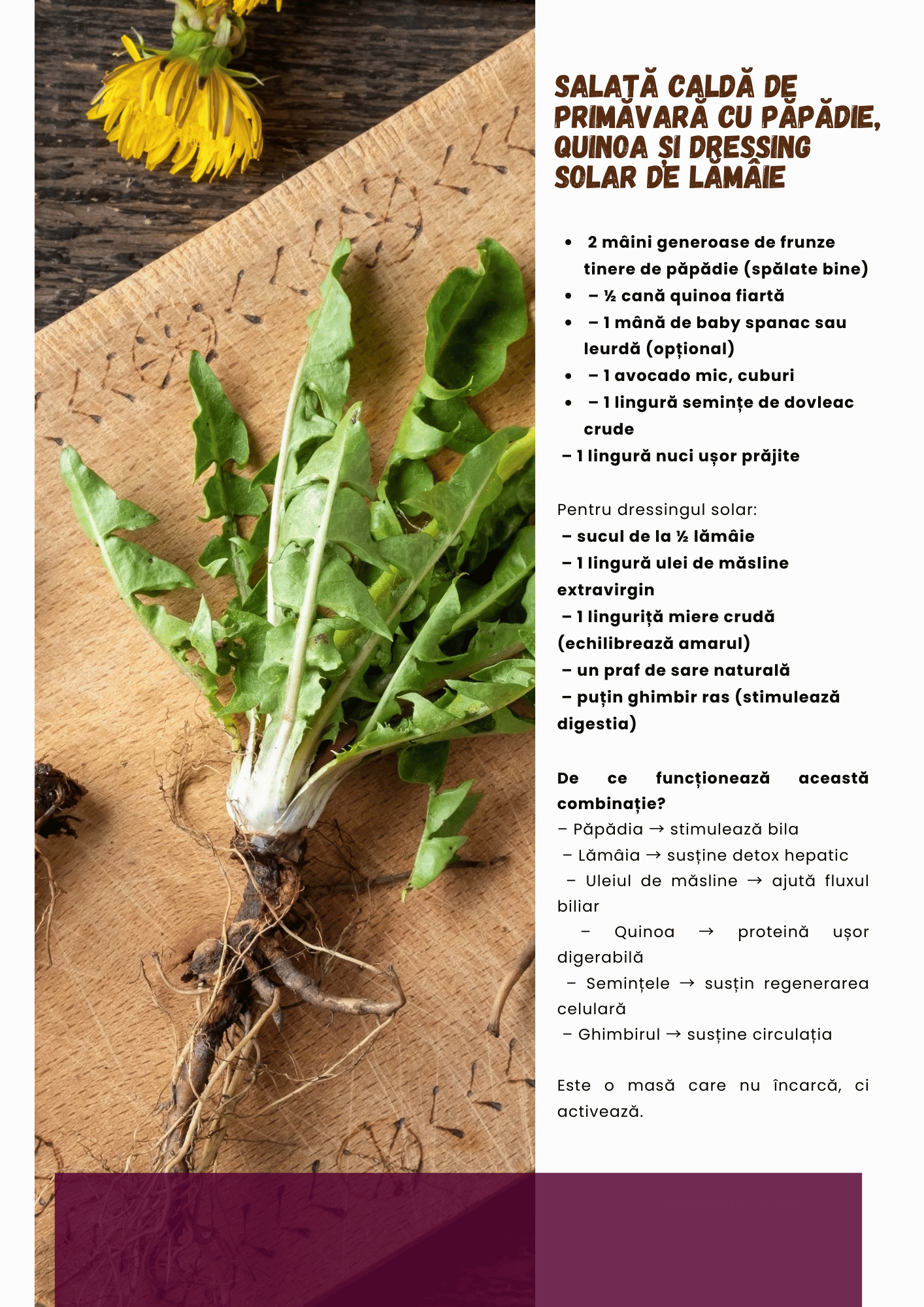
Warm spring salad with dandelion
Small formula of intention (optional)
Before the first bite:
Look at the green. Notice the texture of the leaves. Take a deep breath.
Say within: "I transform what is difficult. I choose clarity."
I nourish life within me.”
Training
Ingredients
2 generous handfuls of young dandelion leaves (washed well)
– ½ cup cooked quinoa
– 1 handful of baby spinach or chard (optional)
– 1 small avocado, diced
– 1 tablespoon raw pumpkin seeds
– 1 tablespoon lightly toasted walnuts
For the solar dressing:
– juice of ½ lemon
– 1 tablespoon extra virgin olive oil
– 1 teaspoon raw honey (balances the bitterness)
– a pinch of natural salt
– a little grated ginger (stimulates digestion)
Pritualized repair:
- Boil the quinoa and let it cool slightly.
- Mix dandelion leaves with spinach or kale.
- Add lukewarm quinoa over the leaves—the gentle heat slightly softens the bitterness.
- Add the avocado, nuts and seeds.
- Mix the dressing ingredients separately and pour it over the salad just before serving.
How can we integrate it into our diet?
– young leaf salad
– tea from leaves or roots
– tincture (under specialized guidance)
– dandelion root coffee
Spring is the ideal time for a gentle 2–3 week cleanse.
listen . read . feel .
Transhumance of the Soul
The 15th edition of the magazine Tot.Una – Essentia Momentum is a profound exploration of the threshold between death and life, between detachment and integration, between fear and liberation.
This edition does not approach death as an end, but as a process of reconfiguring the inner field. It does not treat mourning as a rupture, but as maturation. It does not propose joy as a superficial reaction, but as a sign of a profound adjustment of the being.