

She — Robert A. Johnson | The Myth of Cupid and Psyche | Reading & Inspiration TotUna 17
My Dear Conscious Reader/Listener,
The Reading & Recommendation section in this edition is not an invitation to accumulation, but to crossing.
There are books that do not open as an object, but as a threshold. Texts that do not add information, but place us in front of our own inner weight. Readings that do not explain death, but strip it of fear. Which do not glorify life, but bring it into a simpler and truer light.
If there are books that have accompanied you in moments of inner reconfiguration, that have helped you understand how you construct the reality you live in, or that have shown you the architect within you in a moment of unexpected clarity, we invite you to share them with us.
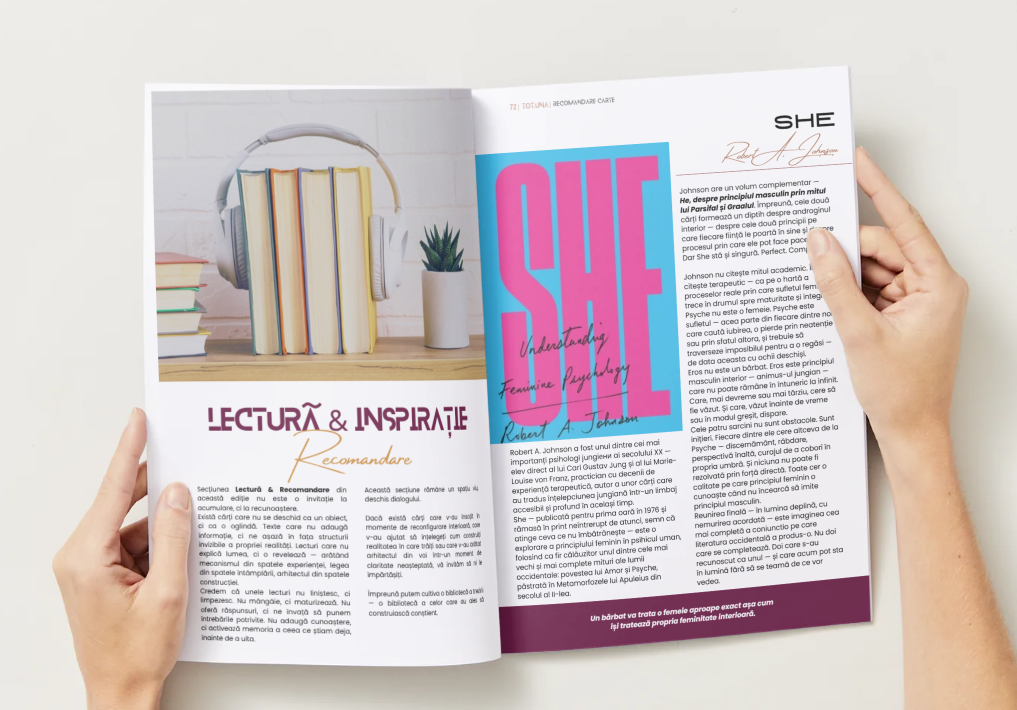
she – robert a. johnson
Robert A. Johnson was one of the most important Jungian psychologists of the 20th century — a direct student of Carl Gustav Jung and Marie-Louise von Franz, a practitioner with decades of therapeutic experience, and the author of books that translated Jungian wisdom into a language that was both accessible and profound. She — first published in 1976 and in print ever since, a sign that he was touching on something that never ages — is an exploration of the feminine principle in the human psyche, using as a guiding thread one of the oldest and most complete myths of the Western world: the story of Cupid and Psyche, preserved in Apuleius's Metamorphoses from the second century.
Hey, about the masculine principle
Johnson has a companion volume— He, on the masculine principle through the myth of Parsifal and the Grail . Together, the two books form a diptych about the inner androgyny—about the two principles that every being carries within themselves and the process by which they can make peace.
But She also stands alone. Perfect. Complete. Johnson doesn't read academic myth. She reads it therapeutically—as a map of the real processes the feminine soul goes through on its path to maturity and integration.
Psyche is not a woman. Psyche is the soul — that part of each of us that seeks love, loses it through carelessness or the advice of others, and must traverse the impossible to find it again — this time with open eyes.
Eros is not a man. Eros is the inner masculine principle—the Jungian animus—which cannot remain in darkness indefinitely. Which, sooner or later, demands to be seen. And which, seen prematurely or in the wrong way, disappears. The four tasks are not obstacles. They are initiations. Each of them demands something different from Psyche—discernment, patience, high perspective, the courage to descend into its own shadow. And none of them can be solved by direct force. All of them demand a quality that the feminine principle knows when it does not try to imitate the masculine principle.
The final reunion—in full light, with immortality granted—is the most complete image of coniunctio that Western literature has produced. Not two who complete each other. Two who have recognized each other as one—and who can now stand in the light without fear of what they will see.
Mitul
The story of Cupid and Psyche is, on the surface, a fairy tale about love and separation. At a deeper level—the level at which Johnson reads it—it is the story of the female soul in its process of maturation. And at an even deeper level, it is the story of any being—regardless of gender—trying to integrate inner polarities and reach wholeness.
Psyche—whose name means soul in Greek—is a woman of such rare beauty that people have stopped seeing her as human and begun to worship her as a goddess. Aphrodite, jealous, punishes her—and sends her son Eros to make her fall in love with the vilest of men.
The plan backfires. Eros falls in love with Psyche himself and takes her to live in an invisible palace, coming to her only at night, in the dark, asking her never to try to see him.
Psyche listens—until her sisters, out of envy, convince her that her invisible husband is a monster. One night, she lights a lamp and looks. And she sees—not a monster, but the god of love himself, asleep in all his glory.
A drop of hot oil falls on Eros' shoulder. He wakes up. And disappears.
She is a slow read. It's not a book to be devoured—it's a book to be savored, one chapter at a time, one layer at a time, one recognition at a time.
Johnson himself recommends reading the myth in its entirety first—without commentary, without analysis. Let it sink in like a story. Let it resonate where it resonates, hurt where it hurts, rejoice where it rejoices.
Then come back to Johnson's commentary—and you'll find that it doesn't explain the myth to you. It explains something about you. A question to carry with you as you read: Which of Psyche's four tasks most closely resembles what I'm going through in my life right now? Not as homework. As a mirror.
If there are books that have accompanied you in moments of transition, that have changed your perspective or brought you closer to an inner truth, we invite you to share them with us. Together, we can cultivate a reading space that nourishes not only the mind, but also the silence from which understanding is born.
Together, we can create a reading space that nourishes the mind and soul.
Reading & inspiration #17
A man will treat a woman almost exactly as she
Robert A. Johnson
she is treating her own inner femininity.
ARTICLE AUTHOR
MELL
Mell is the founder of the magazine TotUna – Essentia Momentum, an editorial space dedicated to the maturation of consciousness through direct experience and integrative reflection. Her writings do not start from theory, but from real journeys – from the encounter with life in its most fragile and revealing forms.
His interest in traditions such as Advaita Vedanta, anthroposophy, Kabbalah or Christian spirituality is not a comparative one, but an attempt to recognize the same thread of continuity that runs through different languages. For Mell, death, suffering and transformation are not abstract themes, but living processes of integration of consciousness into its own vastness.
Through the magazine TotUna and the spaces created around The Meditation Academy, she supports a lucid spirituality, devoid of drama and escapism, anchored in concrete life and open to its subtle dimension. Her approach does not seek followers, but inner maturity; it does not propose doctrines, but invites experience and assumption.
CO-FOUNDER OF THEMEDITATION.ACADEMY


TotUna is not just a magazine. It is a co-creation space.
Submit your article!
If you feel the call to write, share, or contribute your voice, we are here.




