

The Master's Face – Sofia #20
It is something that can be seen with the eyes, before it can be understood with the mind. Place side by side, on the same table, a Byzantine icon of Christ, a statue of Buddha seated in meditation, an Indian miniature of Krishna, a photograph of Babaji as described. Look at them all at once. And you will notice a disturbing thing: they are the same face.
Not the same features—the colors are different, the clothes are different, the hand gestures say slightly different things. But something underneath is identical. The same silence in the gaze, which demands nothing. The same slight tilt of the head, as of someone listening to something we do not hear. And, almost everywhere, the same light behind the head—the halo, the nimbus, the golden circle that humanity has placed, independently, around all these faces, from Byzantium to Tibet, from the Egypt of the pharaohs to Vedic India.
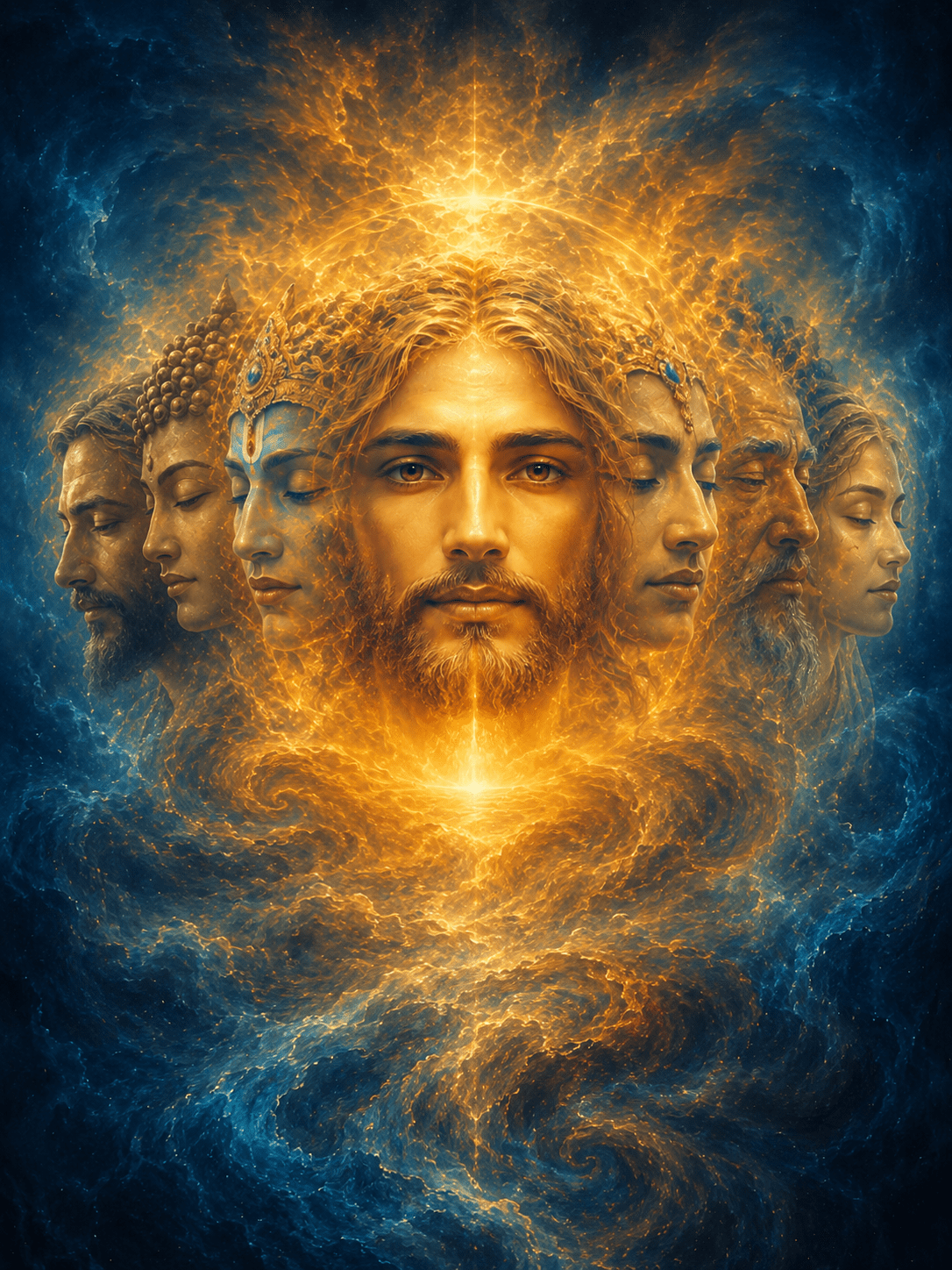
The face beyond faces
The question that Sofia asks us today starts precisely from here, from this almost anthropological fact: why has humanity, everywhere, separated by oceans and millennia, without speaking, seen the same face? Why does the Master look the same in all the languages of the earth?
In Christianity, this image is Christ—the Word made flesh, who says that the kingdom does not come in visible form, for the kingdom is within you. In Buddhism, it is Buddha—the awakened one, who does not demand to be followed, but shows the path that each one must walk alone. In the Indian tradition, it is Krishna, who whispers to Arjuna, in the middle of the battlefield, that the true self is neither born nor dies. It is Mahavatar Babaji, the ageless one, appearing and disappearing over the centuries. And, beyond all this, it is Brahman—not a figure, but the field itself, the absolute from which all images arise.
To an outside eye, these are different, even rival religions, each with its own claim to truth. But to Sophia's gaze, they are the same face turned towards us from different angles. The same energy. The same field of consciousness. The same path, shown in different languages to different peoples, in different ages—but never a different path. Just the same, translated.
And if there is a difference between them, it is not of essence, but of proximity. Brahman is the absolute too vast for man to relate to—it has no face, no voice, no suffering, and no laughter. That is why, says wisdom, that field was made to walk the earth: to take form, to incarnate, to know hunger and fatigue and tears, so that man might finally have something to look at. The embodied masters are not a level lower than the absolute. They are the same absolute close enough for us to grasp with our limited eyes. Not a step lower—an outstretched hand closer.
Brahman is the all-vast absolute
Here someone will ask, as the mind that wants to fixate always asks: but did they really exist? Did Christ walk the earth, did Buddha breathe the air of this world, or are they just beautiful stories, emanations of the collective soul that needed a face?
And it is here that Sofia smiles and lets the question fall. Because the need to know whether they were historical or legendary is itself a tool of the mind that divides—the mind that needs to prove, to anchor in fact, to set a time and a place. From the place of wisdom, the question dissolves. Whether they trod the mud of the roads with their feet, or whether they rose from the great collective of human consciousness, the face is the same and its work is the same. And whoever truly believes does not need them to be one or the other.
Moreover—perhaps the two are not even opposed. Perhaps they stepped on the earth precisely because the collective emanated from them; perhaps humanity's deep longing for the image was the very power that called them into the body. Emanation from the collective and stepping on the earth are not two rival stories, but the same movement viewed from two directions. What matters is not the proof. What matters is that, when you look at the image, something in you recognizes it—and this recognition is older than any history. But if all these images are the same, and if that image is, as all traditions whisper, inside us—then why have we placed it so high, so far away, so outside? Why do we feel that God is there, above, separate from us, and we here, below, small and alone?
Why did I place it in the sky?
Because that is how the ego translates a presence that it cannot otherwise encompass. The still uncultivated mind cannot conceive of unity—it has no way. Its very structure is separation: me and the rest, inside and outside, here and there. When a perennial presence, deeper than any thought, makes itself felt in man, the egoistic mind cannot accept it as itself. So it separates it. It puts it outside. It lifts it up to heaven and calls it God, and calls itself sinful, small, separated.
This feeling of being alone, of having a God-figure somewhere above, is not the truth of presence. It is the shadow that the inner presence casts on the walls of a still dark mind. The outer divinity is the face that the light within takes on when viewed by someone who still believes himself separate from it. God is not far away. Only we believe ourselves far away—and we project this distance into the sky.
The chosen ones and those who follow
From the same root of separation grows one of the most widespread and blocking beliefs of the spiritual world: that some people are chosen to be masters, and others are meant to be their disciples. That there is a caste of the awakened and a multitude of those who need them to awaken.
This belief feeds strong egos. There are people who sit in the master's chair and sincerely believe that they are necessary for the evolution of others—that without their presence, the disciple cannot advance. And, what is more subtle, the disciple actually feels this way. In the presence of such a master, he feels enlightened, uplifted, touched by grace. Everything seems clear and close. But there is a simple, silent proof that is worth knowing.
The test is what happens in the absence of the master. If, removed from him, the disciple relapses into the same pains, the same fears, the same losses—then nothing has truly dissolved. The light he felt was borrowed, not kindled. The sense of separation remained intact; it was only, for a time, covered by the warm presence of the other. The master within was not recognized—it was only externalized once more, as always, into another figure set in the sky.
Here is the distinguishing mark, without the need to point fingers at anyone: a true master makes you less and less dependent on him. His whole work is to become, over time, superfluous—to lead you to the threshold of your own light and then withdraw, glad that he has no business there. A false master, on the contrary, makes you more and more dependent. He needs his disciple as authority needs its subject. The direction of the dependence says it all: the true one frees you from it, the false one deepens it.
The archetype by which we are made
For the Master has always been within. All these faces, carved, painted, prayed to over thousands of years, are not foreign figures to be worshipped from a distance. They are mirrors. They are representations of the perennial presence within ourselves, placed outside so that we can finally look at it. Humanity has painted the same face everywhere because everywhere it has looked, without knowing it, into the same mirror.
And only when man empties himself of ego, when he makes enough space and enough silence within, can he come to recognize this figure as his own. Not to appropriate it out of pride — that would be just the ego putting on an even bigger coat. But to recognize it humbly, like water recognizing the ocean from which it has always been separated only in appearance. This recognition is not a conquest. It is a return home.
We are made through this archetype. Our inner evolution unfolds by looking through it, measuring ourselves by it, approaching it not as someone else, but as our own face that we do not yet dare to recognize. All the traditions of the world have called, each in its own language, the same thing: that what you seek in heaven looks at you, patiently, from behind your own eyes.
RitualContemplation of the face
Choose a single representation of the Master—whatever he calls you. An icon of Christ, a face of Buddha, an image of any figure in which you feel that peace that demands nothing. Place it in front of you, at eye level, in a place where you will not be interrupted.
Look at her. Don't analyze her, don't beg her yet, don't ask her for anything. Just look at the face, as you would look at a mirror. Let your eyes rest in his. And as you look, whisper within, gently, without forcing belief: "This is not someone else. This is the face I still dare not recognize as mine."
Stay like this for a few minutes. You will perhaps feel, at first, the resistance of the ego — which will say that it is too much, too bold, almost blasphemous. Let this resistance pass, too, without fighting it. You are not asking yourself to believe that you are God. You are only asking yourself to stop believing, for a few moments, that that presence is foreign to you. And if, somewhere in those minutes, the distance between you and the face thins even for a second — then you have reached exactly what every tradition that has ever sculpted this face wanted to say. That separation was, from the very beginning, just a story of the mind. And that the Master, the one and beyond all faces, has never left you, for the simple reason that He has never been anywhere else but here.
Sophia, the wisdom of the soul #20
… the breakup was, from the very beginning, just a story of the mind.
mell
ARTICLE AUTHOR
MELL
Mell is the founder of the magazine TotUna – Essentia Momentum, an editorial space dedicated to the maturation of consciousness through direct experience and integrative reflection. Her writings do not start from theory, but from real journeys – from the encounter with life in its most fragile and revealing forms.
His interest in traditions such as Advaita Vedanta, anthroposophy, Kabbalah or Christian spirituality is not a comparative one, but an attempt to recognize the same thread of continuity that runs through different languages. For Mell, death, suffering and transformation are not abstract themes, but living processes of integration of consciousness into its own vastness.
Through the magazine TotUna and the spaces created around The Meditation Academy, she supports a lucid spirituality, devoid of drama and escapism, anchored in concrete life and open to its subtle dimension. Her approach does not seek followers, but inner maturity; it does not propose doctrines, but invites experience and assumption.
CO-FOUNDER OF THEMEDITATION.ACADEMY


TotUna is not just a magazine. It is a co-creation space.
Submit your article!
If you feel the call to write, share, or contribute your voice, we are here.




