

Lucifer – Sofia #21
In each edition, Sofia descends to the root of a symbol and follows it through the traditions that carried it — myths, scriptures, initiatory paths, and the depths of the psyche — not to gather knowledge, but to reach the place where the wisdom of the soul recognizes itself.
Sofia traverses a symbol through the traditions of the world to reach its living core — and this time the very word "light bearer" follows, to the point where the first contact with what we rejected turns out to be the encounter with the light we feared.
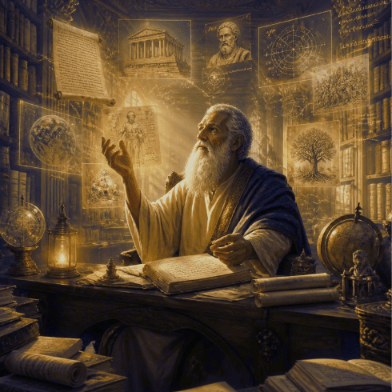
Lucifer – the light beareră
There is a word that today means the exact opposite of what it meant when it was born. A word that originally meant light—and which has come to mean the deepest darkness. That word is Lucifer.
In Latin, lux ferre means, simply and without mystery, “to carry the light.” The bearer of light. And before it was the name of a fear, it was the name of a star—the most beautiful in the sky. The Romans called the planet Venus Lucifer when it appears before sunrise: The morning star, the star that rises in the thickest darkness of the night, just when the night seems endless, to announce that the sun is coming.
This is the first image, and it is worth keeping in mind, because everything grows from it: the bearer of light was the star that brought the news of dawn. Not the light itself — its herald. The one who appears when it is still dark, to say that darkness is not the last word.
How did such a name come to mean the prince of darkness? The answer is not a matter of theology. It is a matter of the history of translation.
A metaphor that went astray
In the Book of Isaiah, in a passage written many centuries before the Christian era, the prophet utters a taunt against a haughty king—the king of Babylon. He calls him, in Hebrew, Helel ben Shachar: “the shining one, the son of the dawn.” It is a poetic image, a political irony: you, king who thought yourself above all, who wanted to rise above the stars, behold how low you have fallen. The text itself is clear that it is speaking of a man—a king with a body, who dies and is buried like any other.
Centuries later, when Saint Jerome translated the scriptures into Latin, he rendered Helel ben Shachar by the Latin word that meant exactly the same thing—the morning star: Lucifer. He did not invent a being. He translated a metaphor. But the word, once placed on the page, began to live on its own.
Later attached to a Gospel account of the fall of evil from heaven, the name detached itself from the Babylonian king and rose—or rather, fell—until it became the proper name of the greatest of the fallen angels. A nickname given to a mortal tyrant became, through translation and centuries of imagination, a cosmic figure of absolute evil.
So here's what happened, at the most concrete level possible: we took the word that meant "light bearer" and made it mean darkness. An entity didn't fall from the sky. A meaning fell, through us.
He who brings light, disturbs
Here too, initiatory traditions have something to say, something that is repeated with an insistence that cannot be accidental. Almost every culture has a figure who brings light to people—and who is punished for it.
Prometheus steals fire from the gods and gives it to mortals, and for this gift he is chained and tortured. The serpent in the garden offers the knowledge of good and evil, and through that knowledge man loses his innocence and is expelled from paradise — but he also emerges from the unconsciousness of the child and becomes a being who knows. In almost every myth of beginnings, the one who brings the light of knowledge disturbs an order, and for this he is condemned.
The Hermetic and Gnostic traditions clearly understood the pattern: the light of knowledge is not gentle. It burns. Whoever brings consciousness where there was sleep disturbs the peace of sleep. That is why the bearer of light is always, at the same time, the one who disturbs—for his light shows what the darkness mercifully hid.
We begin to see why humanity has needed to make the bearer of light a figure of evil. Not because light is evil. But because the light that shows what we did not want to see is difficult to distinguish, at first, from aggression. The one who wakes us up seems, at the moment of awakening, the enemy of our sleep.
The chosen ones and those who follow
From the same root of separation grows one of the most widespread and blocking beliefs of the spiritual world: that some people are chosen to be masters, and others are meant to be their disciples. That there is a caste of the awakened and a multitude of those who need them to awaken.
This belief feeds strong egos. There are people who sit in the master's chair and sincerely believe that they are necessary for the evolution of others—that without their presence, the disciple cannot advance. And, what is more subtle, the disciple actually feels this way. In the presence of such a master, he feels enlightened, uplifted, touched by grace. Everything seems clear and close. But there is a simple, silent proof that is worth knowing.
The test is what happens in the absence of the master. If, removed from him, the disciple relapses into the same pains, the same fears, the same losses—then nothing has truly dissolved. The light he felt was borrowed, not kindled. The sense of separation remained intact; it was only, for a time, covered by the warm presence of the other. The master within was not recognized—it was only externalized once more, as always, into another figure set in the sky.
Here is the distinguishing mark, without the need to point fingers at anyone: a true master makes you less and less dependent on him. His whole work is to become, over time, superfluous—to lead you to the threshold of your own light and then withdraw, glad that he has no business there. A false master, on the contrary, makes you more and more dependent. He needs his disciple as authority needs its subject. The direction of the dependence says it all: the true one frees you from it, the false one deepens it.
The name of everything I exiled
Depth psychology gives us the last key, and the one closest to us. Carl Jung called shadow everything that the being refuses to recognize in itself and pushes into the darkness: unacceptable desires, forbidden anger, the power we fear, the parts that do not fit into the image we want to have of ourselves.
The shadow doesn't disappear when we reject it. It just descends deeper, darkens, and from there, out of the darkness, it leads us without us knowing.
Everything we don't want to look at ends up governing us precisely because we don't look at it.
And now, look at the word with new eyes. "Lucifer" became, on the scale of all humanity, the collective name for everything we declared unacceptable and exiled into darkness. We gathered into one dark figure everything we could not integrate — and then we called it the enemy. But that darkness did not come from outside. It was our unrecognized light, the knowledge we were not ready for, the power we were afraid to bear.
This is the most unbearable encounter of all: the first contact with your own shadow. The moment you understand that what you called the darkness within you was not a demon to be banished, but an exiled part that had been waiting, for a lifetime, to be welcomed home. And that, beneath the fear of it, hid the very light you were running from.
We are not defending any being here. That is not Sofia's business. We are simply showing how humanity's projection worked: how we took a word that meant light, loaded it with everything we could not see, threw it into the deepest darkness, and then were surprised that the world was full of shadows. The shadows were ours. We had just given them a foreign name.
Ritual: welcoming the exiled
This ritual doesn't banish anything. It receives. It just requires a quiet evening, a candle, and a little sincerity.
Light the candle and turn off the other lights. Sit in front of it and let your gaze rest on the flame until your breathing settles on its own.
Then bring to mind something about yourself that you are ashamed of—a trait, a desire, a reaction that you have always hidden, something you have called “the bad part of me.” Don’t judge it. Just look at it, as you look at the flame.
And ask him, silently, one question: what light of mine have you been guarding, all this time, hiding?
Maybe anger guarded a boundary you didn't dare set. Maybe desire guarded a life you didn't allow yourself. Maybe pride guarded a value no one had recognized in you. Listen to the answer that comes—not the one your mind constructs, but the one that rises from the depths, as unexpectedly as a star in the darkness.
When you hear it, tell that part, in a low voice: I see you. I'm not sending you into the darkness anymore. Come home.
Then he blows out the candle—and notices that the darkness that remains is no longer as empty. Something exiled has returned. And with it, the light it carried.
The light bearer always appears when it is still dark. Not to frighten the night—but to announce that the sun is coming.

Sophia, the wisdom of the soul #21
He who brings the light of knowledge disturbs an order, and for that he is condemned.
mell
ARTICLE AUTHOR
MELL
Mell is the founder of the magazine TotUna – Essentia Momentum, an editorial space dedicated to the maturation of consciousness through direct experience and integrative reflection. Her writings do not start from theory, but from real journeys – from the encounter with life in its most fragile and revealing forms.
His interest in traditions such as Advaita Vedanta, anthroposophy, Kabbalah or Christian spirituality is not a comparative one, but an attempt to recognize the same thread of continuity that runs through different languages. For Mell, death, suffering and transformation are not abstract themes, but living processes of integration of consciousness into its own vastness.
Through the magazine TotUna and the spaces created around The Meditation Academy, she supports a lucid spirituality, devoid of drama and escapism, anchored in concrete life and open to its subtle dimension. Her approach does not seek followers, but inner maturity; it does not propose doctrines, but invites experience and assumption.
editor-in-chief totuna.live


TotUna is not just a magazine. It is a co-creation space.
Submit your article!
If you feel the call to write, share, or contribute your voice, we are here.




