

Man as Divine Blueprint — Sofia, the Wisdom of the Soul | TotUna
The wisdom of the soul is not sentimental. It is dense, coherent, and unifying. It does not separate spirit from matter, the sacred from the profane, transcendence from immanence. It sees them as different expressions of the same principle.
Sophia does not belong to a tradition and does not claim to be from a doctrine. Sophia is that level of consciousness that perceives the architecture behind the phenomenon and recognizes law where the mind sees only symbol.
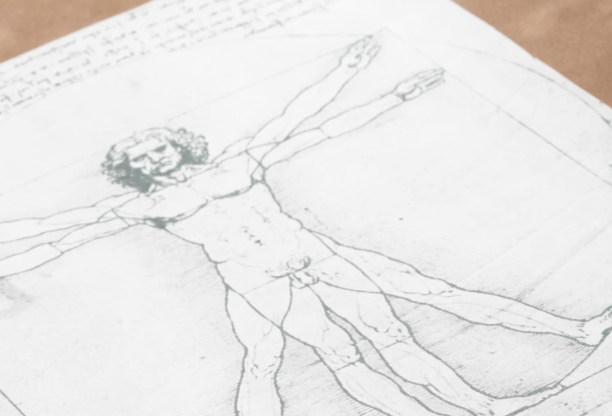
Man as a divine blueprint — the living architecture of creation
Around 1490, Leonardo da Vinci drew a man. Not a specific man. A principle.
The figure stands inscribed simultaneously in a circle and a square — arms and legs extended, center in the navel for the circle, in the genital area for the square. It is not an anatomical illustration. It is a cosmological diagram — a visualization of the law that man is the meeting point between two levels of reality: the circular, divine, without beginning and without end, and the square, terrestrial, structured in the four cardinal points, the four elements, the four directions of manifestation.
The Divine Embracing Matter
Leonardo did not invent this idea. He revealed it visually from a text by Vitruvius , the Roman architect who had written five centuries earlier that the proportions of the human body were the key to understanding the proportions of the universe. But Vitruvius did not invent it either. He passed it on from a much older tradition—one that knew that man was not a biological coincidence but a conscious blueprint. A blueprint that precedes form.
The microcosm reflecting the macrocosm
Hermeticism formulates this law with a precision that has never aged: “That which is above is like that which is below.” Not as a poetic metaphor. As a structural principle of reality. The Vitruvian Man is not an image of a beautiful body. It is the visible demonstration of this principle: that the structure of the human being repeats, on a different scale, the structure of the cosmos. That in the proportions of a finger lies the same law that governs the spiral of a galaxy. This idea does not belong exclusively to the Western tradition.
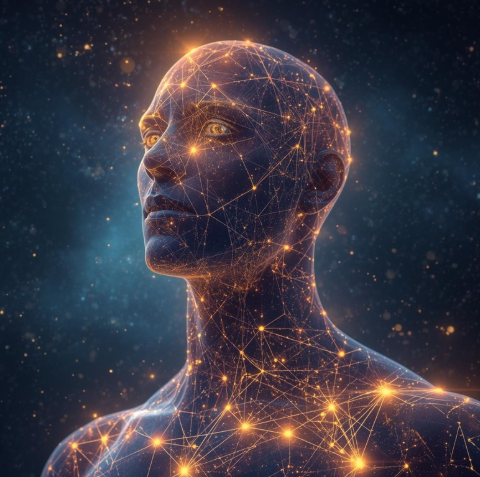
Atman
In the Upanishads, Atman—the individual Self—is described as essentially identical with Brahman—the universal consciousness. Not similar. Not analogous. Identical. The microcosm does not imitate the macrocosm. It is the macrocosm, looking at itself from a particular angle.
The Kabbalah describes the same truth through Adam Kadmon — the Primordial Man, whose body is not physical but cosmic: a field of light in which the sephirot of the tree of life correspond to the energy centers of the human being. The Crown — Kether — in the head. Wisdom and Understanding — Chokhmah and Binah — in the two cerebral hemispheres. Beauty — Tiphereth — in the heart. The Foundation — Yesod — in the sacral center. The Kingdom — Malkuth — in the feet, in contact with the earth.
Man does not live in the cosmos. Man is a map of the cosmos.
Vitruvius wasn't just an architect of buildings. He was an architect of order—someone who understood that all authentic construction starts from an invisible principle that gradually materializes into visible form.
Who is really building?
That the temple is not stone—stone is the ultimate expression of an intention that existed before any hammer or chisel. The same understanding underlies the initiatory traditions of medieval cathedral builders—master masons who knew that they were raising not just stone but a map of heaven on earth. The proportions of Gothic cathedrals are not aesthetic—they are cosmological. Every arch, every pilaster, every ratio of height to width reproduces a law of divine order. But the most profound temple that an initiatory tradition has ever described is not built of stone. It is man himself.
In Kabbalah, the construction of Solomon's Temple is understood esoterically as a process of inner edification—the raising of a sacred space within the being, in which the divine can consciously dwell. Each element of the Temple corresponds to a level of consciousness. The Holy of Holies is not a room—it is that center of being in which the subject and object of knowledge become one. Vitruvian Man, viewed from this angle, is no longer an anatomical figure. It is a reminder: you are the blueprint. You are also the architect. You are also the temple under construction.
Proportion as the language of the divine
There is a number that appears repeatedly in the proportions of the human body, in the spiral of the nautilus shell, in the distribution of flower petals, in the ratio of distances in the solar system. Mathematicians call it Phi — 1.618. The Golden Ratio. It is not a numerical coincidence. It is the signature of intention.
Where nature builds in complete freedom—unconstrained by urgency or accident—she chooses this proportion. From the structure of DNA to the architecture of the atom, from the shape of the human ear to the configuration of the Milky Way spiral galaxy, the same ratio appears with a consistency that surpasses statistical probability.
Pythagoras knew it. Luca Pacioli, Leonardo's mathematician friend, dedicated an entire treatise to it—De Divina Proportione—illustrated by da Vinci himself. Not because it was beautiful. But because it was proof that the universe was designed, not happened.
That there is a blueprint. That there is an architect.
The self-forgotten man
And yet, the man who bears in his proportions the imprint of the divine, the man who is himself a cosmic blueprint, often lives as if he knew nothing about it.
He builds according to inherited, not chosen, plans. He erects walls where there might be windows. He seals doors that he no longer dares to look at. And he forgets—or has never known—that at the center of his figure stands the same point that stands at the center of the circle: a place of perfect balance, where all proportions meet and justify each other.
Wisdom traditions have never proposed an escape from this figure. They have not asked man to become something else.
They only asked for recognition of what already is.
The Vitruvian Man does not represent an ideal to be achieved. It represents a reality to be recognized.
The Vitruvian Man Ritual
This ritual can be practiced in the morning, before the day begins to build in your place.
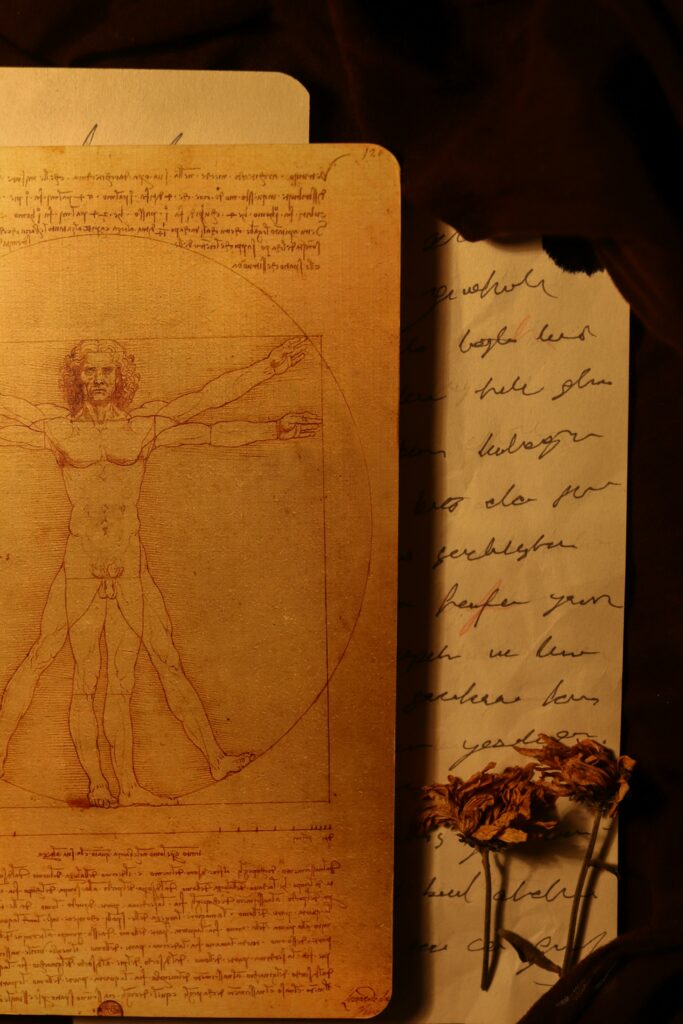
Sophia, the wisdom of the soul #16
The man who bears in his proportions the imprint of the divine, the man who is himself a cosmic sketch,
mell
often lives as if he knows nothing about it.
ARTICLE AUTHOR
MELL
Mell is the founder of the magazine TotUna – Essentia Momentum, an editorial space dedicated to the maturation of consciousness through direct experience and integrative reflection. Her writings do not start from theory, but from real journeys – from the encounter with life in its most fragile and revealing forms.
His interest in traditions such as Advaita Vedanta, anthroposophy, Kabbalah or Christian spirituality is not a comparative one, but an attempt to recognize the same thread of continuity that runs through different languages. For Mell, death, suffering and transformation are not abstract themes, but living processes of integration of consciousness into its own vastness.
Through the magazine TotUna and the spaces created around The Meditation Academy, she supports a lucid spirituality, devoid of drama and escapism, anchored in concrete life and open to its subtle dimension. Her approach does not seek followers, but inner maturity; it does not propose doctrines, but invites experience and assumption.
CO-FOUNDER OF THEMEDITATION.ACADEMY


TotUna is not just a magazine. It is a co-creation space.
Submit your article!
If you feel the call to write, share, or contribute your voice, we are here.




