

Back – Psychosomatic – Living Life
In this edition, we look gently at the place that holds the most — and the quietest: our backs. Where we carry entire families, promises we didn't make to ourselves, expectations, fears, longings, absences, and everything we've been careful not to disturb.
It is the invitation to look at the body not as a mechanism, but as a sincere temple, which sometimes asks us only this: to listen to it before we repair it.
Psychosomatics is not magic. It is not mysticism. It is the way the soul writes its story in matter. It is the architecture of emotions in bones, muscles, breathing. It is the way in which our limits, needs, wounds and truths seek their place in the body because, sometimes, only there can they be listened to.

the back
The mind explains, the soul feels, but the body… reacts. And it does so with that brutal, yet liberating honesty that only our physical side can have. In winter, this honesty becomes even stronger. The light fades, the pace slows, the sacred roots of the nation are activated, and the body begins to send subtle signals: a tension in the neck, a tightness in the chest, a pain in the back that seems to say: “Hey, I think you’re carrying something that’s not yours.”
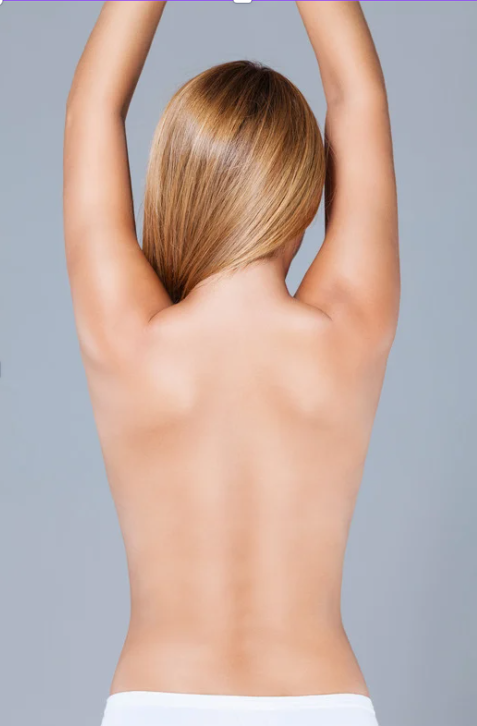
There is a part of the body that we never see directly, but we feel it every day.
A silent, loyal part, invisible to our eyes, but so sincere in the way it speaks to us.
The back.
There are gathered the things we had no one to tell, the hardships we didn't know where to put them, the responsibilities we accepted without asking ourselves if they were ours, and the stories we carry for those who came before us.
In the language of psychosomatics, the back is the "archive of unexpressed emotions" and the "column of identity."
In the language of the soul, it is the place where we see most clearly who we are when we no longer look out at the world, but inward.
Coloana Infinitului
Let's start with the engineering miracle: 33 vertebrae stacked in a perfect curvature, meant to support: the weight of the head (4-5 kg of thoughts, doubts, dreams, fears), the tension of the arms (everything you do, everything you give, everything you pull after you), the pressure of the visceral (the visceral emotions – literally – that press from within), the burden of movement (every step, every gesture, every flight or retreat).
Between each vertebra: intervertebral discs – cartilage cushions that absorb the shocks of life. When they are hydrated, healthy, resilient – you can jump, you can fall, you can get hit and get back up. When they are dry, compressed, degraded – any movement hurts.
Along the column: spinal cord – the highway of the nervous system, where information from the body to the brain and back travels at lightning speed. Any compression here equals interrupted communication between the mind and body. And around the spine: muscles – the hundreds of fibers that hold the structure upright. When they are relaxed but toned = perfect support. When they are chronically contracted = the back becomes hooked, hunched, a prisoner in its own rigidity.
But physical anatomy is just the beginning. Because the back is not just a bio-mechanical structure. It is an emotional map, a genealogical chronicle, a psychosomatic archive.
Psychosomatic map of the back
Each region of the back carries a specific type of burden:
CERVICAL (C1-C7) – Neck and upper body
Location: Base of skull to shoulders
What does it physically support?: Head, head movements, flexibility to look around
What supports emotionally:
- The responsibility to "hold your head high"
- Controlling emotions ("don't cry", "don't look weak")
- Mental flexibility (or lack thereof)
- The ability to say YES and NO with your whole body
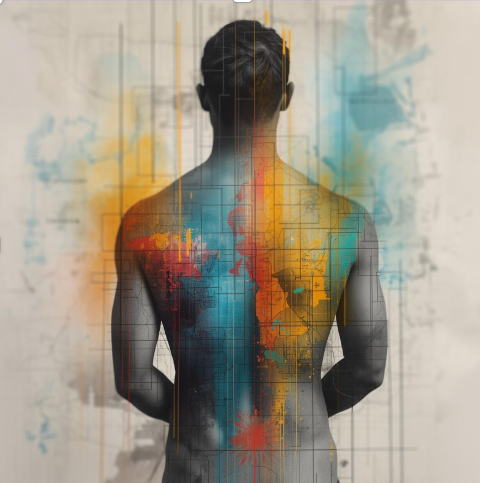
Neck pain occurs when:
You obsessively control your emotions ("I'm not allowed to cry" → stiff neck)
You say YES with your mouth, but NO with your soul (dissociation → tension)
You keep your head up in situations where you want to collapse (false pride)
Refuse to "see" in other directions (rmental rigidity → physical rigidity)
THORACIC (T1-T12) – Mid-back, area between the shoulder blades
Location: From shoulders to mid-back
What does it physically support: Rib cage, vital organs (heart, lungs), arms
What supports emotionally:
- Everything you "carry on your back" (burdens of others taken on)
- Everything you "carry on your shoulders" (responsibilities assumed or imposed)
- Everything you "hold in your chest" (unexpressed emotions, swallowed pains)
Shoulder blade area = "the wings you haven't spread" In mythology, angels have wings between the shoulder blades. Symbolically: the ability to rise, to break free, to fly.
When the area between the shoulder blades is:
- Painful, tense, like a knot = Wings clipped, unmanifested potential, freedom hindered
- Rounded, hump forming = The weight of life bends you, forces you to close in on yourself
Chest pain occurs when:
- You take on responsibilities that don't belong to you ("I have to solve my mother/father/brother's problem")
- You emotionally carry someone else ("If I'm okay, he/she will be okay")
- You swallow your crying, anger, screaming (chest compression → pain between the shoulder blades)
- You don't allow yourself to "fly" (dream, create, leave) → retracted wings → pain
LUMBAR (L1-L5) – Lower back
Location: From mid-back to pelvis
What does it physically support: The entire upper torso, abdominal organs, the connection between the upper and lower body
What supports emotionally:
- Power relations ("Am I dominated? Dominant? Am I equal?")
- Material security (“Will I survive?”)
- Support received or not received (“Is anyone supporting me?”)
- Flexibility in life ("Can I adapt or am I rigid?")
Lumbar = "the foundation on which the house stands"
If the foundation is solid but flexible → you can build high and withstand earthquakes If the foundation is rigid → you break at the first shock If the foundation is weak → you collapse slowly, steadily.
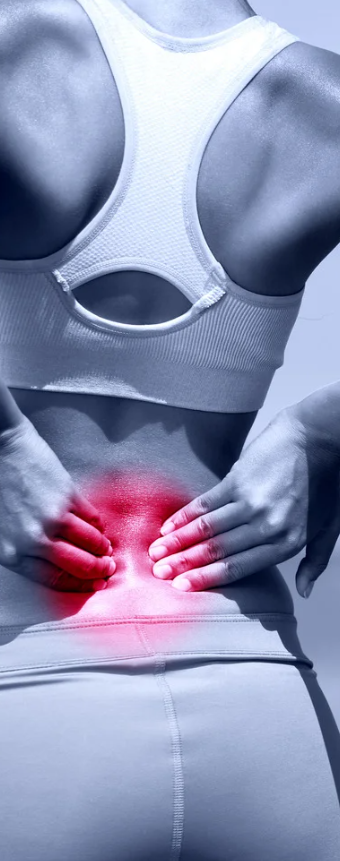
Low back pain occurs when:
- You feel like you have "no one to lean on" (lack of emotional/material support → lumbar compression)
- "You carry them all" (family, job, world) → the lumbar spine gives way: "I can't carry it anymore"
- You refuse to adapt, to be flexible out of pride or fear → stiff lumbar → hernia
- Deep fear of survival (financial, emotional) → lumbar "freezes" in protection
Relationship with hips:
The lumbar spine is directly connected to the hips. Hips = flexibility, forward movement, freedom to walk. When the hips are locked (see the upcoming issue on hips and the sacred feminine), the lumbar spine takes all the strain.
The psychosomatic truth is that the back is the area where the architecture of the soul suddenly becomes three-dimensional. What we don't process, we store. What we don't express, we tense. What we don't acknowledge, we contract. What we don't let go... it sits there, in a pile, like clothes on our favorite armchair in the bedroom. And then we wonder why our shoulders hurt.
Your back is an excellent therapist, but it works silently. It doesn't schedule a session for you, but it lets you know with a prick that you've crossed the line.
It's that honest friend who doesn't criticize you, but raises an eyebrow when you start to repress something again that you could clearly say out loud.
And, if we're honest, sometimes the pain comes just when we're finally ready to admit that we don't need another emotional box hidden in storage.
What's fascinating (and sometimes terrifying) is that the back carries not only our emotions, but also those of previous generations. It's where the silences of our parents, the shame of our grandparents, the fear of our great-grandparents cling. That's how the body is: loyal to the point of absurdity. It takes over, supports, holds. But at some point, the body gets fed up and starts to negotiate: "Okay, but who pays the bill for this storage?" And the bill comes in the form of pain.
The beautiful part is that the back doesn't seek punishment, but liberation.
When we start to honestly ask ourselves whose baggage this is, the back reacts faster than a well-paid therapist. Because it doesn't need explanations. It needs the truth.
THE BACK AS A MAP OF FREEDOM
The truth is that you are not the backbone of the family. The truth is that you do not have to support anyone at the cost of your health. The truth is that your identity is not built on blind loyalty, but on authenticity. The truth is that your back is not a library for other people's emotions.
When we start to honor our backs, something unexpected happens: the architecture of the soul begins to change. In a real way, not poetically.
The shoulders relax when we decide to be honest in relationships. The midsection frees up when we close chapters for real, not just mentally. The lower back straightens when we start to trust ourselves more than in fear scenarios.
The back wants nothing more than to be supported... by us. Let us be our own backbone, not the backbone of the whole world.
The back is not just anatomy – it is an emotional archive, a genealogical chronicle, a relational map. Back pain is not “normal” – it is a message : “Carry too much, put something down”. You cannot heal the back without healing relationships – they are interconnected. Children “inherit” posture and tension – through the morphic field, not genetically. Giving in is not failure – it is wisdom (“I can no longer carry myself = I can ask for help”), and a straight back = flexible, not rigid – like a tree, not like concrete. Because a free back supports a free life. And a free life creates a soul that no longer carries history, but writes the future.
And, honestly, isn't that what the architecture of the soul is all about?
What your back says about you (in 7 honest answers)
1. Shoulders "Please stop carrying big people like little backpacks."
If it's weighing you down, you're probably carrying relationships, obligations, or responsibilities that have forgotten to take care of themselves.
2. Neck "You're tired of looking over your shoulder for other people's approval." Tension here is a classic sign that you don't want to bother anyone... with you.
3. The area between the shoulder blades "It's time to leave the past in the past. He already has a one-way ticket." The pain here occurs when you try to carry closed chapters, just because they are still crying.
4. Mid Back “Not everything you’re told has to become your truth.” This area stores old shame, judgment, and labels. Your body doesn’t want them.
5. Lower back area "Breathe. Life supports you more than you think." When your lower back hurts, your soul is usually trying to tell you that you are not alone in this world, even if you act like you are its central pillar.
6. The Sacred “You have the right to feel. You have the right to want. You have the right to be.” Blockages here occur when you censor yourself too much, when you stop listening to your desires, or are afraid to be vulnerable.
7. The whole back, as a whole “Hey… maybe you’re not the backbone of the whole world. Try just being your own backbone.” When the whole back is screaming, it’s usually because you’ve forgotten the difference between compassion and self-sabotage.
psychosomatic – living life #12
The light doesn't come to fix anything. It comes to remind you of who you were before you got heavy.
mell
ARTICLE AUTHOR
MELL
Mell is the founder and visionary behind the project The Meditation Academy and of the magazine TotUna – Momentum Essence. Mell discovered the brush at the same moment he lost his certainties. Or rather – at the moment when the certainties dissolved and all that was left was a hand that wanted to move color on the canvas, without knowing why, without asking if “it’s okay”, without waiting for permission. Years of branding, marketing, building identities for others – and then, silence. Emptiness. And in that emptiness, something began to paint. Not Mell the person. Something through Mell.
Now, The Meditation Academy and the magazine All.One they are extensions of the same creative gesture: creating spaces where people can remember that they don't have to become artists, healers, spiritual seekers – they just have to stop pretending they aren't already.
"I am not here to offer you finite truths, but to remind you that each of you carries within you the entire library of cosmic wisdom. I am merely a companion on the journey of remembering what you have always known deep within your being."
CO-FOUNDER OF THEMEDITATION.ACADEMY


TotUna is not just a magazine. It is a co-creation space.
Submit your article!
If you feel the call to write, share, or contribute your voice, we are here.




