

Silence – Thich Nhat Hanh | Reading & Inspiration #19
My Dear Conscious Reader/Listener,
The Reading & Recommendation section in this edition is not an invitation to accumulation, but to crossing.
There are books that do not open as an object, but as a threshold. Texts that do not add information, but place us in front of our own inner weight. Readings that do not explain death, but strip it of fear. Which do not glorify life, but bring it into a simpler and truer light.
If there are books that have accompanied you in moments of inner reconfiguration, that have helped you understand how you construct the reality you live in, or that have shown you the architect within you in a moment of unexpected clarity, we invite you to share them with us.
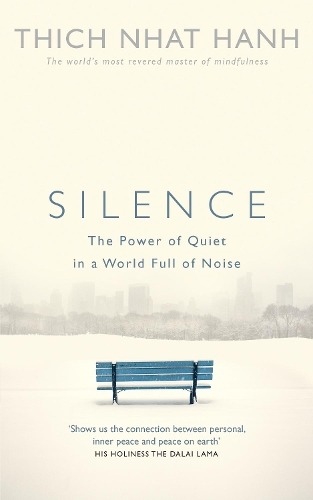
Silence – Thich Nhat Hanh
There are books that are read and books that are heard. Thich Nhat Hanh's Silence falls into the latter category—though it is written in words, it speaks of the space between them. It is a thin, smooth book, without philosophical weight, that you can read on a July afternoon and carry with you for years to come. It doesn't ask you to understand anything. It just asks you to stop.
I chose it for this edition precisely because it adds nothing. In a month in which we talk about the vacation that the Self imposes on man, about the water that clears when you stop stirring it, about the anchor lowered from the silence, a book about silence is the only one that does not contradict the theme by the very fact of being read. The other books fill. This one empties. And in the void it leaves, the silence of the Self can, at last, anchor in the heavens.
Thich Nhat Hanh
the Vietnamese Buddhist monk who has lived through war, exile, and a lifetime of teaching peace—he doesn’t write like a philosopher. He writes like someone who has been in silence long enough to describe it from the inside. His voice carries the same gentle smile that I have felt in other corners of this edition: the tenderness of one who sees the absurdity of our struggle without judging us for it.
Her thesis is simple and disturbing. Thich Nhat Hanh calls the most unbearable noise not the one outside—the traffic, the crowds, the notifications—but the one inside. That radio station that broadcasts nonstop in our heads, which he humorously calls Radio Non-Stop Thinking—the station of thinking that never stops. We have learned to live with it so much, he says, that we fear silence precisely because, when the noise outside stops, we suddenly hear the noise inside.
And that's why we run. We fill every void with something—a screen, a word, a snack, a thought. Not because we need those things, but because we can't stand the silence that would remain without them. The book gently names this reflex and, without scolding us, shows us another way: not to add more good noise to the bad, but to learn to turn off the radio. To make, inside, silence.
Ipractical reading invitation
In a summer when the body naturally demands to slow down, this book is a permission. It gives us permission not to do. It shows us that stopping is not laziness, nor running away, but the deepest way of being present. That sitting in silence does not mean wasting time, but receiving it back whole.
And there is something else that connects this book to the heart of the edition. Thich Nhat Hanh does not propose silence as a retreat from the world, but as a way of settling back into it. A man who has made peace within, he says, changes the field around him without saying a word. He becomes a place of rest for others. Exactly the anchor in the sky that the entire edition talks about: the one who has become deeply peaceful becomes, by his mere presence, a point of support for the struggling world.
The book won't make you go to the mountains.
It will teach you to find the mountain in the middle of the city. To carry silence with you, like a silent thread that rises, even in the din of midday. Don't read this book to find out something. Read it to stop.
Take it with you somewhere where you can be alone for an hour—a park bench, a corner of the garden, an early morning before the world wakes up. Read a short chapter, then put the book down. Don't move on to the next. Remain in the silence it opened. Let the line you read settle, as you let the mud in a glass of cloudy water settle by itself.
And try, at least once while you're reading it, the simplest and most difficult exercise in the entire book: sit for five minutes doing absolutely nothing. No phone, no music, no focused thought. Just sit, and listen. At first you'll hear the radio inside, loud, insistent. Don't fight it. Just listen to it, gently, until it gets tired. And behind it, when it quiets down, you'll hear what this book is trying, with all its words, just to show you:
the silence that was there the whole time, just waiting for you to stop covering it up.
If there are books that have accompanied you in moments of transition, that have changed your perspective or brought you closer to an inner truth, we invite you to share them with us. Together, we can cultivate a reading space that nourishes not only the mind, but also the silence from which understanding is born.
Together, we can create a reading space that nourishes the mind and soul.
Reading & inspiration #19
Silence is essential.
Thich Nhat Hanh
ARTICLE AUTHOR
MELL
Mell is the founder of the magazine TotUna – Essentia Momentum, an editorial space dedicated to the maturation of consciousness through direct experience and integrative reflection. Her writings do not start from theory, but from real journeys – from the encounter with life in its most fragile and revealing forms.
His interest in traditions such as Advaita Vedanta, anthroposophy, Kabbalah or Christian spirituality is not a comparative one, but an attempt to recognize the same thread of continuity that runs through different languages. For Mell, death, suffering and transformation are not abstract themes, but living processes of integration of consciousness into its own vastness.
Through the magazine TotUna and the spaces created around The Meditation Academy, she supports a lucid spirituality, devoid of drama and escapism, anchored in concrete life and open to its subtle dimension. Her approach does not seek followers, but inner maturity; it does not propose doctrines, but invites experience and assumption.
CO-FOUNDER OF THEMEDITATION.ACADEMY


TotUna is not just a magazine. It is a co-creation space.
Submit your article!
If you feel the call to write, share, or contribute your voice, we are here.




