

Healing Fear – The Sacred Feminine – Meditative Practice
There are moments in life when the mind can no longer bear it, the body can no longer hide it, and the soul can no longer postpone it.
There are moments when true power comes not from effort, but from turning, from slowing down, from the simple act of breathing deeply enough to hear your own life. 2026 is such a moment.

The Sacred Feminine – A practice for healing fear and awakening inner wisdom
A year in which fear can no longer be pushed to the sidelines, but must be encountered. A year in which the Sacred Feminine – the energy that holds, hears, embraces and heals – once again becomes the space necessary to move forward. The meditation we propose in this edition is not an exercise in technique, but an inner ritual. A slow path to the center. A gentle dialogue with fear.
guided trip
Sit in a quiet place. Let your body find a comfortable position. Don't rush.
Take a deep breath... and exhale slowly. Once again.
Feel the breath begin to descend into the body. With each inhalation, allow your shoulders to relax. With each exhale, let the weight of the day fall away from you.
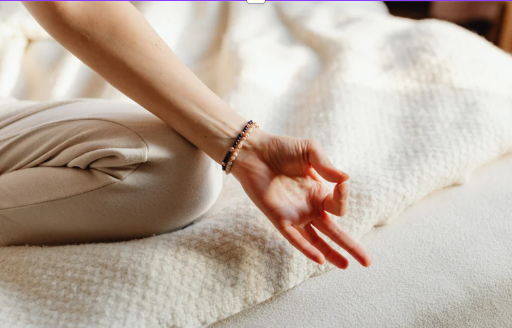
Place one hand on your lower abdomen.
There is the space of the inner Feminine. That's where peace lives.
Inspire… and feel your abdomen rise slightly under your palm.
Expire… and feel your body settle deeper.
It doesn't change anything. Just observe.
Let your breathing become slower, like walking into a room you haven't been in for a long time, but which you immediately recognize.
Now bring your attention to your chest area. Where sometimes fear makes a nest. Don't chase anything away. Just approach gently.
Say to yourself, slowly: "I see you." And then: "I'm here."
Feel your body begin to relax. Not because the fear is gone, but because she is no longer alone.
Inspire… and let a warm light descend from the top, a soft, pale golden light, like an old touch you forgot.

The Sacred Feminine
Let it fall towards the forehead... towards the neck… towards the chest... and lower down, in the abdomen.
This is the light of the Sacred Feminine. The Light of Sophia.
She doesn't take the pain. She tames it.
Let it expand… slowly… without rushing. Like breathing light. If you feel afraid, don't run away.
Inspire on the word "sense".
Expiry on the word "I receive".
Inspire"I accept".
Expire "I release".
Repeat at your own pace.
Feel the fear transform from a knot into a wave, from tension to movement, from blockage to presence.
Now imagine two energies meeting.
A calm, round, receptive one. Another vertical, stable, protective.
The Feminine and the Masculine within.
Let them meet... there, inside you, without words. Just breathing.
Inhale... and feel the Feminine.
Exhale... and feel the Masculine. Two halves of the same being.
Stay here for a few moments. Body present. Peaceful mind. Open heart.
When you're ready, take a deep breath... exhale slowly... and bring your attention back to the room.
Open your eyes slowly.
You are here.
You are whole.
You are ready for a new beginning.
scientific basis
The meditation proposed in this edition is based on a combination of neurophysiological, emotional and cognitive processes that, once activated together, produce one of the most coherent forms of inner self-regulation. The practice is not only a spiritual exercise, but also one deeply anchored in scientifically proven mechanisms.
The nervous system and sympathetic–parasympathetic balance
In each of us there are two systems that govern our internal state: the sympathetic – responsible for rapid survival reactions – and the parasympathetic – responsible for recovery, digestion, rest and healing. In a moment of fear or intense stress, the brain automatically activates the sympathetic system, flooding the body with adrenaline and cortisol, increasing the heart rate, tensing the muscles, narrowing the field of attention and reducing access to clear thinking.
The proposed meditation works as a direct mechanism for switching between the two states of the body.
Slow, deep, deep breathing into the abdomen sends immediate signals to the autonomic nervous system that “the danger has passed,” and the body can come out of alert mode. When the abdomen moves freely during breathing, the diaphragm is fully activated, massaging the internal organs and stimulating the vagus nerve. This leads to rapid regulation of the heart rate and decreased muscle tension.
As breathing stabilizes, the prefrontal cortex regains functionality, and the limbic system—the center of primitive emotions—begins to calm down. Thus, breathing practice is not just a relaxation technique, but a neurophysiological recalibration tool that allows the mind to return to clarity and the body to return to safety.
Polyvagal Theory – safety as a biological language
Dr. Stephen Porges demonstrated, through the Polyvagal Theory, that our nervous system has three main states:
- survival – sympathetic activation (fight or flight),
- blockage – dorsal vagal (freezing, dissociation),
- safety – ventral vagal (the ability to socialize, feel, reflect, love).
Guided meditation intentionally activates the ventral vagus nerve, the branch responsible for the authentic feeling of safety.
Why? Because the practical elements are exactly those that trigger the physiology of safety: the gentle tone of guidance → the brain associates the calm voice with the absence of danger, the slow pace → the nervous system involuntarily slows down, touching the abdomen → a self-care signal, equivalent to comforting touch, deep breathing → activates the vagal reflex, lowering the pulse. When the vagus nerve is active, the brain no longer interprets fear as an “external threat”, but as a “processable emotion”. This is the biological mechanism by which fear becomes tameable.
Body memory – emotions do not live in the mind, but in tissues
The body is our largest repository of emotions. When an emotion is not processed, it does not disappear – it remains stored in muscle tissue, in the fascia that envelops the entire body, in breathing patterns and in general posture.
Therefore, fear cannot be cured by thought alone.
Meditation lowers attention to the abdomen – the instinctual center –, exactly where the body holds old anxieties, silent traumas, environmental tensions, transgenerational fears, and blockages associated with the inner Feminine.
When you feel the abdominal area with your palm, two things happen: the body is told that it is seen, and what is recognized can relax; it activates the primary safety memory (the mother's warm touch during the neonatal period), which induces a deep state of calm.
Body memory reorganizes itself not through mental analysis, but through presence, attention, breathing, and gentle touch.
Visualization and the prefrontal cortex – how inner light reconfigures the brain
When you imagine light descending into your body, your medial prefrontal cortex—the center of self-understanding, self-compassion, and self-regulation—activates. This area has the ability to “tame” the amygdala, the region responsible for fear and panic.
Studies show that “warm light” visualization:
- reduces the activity of stress centers,
- improves neural connections in areas involved in emotional stability,
- increases the production of neurotransmitters associated with well-being.
The light in meditation is not a poetic symbol, but a neurocognitive tool for reorganizing perception. The brain does not differentiate between a real image and a strongly visualized one; it reacts physiologically to both. Thus, the light becomes a channel of access to a state of safety that the body begins to recognize as normality.
Oxytocin and therapeutic touch
– the chemistry of safety happens when the palm is placed on the abdomen, the body enters a state of physiological self-regulation by increasing oxytocin – the hormone associated with trust, connection and taming. Oxytocin lowers cortisol, reduces blood pressure, relaxes deep muscles, increases the capacity for empathy towards one's own emotions, stimulates the immune system.
So, meditation uses abdominal tapping as a neurochemical "shortcut" to calming the limbic system.
meditation practice #13
Allow yourself not to know. The masculine seeks immediate answers. The feminine knows that some things only reveal themselves over time.
mell
ARTICLE AUTHOR
MELL
Mell is the founder and visionary behind the project The Meditation Academy and of the magazine TotUna – Momentum Essence. Mell discovered the brush at the same moment he lost his certainties. Or rather – at the moment when the certainties dissolved and all that was left was a hand that wanted to move color on the canvas, without knowing why, without asking if “it’s okay”, without waiting for permission. Years of branding, marketing, building identities for others – and then, silence. Emptiness. And in that emptiness, something began to paint. Not Mell the person. Something through Mell.
Now, The Meditation Academy and the magazine All.One they are extensions of the same creative gesture: creating spaces where people can remember that they don't have to become artists, healers, spiritual seekers – they just have to stop pretending they aren't already.
"I am not here to offer you finite truths, but to remind you that each of you carries within you the entire library of cosmic wisdom. I am merely a companion on the journey of remembering what you have always known deep within your being."
CO-FOUNDER OF THEMEDITATION.ACADEMY


TotUna is not just a magazine. It is a co-creation space.
Submit your article!
If you feel the call to write, share, or contribute your voice, we are here.




